

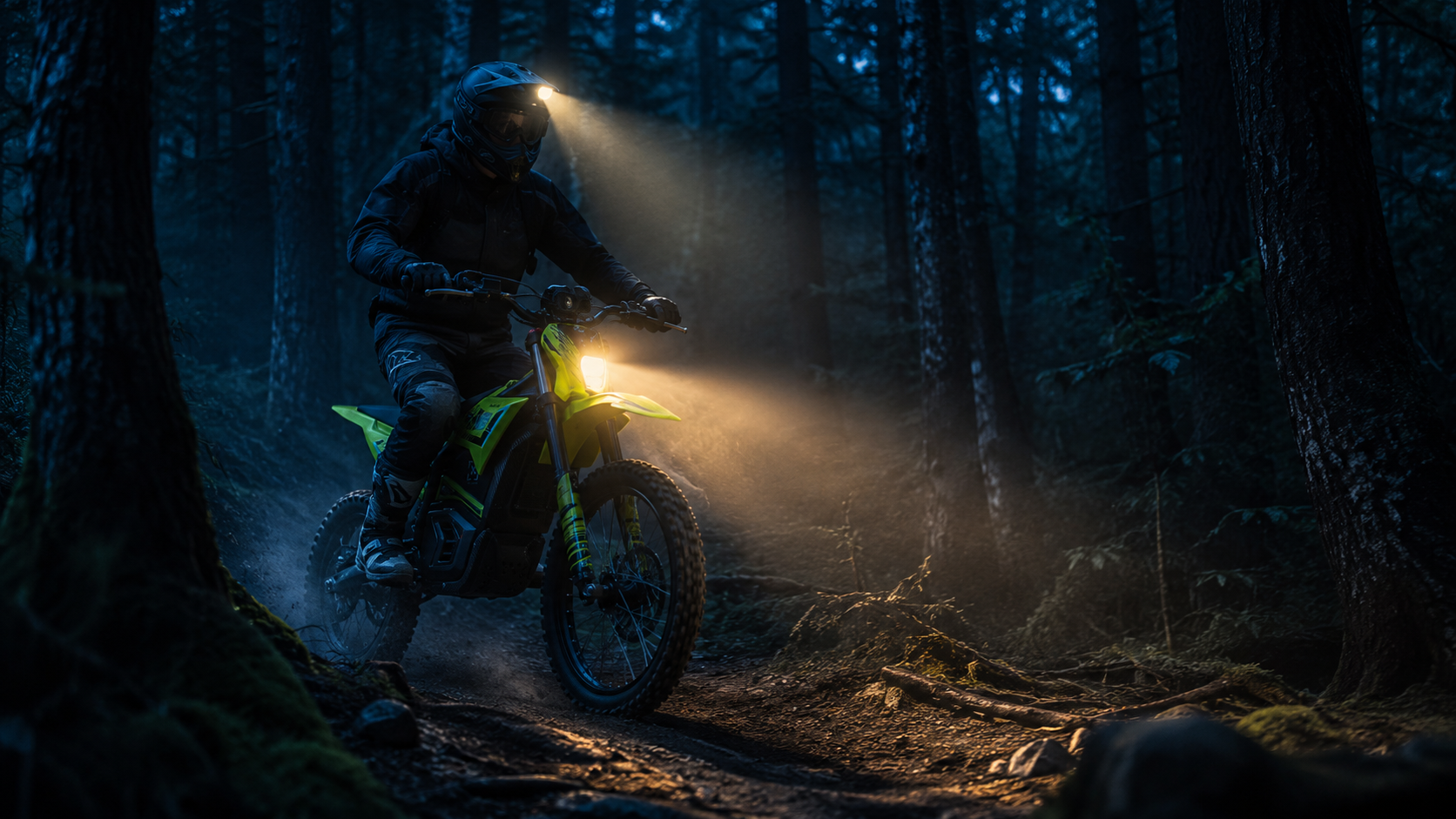
Night Riding on an Electric Dirt Bike: Lights, Safety & Setup Guide
Yes. You can ride an electric dirt bike at night, and done right it is one of the best ways to use one. The catch is what the dark takes from you. Roots, ruts, corners, all of it hides in the gaps your headlight never reaches.
An adult electric off-road motorcycle behaves differently at night than at noon. The motor is quiet. You hear the trail, but other people stop hearing you. And the torque arrives instant, which saves you on a climb and bites you when a sharp throttle twist breaks the rear loose before your eyes have read the ground.
CPSC notes that micromobility devices are often small, quick, and quiet, which makes them hard for drivers and people nearby to spot. That one fact shapes everything below: the lights, the gear, the battery math, the way you ride a dark trail. Here is how to set it up.
Why Night Riding on an Electric Dirt Bike Feels Different
// IMAGE: Why Night Riding Feels Different | Type A | 16:9 (hero)
Three things shift the moment the sun drops. Sound carries. Power feels sharper. And the trail flattens into one plane, where a raised root and a painted shadow read exactly the same.
Quiet Power, Sharper Senses
A gas bike drowns the trail in engine noise. An electric one lets the rest through. A sliding rock, a snapping branch, a rider coming around the bend, you hear them first. At night, when your eyes have less to work with, that head start matters.
The quiet fools your sense of speed too. No engine revs climbing in your ears. So you may not feel how fast you are going until the trail tightens. Watch the display, not your gut.
Instant Torque in the Dark
Electric power arrives now, not after a rev. Good for clearing a rise or pushing through soft dirt. In the dark it wants a softer wrist, because the same quick hit spins the rear before you ever spot the rut under it.
Smooth throttle. Roll it on. Give the tire time to grip and your eyes time to finish the line.
Why Roots and Corners Get Riskier
Darkness erases depth. A root that looks flat might be raised, wet, or angled across your path. Corners are worse. A bar-mounted beam points dead ahead while the trail bends off somewhere to the side.
One rule handles most of it. Ride at a speed that lets you stop inside the patch your lights actually show. Beam reaches 40 feet? Then 40 feet is your speed, not the trail you remember from daylight.
Best Light Setup for Night Riding
A single headlight is not enough. Trails change fast, corners hide hazards, dust eats a narrow beam. So you run layers of light, each with one job.
NHTSA recommends a white front light, a red rear light, reflectors, and reflective gear for the dark or poor visibility. On a fast, quiet off-road bike, treat that as the floor. Not the ceiling.
The Five Lights, and What Each One Does
most riders use 400–800 lumen front lights
|
Light |
Beam |
Its job |
|
Main headlight |
Focused, long throw |
Shows the trail far enough ahead to plan your line. |
|
Helmet light |
Medium, follows your eyes |
Lights the corner apex before the bike points at it. |
|
Handlebar light |
Wide, close |
Fills the dark patch near the front tire. |
|
Rear light |
Red, rearward |
Tells riders and drivers behind where you are. |
|
Backup light |
Small, USB |
Saves the ride when a main light fails. |
Main Headlight for Distance
Your primary beam should reach past the next obstacle, not pool around the front wheel. A focused throw lets you read dips, rises, gates, trail edges before they land on you. Check the mount every ride. A loose light drops or shakes the second the trail turns rough.
Helmet Light for Where You Look
This is the upgrade that changes dark riding most. A helmet light points where your head turns. So it sees through a corner before the bike points at it, and it tracks your eyes down to a rut or a creek crossing during slow technical work. Mount it clear of vents, the safety liner, and visor travel. The helmet still has to fit and protect first.
Handlebar Light for the Near Ground
A wide bar light covers what the long-throw headlight skips. The few feet right in front of the tire. Think of it as a ground reader. Headlight for where you are going, bar light for what the wheel is about to hit.
Rear and Side Visibility
A red rear light marks your position on shared lanes, dirt access roads, group rides. Side visibility is the part most riders forget. Reflective tape on the frame, wheels, helmet, or jacket catches angles a rear light never reaches. Black gear vanishes the instant you leave the beam.
Lights and the Bike Underneath Them
Lights only help if the bike can carry them and run them all night. Take a 60V machine with a 27Ah pack, like the EM-5 Pro. It has the reserve to hold a headlight, a rear light, and a USB feed across a 59-mile range without starving the motor.

Wheel size reads rough ground better in low light too. The EM23 runs a 19-inch front. It rolls over square edges a small wheel trips on, which helps when your eyes are short on detail. Match the bike to the dark first. Then add the lights.
How to Aim Your Lights Without Blinding Anyone
Bright lights help you see and ruin it for everyone else if you aim them wrong. Strong beams bounce off dust, fog, and pale dirt right back into your own eyes. The goal: light the trail without turning the bike into a moving spotlight.
Low Beam vs High Beam
High beam earns its place on open ground. Wide dirt roads, desert flats, long straights with nobody coming. Drop to low near riders, hikers, houses, campsites, road crossings, tight woods. Switch before you reach people, not after you pass them.
Angle the Beam Down
Aim the main beam slightly down so the brightest part lands on dirt, not on a face. A good starting point keeps the top edge below head height while still lighting the path. Set it at dusk. Then have a riding partner stand ahead and check. If they squint, drop it further.
Glare From Dust, Fog, and Leaves
Dust turns a bright headlight into a white wall. Fog and wet leaves do the same. When glare builds, lower the beam and ease off the speed. A softer, wider light often shows the ground better than a narrow beam on full power. Leave more room behind other riders in dust. Their rear wheel throws it straight into your line.
Night Riding Safety Gear
Gear after dark does two jobs. It makes you visible, and it protects you when the trail changes faster than you can react. A helmet, boots, gloves, armor, all of it matters more at night, not less. Your reaction time is shorter.
NHTSA recommends bright clothing, reflective gear, and lights for night or low-visibility riding. The list below is the off-road version.

Reflective Vest or Jacket
A reflective layer shows your body shape, not just a bike light. That is what helps when you stop, turn, or stand beside the trail. Spread the reflective material across chest, back, arms, shoulders, because movement catches an eye better than a single patch. A high-vis color earns its keep at dusk. The reflective strips take over once headlights hit them.
Clear-Lens Eye Protection
Tinted lenses make a dark trail harder to read. Run clear ones and give your eyes every bit of light there is. Clear goggles still block dust, bugs, branches, gravel, and at off-road speed a single bit of grit wrecks your focus. Keep a microfiber cloth in your pack. A dusty lens scatters light and makes glare worse.
Gloves, Boots, and Body Armor
Gloves hold a steady grip when the air turns cold or damp, and they save your hands in a slide. Boots protect ankles and feet from rocks, pegs, the bike itself. Trail shoes are not enough for most dirt riding. Body armor across shoulders, chest, elbows, knees, back, that is the layer that earns its place at night, when there is less time to react.
Weather Layers for the Temperature Drop
Night air feels colder than the same trail did at noon. Bring a layer even if the ride starts warm. A thin wind shell, a neck gaiter, a thermal base, any of them keeps cold hands and stiff arms from dulling your throttle and brake control. Pack layers that fit under or over armor without snagging on bars or branches. Heading out in genuinely cold conditions? Our cold-weather riding guide covers tire and battery behavior in more depth.
Battery Planning Before You Ride
Battery planning is safety planning at night. You need power for the motor, power for the lights, and enough reserve to get home if the route runs long. Range drops in the cold, on soft dirt, on climbs, under hard throttle. So the number on the display is a guide, not a promise.
CPSC advises riders to follow the maker’s charging instructions, unplug when charging is done, and use only the charger supplied or recommended for the bike. Those habits matter more the night before a ride, not less.
Start Full, Plan the Return
Begin on a full pack. Darkness is the wrong time to find out how much range is left. Plan the loop around your real turnaround point. And never treat the last bar as your ride home.
Keep Lights on Separate Power When You Can
Bike-powered lights are convenient. Independent light batteries are a backup. If the main pack runs low, separate lights still let you see, and motor power stays with the motor while light power stays with visibility. Charge every light before you leave. Label the packs if you carry spares.
Carry a USB Backup
USB lights charge easy and swap easy, and most clip to a helmet, bars, pack, or jacket. On a long route, a small power bank tops up a phone or a backup light during a break. Turn the spare on before you leave so you know it works. A dead backup is just weight.
Route Planning for Dark Trails
A good night route is familiar, legal, easy to exit. The most exciting trail is rarely the right one after sunset.
PeopleForBikes notes that the three-class e-bike system was built for low-speed electric bicycles, and more powerful machines often fall outside it. Which is exactly why you check local rules before taking a powerful off-road bike onto any road, path, or piece of public land.
Ride Familiar Ground First
Start on trails you know. Familiar ground helps you judge corners, climbs, exits, even though shadows and dust make every turn look new in the dark. Run the first loop slower than usual. Let your eyes and lights settle before you add speed.
Save New Technical Sections for Daylight
Night is the wrong time to learn a rocky climb, a steep drop, a tight switchback. If a section looks worse than expected, stop and walk it. Thirty seconds of checking beats a hard crash. When the trail feels wrong, turn around. After dark, judgment beats bravery.
Check Access, Then Share Your Plan
Many areas treat low-speed e-bikes, electric motorcycles, and off-road dirt bikes differently, and private land still needs permission. Quiet running does not make access legal. Before you leave, tell someone your route, your parking spot, your return time, and share a live location if signal allows. Check in when you finish.
Riding Technique for Low Visibility

Night riding rewards more space, smoother inputs, slower decisions. On a fast, quiet off-road bike, doubly so.
CPSC advises riders to slow down, stay aware, use visibility gear, and avoid abrupt moves, since quiet devices are hard for others to spot. Every habit below comes back to that.
Ride Slower Than Your Beam
Your light sets the speed limit. If you cannot stop inside the lit area, you are going too fast. Fast riding outruns your eyes until the front wheel reaches a rock before you do. Slow before the trail narrows, because late braking is far less forgiving in the dark.
Brake Earlier Into Corners
Brake before the corner, not halfway through it. The tire needs its grip for turning, and hard braking steals it. At night the exit is often hidden, so enter slower and leave room to adjust if the trail tightens or drops again. Both brakes. Smooth, even pressure.
Smooth Throttle, Light on the Pegs
Small throttle changes through rocks, roots, turns, all of it keeps the rear from spinning, and on slick ground you wait until the bike is pointed straight before rolling on. Standing light on the pegs lets your legs absorb hits and the bike move under you. Knees loose. Elbows up. Weight centered. A new rider building this habit is better off on a forgiving, lower-seat bike like the EM-5, which delivers power gently enough to learn on before anyone tries a dark trail.
Leave More Space in a Group
Give the rider ahead more room than you would by day. Dust, shadows, a rear light in your eyes, all of it makes depth hard to judge. More space also buys time if someone stops, falls, or misses a turn, and on a narrow trail one mistake blocks the line. Set the pace for the slowest rider. A group ride is not a race.
Pre-Ride Setup Checklist
A night ride should be ready before sunset, while you can still see the bike, the trailhead, your gear. Run this every time:
- Test every light and every mode.
- Charge the bike pack and all light batteries.
- Check brakes, tires, chain, and controls.
- Pack tools, water, phone, first aid, and a power bank.
- Share your route and return time.
Test Lights and Mounts in Daylight
Turn on every light and cycle high, low, flash, backup. Shake the bars and helmet gently to catch a mount that slips. Look at the beam pattern on the ground so you fix the aim now, not on the trail.
Brakes, Tires, and Chain
Brakes matter more at night because you see hazards later. Confirm the levers feel firm and the pads have life. Set tire pressure for the terrain, since too soft pinches and rolls while too hard bounces and loses grip. Check the chain before you load up. A dry or loose one robs power and adds noise.
Secure Mounts, Cables, and Gear
Strap or clamp every light mount, and keep cables clear of the front tire, fork, chain, and brake rotor so nothing snags when the bars turn. Helmet-light wires should not pull or flap. Replacement brakes, throttles, controllers, other parts for the lineup live in our accessories collection if a pre-ride check turns something up.
Common Night Riding Mistakes to Avoid
Most night-riding trouble traces back to two things. Poor setup, or riding faster than the view ahead. Name the mistakes and they are easy to dodge.
|
Pros |
Cons |
|
|
CPSC also warns against unsafe charging habits. Follow the charging directions, and never charge a pack while you sleep or while you are out of the house. Several lithium-ion fires have started overnight.
How We Put This Guide Together
Our team rides and tests these bikes after dark. This guide leans on that, plus published safety guidance, not guesswork.
Real Riding, Not Spec Sheets
Across the rides our team has logged, the patterns that hold up at night are the dull ones. Layered light beats one bright beam. Reserve battery beats range optimism. We wrote those plainly because they are what keep a dark ride uneventful.
Cited to Safety Authorities
Visibility, charging, and legal-access claims trace to CPSC, NHTSA, and PeopleForBikes, listed in full at the end. Where a rule depends on your state, we point you to check locally rather than guess for you.
Specs Verified Live
Every bike figure here was checked against the live Valtinsu collection page on the day of writing. Not pulled from memory. So the numbers match what you would see on the product pages today.
Bringing It Together
A dark trail is calm, quick, and worth the extra effort, as long as the setup is done before the light goes. Layer your lights. Wear gear that shows up. Start full and turn back early. Ride to the patch of trail your beam can actually reach.
The bike under all of it matters too. Enough battery to run lights all evening, wheels that read rough ground, power smooth enough to trust in the dark. Still weighing which model fits how and where you ride at night? Compare the full electric dirt bike range and match the bike to your trail before you match it to the dark.
FAQs
Is it safe to ride an ebike at night?
Yes, with the right setup and a slower pace. The risk after dark is simple: drivers, hikers, animals, and other riders may not see you in time. An off-road bike is faster and quieter than a regular bicycle, so the margin is thinner. NHTSA recommends reflective gear, a white front light, a red rear light, and reflectors for low-visibility riding. Build from there:
- Two front light sources, not one.
- Reflective gear plus a red rear light.
- Speed that stays inside your beam.
What electric dirt bike can go 50 miles an hour?
Several can, depending on model, rider weight, and battery charge. The Sur-Ron Light Bee X sits in that range, with listings around the high-40s to roughly 50 mph. Valtinsu’s EM-5 Pro reaches 52 mph from its 5,600W motor. A 50 mph machine is not a low-speed e-bike, and that changes road use, trail access, and local rules:
- Confirm your exact model’s top speed.
- Check local laws before any public road use.
Can a Sur-Ron go 70 mph?
Not in stock factory form, as a rule. Some modified builds claim speeds near or above 70 mph. But changes to battery, controller, gearing, and firmware all affect safety, legality, and reliability. Factory numbers vary by model and region, and a modified high-speed build may no longer fit the same legal category. For night riding, speed is not the point anyway:
- Stock figures differ by model and market.
- Ride to what your lights and brakes can handle.
What are the disadvantages of electric motorcycles?
A few real ones, alongside the upsides. The common trade-offs: limited range, charge time, battery cost, weight, trail-access rules, and fewer quick refuel options than a gas bike. Range drops with hills, cold, soft terrain, high speed, and hard throttle. And the legal picture is messy, because different machines fall into different groups. For night use, range planning leads:
- Start full; set an early turnaround.
- Keep lights on separate power when you can.
What are the odds of an ebike battery exploding?
Low, and lower still with good habits. Battery fires are not normal. They tend to happen when lithium-ion packs are damaged, poorly made, charged with the wrong charger, or modified. CPSC urges riders to follow the maker’s charging instructions, use only the recommended charger, stay present while charging, and never charge while asleep or away from home. Practical version:
- Use the original charger only.
- Stop using a swollen or hot pack.
- Charge in a clear area, awake and home.
Can you leave an ebike battery plugged in overnight?
No. CPSC advises being present while charging micromobility products and never charging them while you sleep or while you are out. An overnight charge hides early warning signs like heat, smell, smoke, or swelling. The risk climbs with an old, damaged, aftermarket, or mismatched pack. The safer routine is simple:
- Charge while you are awake, before the ride.
- Unplug once it reaches the recommended level.
What’s the fastest street-legal electric dirt bike?
It depends on country, model year, and how the bike is equipped and registered. The Zero FX dual-sport is one strong example, listed by Zero Motorcycles with a top speed up to 85 mph. Fast off-road does not mean street legal, though. That takes the right lights, signals, mirrors, registration, and approval. Before buying for the road, check:
- Title, VIN, and registration path.
- Lights, signals, mirrors, and tires.
- License and insurance rules locally.
How fast is 72V 3000W in mph?
Roughly 30 to 45 mph for most off-road builds, with gearing, weight, and tire size moving the number. Voltage and wattage describe the system’s power, not a fixed speed. So the same 72V 3000W setup lands in different places depending on how it is geared. Treat any single figure as a starting point, then confirm on the spec sheet:
- Gearing and wheel size shift the result.
- Check the model’s rated top speed.
What is the biggest problem with electric bikes at night?
Battery planning, with legal confusion close behind. After dark you are powering both movement and visibility, so a low pack is a bigger problem than it is by day. PeopleForBikes notes the three-class system is built for low-speed electric bicycles, not faster machines, which means a powerful off-road bike may not be welcome where a Class 1, 2, or 3 e-bike is. Before a night ride, check the route, the rules, the battery, the lights, and your backup plan.
Sources
- U.S. Consumer Product Safety Commission, Micromobility Information Center (2026).
- National Highway Traffic Safety Administration, Bicycle Safety (2026).
- PeopleForBikes, Electric Bike Policies and Laws (2026).


Looking for something else?

Fit-First Electric Dirt Bike for Women: Lightweight Models & Seat Height Guide
LEARN MORE
Electric Dirt Bike Weight Limit: What Riders Over 200 lbs Need to Know
LEARN MORE
Electric Dirt Bike for Farm Use: Practical Fencing, Livestock & Land Management Guide
LEARN MORE
Night Riding on an Electric Dirt Bike: Lights, Safety & Setup Guide
LEARN MORELooking for something else?

Mid-Drive vs Hub Motor Electric Dirt Bike: Which Is Better for Off-Road Riding?
LEARN MORE
Electric Dirt Bike vs ATV: Which Is Better for Off-Road Beginners?
LEARN MORE
Electric Dirt Bike Battery: Voltage, Amp-Hour Range & Replacement Tips for Off-Road Riders
LEARN MOREYou may also like
VALTINSU EM-5 Off-Road Electric Dirt Bike
VALTINSU EM-5 Pro Off-Road Black Electric Dirt Bike
VALTINSU EM-5 Pro Green Electric Dirt Bike
Further reading

Electric Dirt Bike Steep Descent Technique: Braking and Body Control

Electric Dirt Bike Whoops Setup: Suspension, Stance and Timing

Electric Dirt Bike on Clay Soil: Setup, Technique and Cleanup
