

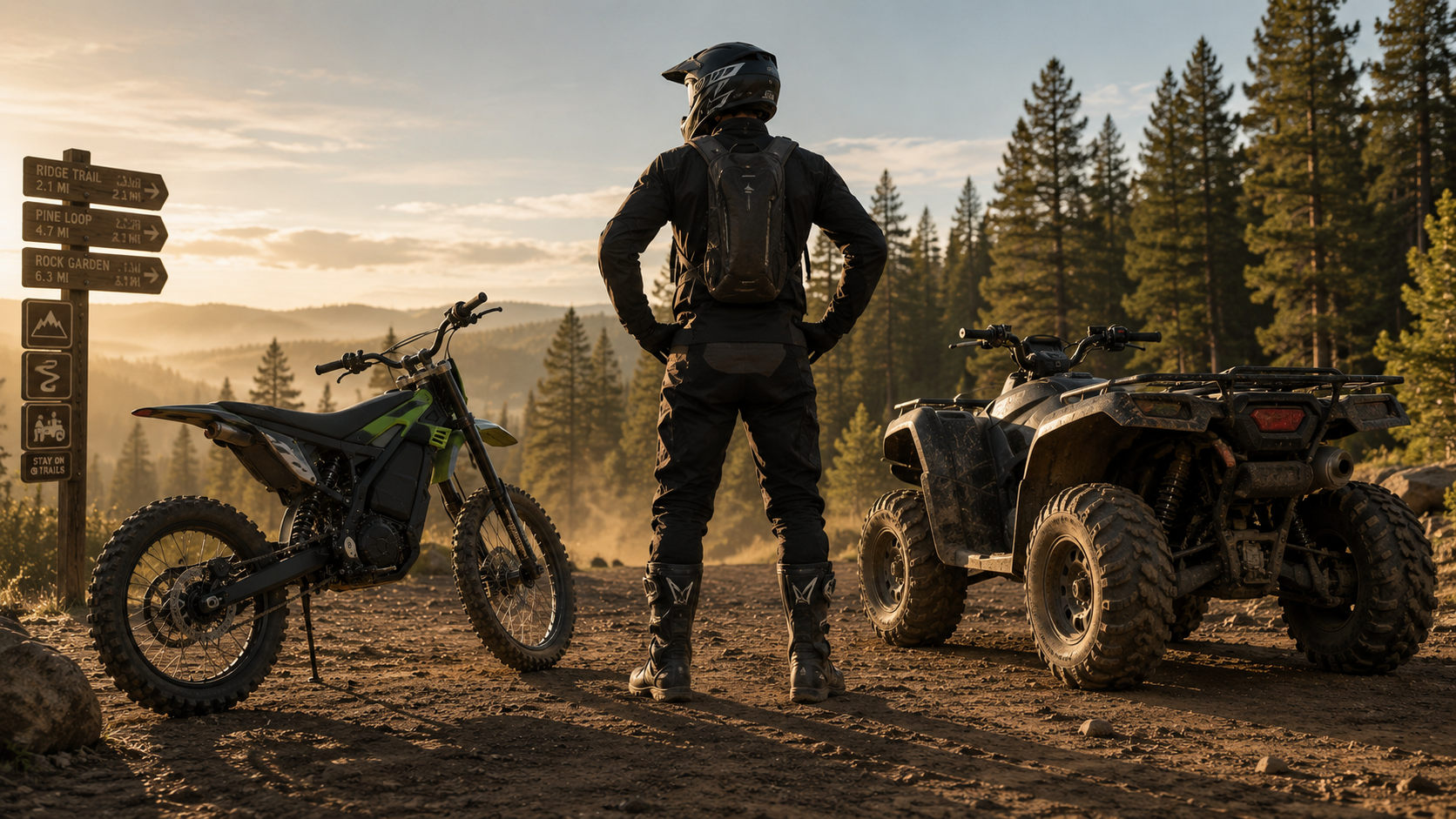
Electric Dirt Bike vs ATV: Which Is Better for Off-Road Beginners?
Short answer. Worried about day one? An ATV is easier. Four wheels stand on their own, so you steer and brake and that is about it. No balancing act. A dirt bike wants more from you at the start. What you get back is a lighter, quieter, quicker ride once it clicks.
But speed is not really the question. Where you ride is. What you haul is. A wide farm track, a hunting road, a load of gear, that points at an ATV. Tight woods and short weekend loops and quiet solo miles point the other way, at an electric dirt bike, which is an adult electric off-road motorcycle built for dirt, not pavement. We put both side by side below: stability, learning curve, cost, terrain, trail access, range. Enough to pick the machine that fits your life instead of a spec sheet.
|
Quick verdict New and nervous, or hauling gear: start on an ATV. Want light handling, tight-trail fun, and less upkeep: start on an electric dirt bike. Match the machine to your terrain and storage before you look at power. |
Electric Dirt Bike vs ATV & off-road beginners
Both are motorized off-road machines. They solve different problems, though. Here is the short version before the detail.
|
Factor |
Electric Dirt Bike |
ATV |
|
Wheels / balance |
Two wheels, needs rider balance |
Four wheels, self-standing |
|
Day-one ease |
Steeper start |
Easier for most beginners |
|
Weight |
Light, easy to lift and correct |
Heavy, harder to move alone |
|
Best terrain |
Tight woods, singletrack, dry trails |
Wide trails, mud, open ground |
|
Hauling / passengers |
Solo, backpack only |
Cargo racks, tows when rated |
|
Noise |
Near silent |
Loud gas engine (most models) |
|
Refuel / recharge |
Hours to charge |
Minutes to refuel |
|
Upkeep |
No oil, fewer parts |
Oil, filters, more service |
|
Trail access |
Often wider on many public lands |
Motorized routes only |
|
Transport |
Truck bed or hitch rack |
Usually a trailer |
Which One Should You Pick First?
Pick by your biggest worry. Then by the ride you do most. Three cases cover almost everyone.

Choose an ATV if balance is the problem
Four wheels take away the one skill that stops most new riders cold. You do not tip at a standstill. Slow turns, stops, rough open ground, all manageable inside the first hour. ATVs haul gear too, and handle real work, which is why you see them on hunting land, farms, and campsites.
The cost is size. Heavier. Wider. Harder to store. And it usually needs a trailer just to reach the trail.
Choose an electric dirt bike if you want light handling
A dirt bike is nimble. It threads gaps an ATV cannot fit through, drops into a truck bed, tucks into a garage corner. Electric power layers on a smooth throttle, no gas smell, and a lot less engine noise. The first ride feels calmer for it.
Balance is the catch. You stand, lean, brake, steer, all with real body input. Flat dirt first. Hills and ruts and mud later.
Choose by terrain, not by hype
Speed clips sell bikes. They do not pick the right one for you. Deep mud, soft ground, heavy loads, the ATV usually takes those. Tight trails and quiet solo miles go to the dirt bike, more fun and less hassle. Wide open paths? Either works, so budget and storage break the tie.
The Basic Difference
Two wheels and a battery. Versus four wheels and, usually, a gas engine. That one split drives the rest of it. Two wheels want balance and constant input. Four wheels hand you stability, weight, and utility, but they eat more room.
Both read as motorized vehicles on most trails. So age rules, permits, and access limits can apply. Check before any public-land ride. E-bike and ATV access swings state to state, trail to trail.
What an electric dirt bike is
A battery-powered off-road bike. Built for dirt, gravel, grass, trails. Electric motor instead of a gas engine, twist throttle, strong torque down low, simple controls. Most skip the clutch and the gears, which takes the stress off the first few rides. One thing to watch, though. A legal pedal-assist e-bike is not the same animal as a high-power electric dirt bike, and the faster machines follow motorcycle-style rules in plenty of places.
What an ATV is
A four-wheeled all-terrain vehicle. Most beginner and utility models run on gas. Electric ATVs exist too. You sit, steer with handlebars, work the throttle and brakes by hand or foot. Stability, traction, hauling, that is the reputation. The weight is the catch. Turn too hard, climb wrong, or cross a slope at a bad angle, and it can roll.
Where side by sides fit
Bigger again. Seats side by side, a steering wheel, seat belts, a roll cage. Easy to drive. Also the priciest to buy, store, and haul, and they need the widest trails of the three. Great for group rides and property work. For simple beginner practice, though, too much machine.
Learning Curve for New Riders
The curves differ. An ATV feels easy on day one because it does not ask for balance. A dirt bike takes more practice, then pays it back, teaching body control that carries into mountain biking and motorcycles down the line.
The best first ride is slow and boring. Flat dirt. Open space. No traffic. Speed comes later, after you can stop, turn, and react without thinking about it.
Why ATVs feel beginner friendly
They stand on their own. Starts, stops, slow turns, confidence builds fast. Controls feel familiar, and a lot of them are automatic. The risk is false confidence. Feel safe, push too hard too soon, and an ATV rolls in a sharp turn or a bad climb.
Why electric dirt bikes need more balance

Balance shows up in second one. Lean, speed, braking, body position, all at once. The light weight helps once it clicks, since a small mistake is easy to fix and you can step off at low speed. Electric torque, though, wants respect. Start in the lowest mode. Every EM-5 electric dirt bike ships with three ride modes for exactly this, so a new rider eases in before opening it up.
Safety and Stability Off-Road
Safety is not just wheel count. Speed, terrain, skill, machine size, gear, all of it together. Treat both as serious motorized machines.
The CPSC urges riders to get hands-on training, keep ATVs off paved roads, skip extra passengers, and put riders under 16 on youth-size models only. Those rules exist for a reason. A stable machine still turns dangerous when it is used wrong. Electric dirt bikes are quiet, sure, but they accelerate hard. Brake practice and gear come before speed.
Four wheels vs two wheels
Four wheels give you standing stability on flat ground and wide paths. Two wheels give you line choice. You thread rocks, ruts, and trees in less space, and you can lift or reposition the bike after a spill. The trade is clean. ATVs cut balance stress and add rollover risk. Dirt bikes need balance but stay light and narrow.
Gear every beginner should wear
Not optional. A slow fall still hurts hands, knees, ankles, heads. Good gear builds confidence too.
- Helmet, DOT-certified for off-road riding.
- Goggles or eye protection.
- Gloves with palm protection.
- Long sleeves, long pants, over-the-ankle boots.
- Knee and elbow guards, plus chest protection for rocky trails.
Terrain: Trails, Mud, Hills, and Tight Woods
Terrain should shape the buy. Smooth dirt roads and tight woods want different machines. No machine wins every surface.

Tight singletrack and forest trails
The dirt bike's turf. A narrow shape slips between trees and holds a small trail line, so a beginner works around obstacles without a wide turning path. ATVs need more room. Push a wide stance into soft edges and you tear up narrow trails. In the woods, the quiet electric power is a bonus.
Mud, snow, and rocky ground
ATV territory. Four wheels, wider tires, more weight, all of it keeps them moving through mud, snow, and rough open ground. An electric dirt bike handles light mud and rock if the rider has the skill, but deep mud stops the front wheel and snow hides ice. For serious open-ground miles, the big-wheel EM23 and its 19-inch front wheel is the calmer dirt-bike pick, though an ATV still wins the worst muck.

Open fields and wide paths
Friendly to both. An ATV feels planted and relaxed. A dirt bike feels light and playful. Comfort level breaks the tie. One warning. Open space tempts new riders to go too fast, and wide trails still hide holes, ruts, and bumps.
Speed, Power, and Ride Feel
Speed should not decide it for a beginner. Control matters more. A machine that feels smooth at 15 mph beats one that feels scary at 30.
Electric dirt bike acceleration

Electric torque lands the instant the throttle moves. Fun. Also needs a soft hand. Ride modes help, so use the mildest one first. For a sense of where the numbers sit, the EM-5 Pro runs a 5,600W geared motor to a 52 mph top speed with 177 lb-ft of torque, and that torque arrives low in the rev range where a climb actually needs it. Real speed, no race machine required. And still dialed down for beginners in the lowest mode.
ATV power and planted control
Four tires and more weight make an ATV feel planted, which calms a nervous rider on rough open ground. Does not mean push it. Heavy machines need more room to stop and turn, so smooth, slow throttle keeps all four wheels predictable.
Why beginners should not chase top speed
Top speed rarely helps a new rider. Dirt, grass, and gravel all change traction, and a bump that is nothing at low speed can throw you at high speed. Buy for control. A machine you ride often beats a fast one that sits in the garage.
Cost, Maintenance, and Storage
Cost is more than the sticker. Gear, charging or fuel, repairs, tires, storage, transport, all of it counts. A cheap machine gets expensive when it needs constant work.
Upfront cost and running cost
Electric dirt bikes can cost more than some small gas bikes up front. What they drop is fuel, oil changes, and a stack of engine parts. ATVs usually cost more to buy, move, and maintain, since they are larger with more parts. Do not blow the whole budget on the machine, either. Helmet, gloves, boots, tools, those are part of the plan, not an afterthought.
Charging vs fuel and oil service
Charging is simple. Plug in, wait, ride. No spark plugs, no filters, no carburetor cleaning on most electric bikes. A gas ATV wants fuel plus oil changes, air-filter service, belt checks. Electric still is not maintenance-free, though. The U.S. Department of Energy notes all-electric drivetrains need less upkeep thanks to fewer moving parts and fluids, but tires, brakes, chain, suspension, and battery all still need routine checks. Keep spare parts and gear around so a small job does not sideline the bike for a week.
Truck bed, hitch rack, or trailer
Transport often decides which machine actually gets used. A dirt bike fits a truck bed or a hitch rack, so weekend rides stay easy. An ATV usually needs a trailer, ramps, tie-downs, and a tow-capable vehicle. The easier machine to move is the one you ride.
Trail Access and Legal Rules

Access is where these machines split hard. It surprises most buyers. Electric dirt bikes, e-bikes, ATVs, side by sides, they can all land in different categories. High-power electric dirt bikes often face stricter rules than a pedal-assist e-bike, so read the actual trail rule. Not a forum comment.
PeopleForBikes notes e-bike laws differ by state and can confuse riders. The U.S. Forest Service says Class 1, 2, and 3 e-bikes are allowed on motorized trails and roads across national forests and grasslands, though not every trail is a motorized one. On BLM land, e-bikes are allowed in motorized areas and on OHV trails, while ATVs stick to designated motorized routes only.
Private land vs public land
Private land is simpler with the owner's permission, though local noise, age, and safety rules still apply. Public land is layered. A trail open to bicycles may not allow electric dirt bikes, and a high-power machine may need an OHV area instead of a bike trail. Read the posted signs and the official maps first.
What beginners should check before riding
A two-minute check saves tickets, conflicts, and wasted trips.
- Is the trail open to motorized vehicles at all?
- Are ATVs allowed on this route, or only narrower machines?
- Are e-bikes or electric dirt bikes allowed, and which class?
- Permit, registration, or sticker required?
- Age, helmet, and speed rules for the area?
- Seasonal closures or recent weather damage?
Range and Ride Time
Range shifts with terrain, rider weight, speed, tire pressure, temperature, and how hard the motor works. A flat dirt road sips energy. A steep, muddy climb drains it. Plan rides with margin to spare.
Electric dirt bike battery range
Range swings a lot by model and by trail. Smooth riding in a low mode stretches the battery. Hard climbing, soft dirt, cold weather, full throttle, all of that shortens it. Do not bank on the advertised best case out on real trails. Charge before you go, avoid storing the pack empty, and bring the charger only if there is safe power at the trailhead.
ATV fuel range
ATVs usually run longer between stops, and refueling is fast, which helps on long days and remote property. Mud, towing, and steep hills still burn more gas. Do not ride the tank to empty. Save enough for the return, since off-road detours run longer than you planned.
Utility: Hauling, Passengers, and Work
Utility is the ATV's clear edge. It carries gear, tows rated loads, handles property tasks. An electric dirt bike is a solo trail machine. Strong on movement, not on work.
When an ATV is better
When the job needs stability, traction, and cargo. Hunters lean on ATVs for game retrieval and gear. Property owners haul tools, feed, firewood. The limits are size and trail access, since some public trails pin ATVs to marked motorized routes.
When an electric dirt bike is enough
Light solo rides, short loops, quiet fun with a backpack, that is plenty, and the low upkeep is a real win. Not a work vehicle, though. Do not expect it to tow or carry a passenger. If hauling is part of the plan, buy for that instead.
How We Compared Them
Our team reviews electric off-road machines against real beginner needs, not spec-sheet bragging. Three things drove this one.
Real beginner priorities
We weighted what actually decides whether a new rider keeps riding. Balance. Low-speed control. Storage. Transport. In our experience the machine that is easy to move gets ridden far more than the one with the higher top speed.
Verified specs and access rules
Every Valtinsu figure here was checked against the live product pages. Range figures we could not confirm got left out, not guessed. The trail-access points come from CPSC, the Forest Service, BLM, and PeopleForBikes.
Honest trade-offs, both sides
We call the ATV the better tool where it truly is. Mud. Hauling. Refuel speed. And the dirt bike where it wins, on weight, access, and upkeep. No machine takes every category, and pretending one does helps nobody.
The Bottom Line
For most off-road beginners, an ATV is the easier first ride when stability, comfort, and hauling top the list. An electric dirt bike is the better call when you want something lighter, quieter, and easier to store for tight woods and short loops, with less day-to-day upkeep.
Match the machine to your real riding plan, your terrain, and your storage before you ever look at power. Leaning toward a dirt bike? Compare the full lineup by seat height, speed, and age rating, then start slow in the lowest mode. The right first machine is the one you ride often, store easily, and take where the law lets you.
FAQs
What's better, an ATV or a dirt bike?
Depends on the rider. And the ride. An ATV suits cautious beginners who want stability, comfort, and hauling. A dirt bike suits riders who want agility and an active feel.
- ATV: wide trails, mud, open land, hunting, work.
- Dirt bike: tight trails, quick turns, sporty solo riding.
- First machine? Pick by where you ride most and what you carry.
Is an e-bike better than an electric dirt bike?
Different tools, really. A legal e-bike is built around pedals and class limits for casual and light-trail use. An electric dirt bike sits closer to a small off-road motorcycle, so it is faster and stronger but runs into stricter trail rules.
- Check motor power, throttle, top speed, and local rules.
- Too powerful for e-bike limits means off-road vehicle rules apply.
- Do not assume the two are interchangeable.
Why are e-bikes banned on some trails?
Land managers often classify them as motorized. Speed, crowding, user conflict, and wildlife pressure play into it too.
- Some trails allow Class 1 pedal-assist but ban throttle bikes.
- The Forest Service allows Class 1, 2, and 3 e-bikes on motorized trails, not every trail.
- Read the official map before you ride.
How fast can you legally ride an e-bike?
It depends. State, trail, and class all matter. Many systems assist Class 1 and 2 up to 20 mph and Class 3 up to 28 mph on certain roads or paths.
- Local rules can set lower limits or ban some classes.
- Legal speed is not your target speed as a beginner.
- A steady 10 to 15 mph on dirt is safer while you learn.
Can electric dirt bikes go 50 mph?
Some can. At that speed, though, the machine is usually closer to an electric moped or motorcycle than a legal e-bike. Registration, insurance, or a license may apply.
- High speed adds stopping distance and crash risk.
- Such machines are often banned from bike paths and soft trails.
- Not a smart first ride; start with beginner power modes.
How long does an electric dirt bike battery last?
Several years with normal care. Lifespan comes down to quality, charge cycles, storage habits, heat, cold, and how hard the bike gets ridden.
- Capacity slowly drops, so range shrinks over time.
- Store cool and dry; do not leave it fully empty for long.
- Cold weather means shorter range, so plan a shorter loop.
Can police chase you on a dirt bike?
They can act if a rider breaks the law on any dirt bike, ATV, or e-bike. What happens depends on local policy and the situation.
- Most off-road machines are not street legal without the right equipment and paperwork.
- Riding public roads, sidewalks, or closed trails risks fines or impoundment.
- Ride only where your machine is legal: marked trails, OHV areas, or private land with permission.
Sources
- U.S. Consumer Product Safety Commission, All-Terrain Vehicle Safety (2026)
- U.S. Forest Service, Electric Bicycle Use (2026)
- PeopleForBikes, State-by-State Electric Bike Laws (2026)
- Bureau of Land Management, E-Bikes on BLM-Managed Public Lands (2026)
- U.S. Department of Energy, Alternative Fuels Data Center, Maintenance and Safety of Electric Vehicles (2026)


Looking for something else?

Electric Dirt Bike Loses Power Under Load: Causes and How to Fix It
LEARN MORE
Electric Dirt Bike Bolt Torque Checklist: What to Check and Where the Numbers Come From
LEARN MORE
How to Bleed Electric Dirt Bike Brakes Safely
LEARN MORE
Electric Dirt Bike Throttle Not Working: What to Check First
LEARN MORELooking for something else?

Electric Bike Battery Not Charging? Work Through This Before You Buy a New One
LEARN MORE
Electric Dirt Bike Error Codes: What They Mean and What to Check First
LEARN MORE
Electric Dirt Bike Brake Rotor Rubbing: Diagnose the Cause Before Adjusting
LEARN MOREYou may also like
VALTINSU EM-5 Off-Road Electric Dirt Bike
VALTINSU EM-5 Pro Off-Road Black Electric Dirt Bike
VALTINSU EM-5 Pro Green Electric Dirt Bike
VALTINSU EM-5 Ultra Electric Dirt Bike
Further reading

Electric Dirt Bike Trailside Power Loss: Recovery Plan When the Battery Is Dead

Electric Dirt Bike Fall Riding on Wet Leaves: Grip, Hidden Obstacles and Braking

How to Lift a Fallen Electric Dirt Bike Without Hurting Yourself or the Bike
