

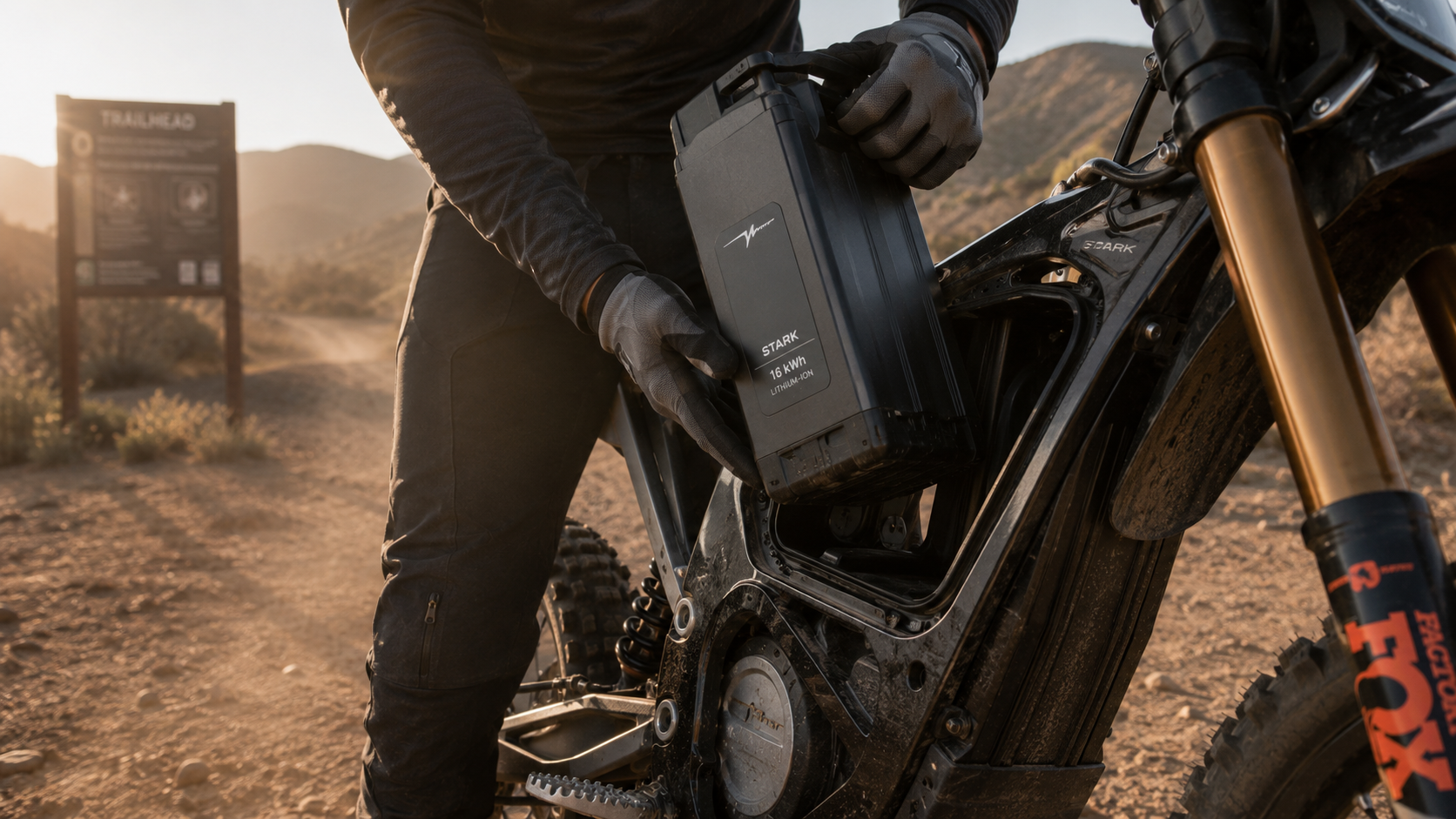
Electric Dirt Bike Battery: Voltage, Amp-Hour Range & Replacement Tips for Off-Road Riders
The electric dirt bike battery feeds the motor, controller, lights, and display. It does the fuel's job on a gas bike. It does more too. Weight, balance, throttle response, ride time, the pack sets all of it. Four numbers carry most of the story: voltage, amp-hours, watt-hours, discharge rate. Get those right. The rest falls into place.
On an adult electric off-road motorcycle, the pack is usually the priciest single part. A weak one drags. A strong motor with a tired pack behind it feels slow, every time. Match the pack well and it holds power on a climb, through sand, across a long loop without fading. What follows: the numbers, how to choose or replace a pack, real range, and the charging habits that keep it alive for years.
Electric Dirt Bike Battery, at a Glance
An electric dirt bike battery stands out for its combination of voltage, amp-hour capacity, watt-hours, and discharge rating, which together determine ride range, power delivery, and overall trail performance.
|
Spec |
What it means |
What it changes |
|
Voltage |
48V / 60V / 72V system |
Power and top-speed ceiling |
|
Amp-hours (Ah) |
Charge the pack holds |
Ride time / range |
|
Watt-hours (Wh) |
Volts × Ah |
Best single range number |
|
Discharge (C-rating) |
How fast it can push current |
Climbing and hard launches |
Voltage sets the ceiling. Ah sets the distance. Wh ties the two together so you can compare packs across different systems. Discharge is the one buyers skip. Dirt riding punishes that one hardest.
Best Electric Dirt Bike Battery Types by Use
No single pack wins. There is a best pack for a rider, a bike, a budget, and that is a different answer each time. Here is how the field sorts in 2026, matched to the way people actually ride.
- Best chemistry overall: lithium-ion. Lighter, faster to charge, more energy per pound than lead-acid.
- Best for beginners and teens: a 48V pack, roughly 20–24Ah. Smooth, manageable, plenty for shorter loops, as on the EM-5 with light (rated 13+).
- Best all-round value: a 60V 27Ah pack. The sweet spot for adult trail range and steady climbing power.
- Best for high power and long range: 72V, high-Ah, high-discharge cells. Race-tier headroom, more weight and cost.
- Worst false economy: a cheap pack with a bold Ah claim and no discharge or cell spec. It sags, heats, and ages fast.
How Common Pack Sizes Compare
Watt-hours keep the comparison honest. A few common sizes below, with three Valtinsu packs as real reference points. Range moves with terrain, rider weight, and throttle, so read the miles as a guide, not a promise.

|
Pack |
Watt-hours |
Full charge |
Reference model |
|
36V 12–15Ah |
~430–540Wh |
3–5 hrs |
Youth / mini bikes |
|
48V 23.4Ah |
~1,123Wh |
7–8 hrs |
Valtinsu EM-5 (40 mph, 50 mi, 13+) |
|
60V 27Ah |
~1,620Wh |
6–8 hrs |
Valtinsu EM-5 Pro / EM23 |
|
72V 25–30Ah |
~1,800–2,160Wh |
7–8 hrs |
Race / flagship class |
That 60V 27Ah figure is the value tier most adult riders want. It is the pack behind the EM-5 Pro, a 5,600W geared motor with a 59-mile range for under two grand, and the big-wheel EM23 cruiser. Want the side-by-side on every pack? Compare the full electric dirt bike lineup.
Electric Dirt Bike Battery Specs Explained
Battery specs look like alphabet soup at first. They are not. Four numbers do the heavy lifting, and once they click, comparing packs takes a minute. Price alone tells you almost nothing.

Voltage: 36V, 48V, 52V, 60V, 72V
Voltage sets how strong and fast a bike can feel, once the controller and motor match it. Higher voltage supports harder acceleration and a higher top speed. It is a ceiling, not a promise.
Youth and mini bikes run 36V or 48V. Stronger adult machines run 60V or 72V. One rule beats all the others here. Do not guess on a replacement. Drop a 72V pack onto a system wired for 48V and you can cook the controller, the wiring, the display, the motor. The label decides. The manual decides. Not the price tag.
Amp-Hours: What Ah Means for Ride Time
Amp-hours measure how much charge the pack holds. A 20Ah pack holds less than a 40Ah pack at the same voltage. More Ah, more ride time. Usually.
It also means more size and more weight. For backyard laps a smaller pack is plenty. For long trail days, hill climbs, and heavier riders, the extra Ah keeps range anxiety off the dash.
Watt-Hours: The Best Way to Compare Range
Watt-hours beat voltage or Ah alone for a range picture. The math is simple. Volts times amp-hours.
A 48V 20Ah pack is about 960Wh. A 72V 20Ah pack is about 1,440Wh. Same Ah, far more stored energy. Wh lets you line packs up across different voltages and see which one truly carries more. A bigger Wh number points to more possible range. Terrain and throttle still write the last number.
C-Rating and Peak Power Delivery
C-rating shows how fast a pack can safely dump current. This is where dirt bikes split from city e-bikes. A steep climb, loose sand, a hard launch out of a corner, each one wants a burst of current in a second or two.
A low-discharge pack can feel fine on flat pavement and fall apart in dirt. It sags. It heats. Ask for peak power and it shuts down. So check the continuous and peak discharge ratings before you buy. The pack has to feed the controller's current draw, not just match the motor's watt number.
Lithium-Ion vs Lead-Acid Batteries
For a modern adult electric off-road motorcycle, lithium-ion is the default. Good reason for it. Lead-acid still turns up on older or bargain builds. For off-road use the trade-offs are not close.
The U.S. Department of Energy notes that lithium-ion cells pack high energy per unit of mass and volume, with a strong power-to-weight ratio (DOE AFDC). On a bike you throw around, that weight saving is not a luxury. It is handling.

Lithium-ion - the case for
- Lighter. Less weight to launch, corner, and land.
- Charges faster and holds voltage better under load.
- More energy for its size, so more range per pound.
- Longer service life with decent care, usually 3–5 years.
Lead-acid - the trade-offs
- Heavy. Hurts handling and adds strain on climbs.
- Sags harder under load and loses power faster.
- Slower to charge, shorter usable life.
- Cheaper up front, and that is about the only win.
Bottom line for most riders. Lithium-ion, unless the bike is a light-duty toy and budget rules the whole call.
How to Choose the Right Battery for Your Dirt Bike
The right pack is not the biggest or the priciest. It is the one that fits the frame, matches the electronics, suits your riding, and comes from a seller who lists real specs. Run this short list before you buy a replacement or an upgrade.
Match Voltage to the Controller
Pack voltage has to match the controller's rated voltage. Built for 48V, run 48V, unless the maker states plainly that 52V is allowed. Some 48V systems tolerate 52V. Many do not. The only safe answer sits on the controller label, in the manual, or with the brand's support team. Guess wrong and parts fail, wires heat, connectors heat, all the way down the line.
Check Size and Mounting Space
A pack has to sit in the frame, tray, or box without force. Even a small gap can stop the cover closing or leave the pack loose. Loose is a real hazard on dirt. Vibration, jumps, and hard landings all work at the cells and the connectors. Measure length, width, height, and mount points before you order. Check weight too, since a heavier pack changes how the bike turns and how it lands.
Compare Connectors and Wiring
Connectors have to match the wiring and handle the current. Common styles: XT60, XT90, Anderson, or brand-specific plugs. A plug that looks close is not always safe. Loose pins, thin wire, cheap adapters, all of them overheat under hard riding. Check the discharge connector and the charge port both. Does not match? Ask before you reach for an adapter.
OEM vs Aftermarket
An OEM pack comes from the original brand or an approved parts supplier. Usually the safest fit, since voltage, case size, connector, charger, and BMS were all built for that bike. Valtinsu, for one, keeps “replacement batteries and parts matched to each model matched to each model.
Aftermarket packs can cost less or add range. Some are excellent. Others hide weak cells, thin wiring, and vague specs behind a big Ah number. Go aftermarket only from a seller who lists voltage, Ah, Wh, discharge rating, cell type, connector, dimensions, and warranty. A listing that makes a huge range claim with no cell spec is telling you something. Listen to it.
Electric Dirt Bike Battery Range Guide
Range depends on pack size, motor power, rider weight, terrain, speed, tire pressure, and throttle use. The same pack that carries a smooth 40 miles on hardpack can drain in half that over sand or a steep climb. Product-page range gets measured in easy conditions. Use it as a guide. Not a promise.

How Voltage and Ah Affect Range
Voltage drives power potential. Ah drives how much charge sits in the pack. Together they make watt-hours, the best simple range number. A 60V 30Ah pack stores more than a 48V 30Ah pack, and that extra energy helps range, as long as the rider does not spend it all on the throttle. Bigger packs weigh more, too. Weight costs energy on every climb.
Trail Riding vs Track Riding
Trail riding mixes throttle. You coast, climb, crawl over rock, then cruise, so a smooth rider stretches range. Track riding drains fast. Hard acceleration, braking, jumps, repeated corner exits, all of it pulls heavy current. One track session can empty a pack that would carry you all afternoon on a mellow trail. Plan pack size around the hardest riding you do most. Not the easiest.
Rider Weight, Speed, Hills, Mud, Sand
Heavier riders use more battery. The motor moves more total weight. Gear, tools, a loaded pack, all add to it. Speed is the big lever. Hold a high speed for long stretches and the pack drains far faster than it would at a steady, moderate pace. Hills, mud, sand, soft soil, all of it piles on load. The controller pulls more current and the miles fall.
How to Estimate Range Before a Ride
Start from the Wh rating. More Wh, more stored energy, and your right wrist spends it. For safer planning, assume off-road range runs below the product-page figure, then pad it for sand, hills, or cold. Log your first few rides on the same loop and speed. After two or three you will know your bike's real range better than any chart. Our own guide to the 5 habits killing your range covers the rest.
Replacement Battery Buying Tips
A replacement should restore safe power, steady range, and a normal ride feel. Voltage and price are not enough on their own. Good planning checks fit, current rating, charger match, warranty, and seller support, and it matters more on a dirt bike, since off-road use is hard on packs.
Signs Your Battery Needs Replacing
Watch three things. Range that drops well below normal is the first. If a loop that used half the pack now nearly empties it, the cells are aging. Power cutouts are the second. Shut down on climbs or under hard throttle, and the pack may be sagging under load. Physical changes are the serious one.
- Swelling or a puffed case. Stop using it.
- A sweet, chemical, or burning smell.
- Melted plugs, heat marks, or a cracked casing.
- Repeated shutdowns under normal riding.
What to Check Before Ordering
Voltage first. Then work down the list, using the old battery label, the manual, and the controller label. A photo of the label helps if you contact the seller.
- Voltage and Ah.
- Battery dimensions and mount points.
- Discharge connector and charge port.
- Charger compatibility (voltage and chemistry).
- Continuous and peak discharge rating.
- Warranty and return terms.
Why Cheap Batteries Can Cost More Later
A cheap pack looks like a bargain until the cells fade early. Some exaggerate the Ah rating, so real capacity sits under the label. Weak wiring and poor connectors heat up under dirt-bike loads, and that heat can take out the pack, the controller, or the motor. A better pack costs more for a reason: safer cells, stronger wiring, a cleaner build, a real BMS. For off-road use, those details are the whole game.
Charging, Storage, and Battery Life
Battery life turns on how often you ride, how deep you drain the pack, how you charge, and where you store it. Good habits keep a pack healthy for years. Lithium cells do not need draining to zero before a charge. Deep drains and long spells at full charge do the most quiet damage. For the full routine, see how to charge an electric dirt bike.

How Long Electric Dirt Bike Batteries Last
Most lithium packs last about 3 to 5 years with normal use and decent care. Some go longer. Hard riding, heat, poor charging, and deep drains cut it short. Life gets measured in charge cycles, not calendar days, and a full cycle is 100 percent of the pack used, even if that happens across several rides. You may not notice the aging at first. Then range slips, charging drags, and the bike feels tired under load.
Safe Charging Habits
Use the charger made for your pack's voltage and chemistry. The wrong one can overcharge, undercharge, overheat the pack, or fry the BMS. The U.S. CPSC has warned riders off generic and universal chargers for micromobility products for that exact reason (CPSC). Let a hot pack cool after a hard ride before you plug in. Charge in a dry, open space, clear of anything that burns, and unplug at full unless the maker says the charger is built to stay on.
The 20/80 Rule for Lithium Batteries
Keep the pack roughly between 20 and 80 percent for everyday use and the cells take less stress. Battery University's testing backs the partial-charge approach for longevity (Battery University). You can still top to 100 percent before a long ride. The point: do not leave it full for days you do not need the range, and do not drain it flat. Do not overthink it either. Skip zero, skip long full-charge storage, and you have most of the benefit.
Winter and Long-Term Storage
Store the pack in a cool, dry place when the bike will sit for weeks. Skip the hot garage, the freezing shed, anywhere damp. Around 50 to 60 percent is the storage sweet spot, better than full or empty, and Battery University recommends the same mid-charge, cool-storage approach (Battery University). Check a stored pack every month or two. Top it back to the storage range if it drifts low.
Battery Safety and Maintenance
Safety starts with the right charger, the correct voltage, clean connectors, and careful storage. Dirt, water, heat, and hard impacts all raise the risk. A pack does not need daily service. It does need a look before hard rides. Third-party certification helps too. The UL 2849 standard tests the electrical safety of e-mobility systems end to end (UL Solutions).

Use the Correct Charger
Match voltage and chemistry, every time. A 48V charger has no business on a 60V or 72V pack. A plug that fits does not mean the charger is right. Runs very hot, smells odd, sparks, makes odd sounds, stop. Replace a damaged charger with the correct model from the brand or a trusted supplier.
Avoid Heat, Water, and Hard Impacts
Heat is hard on lithium. Keep the pack out of direct sun, out of hot vehicles, away from heaters. Water causes trouble even on a pack rated water-resistant, so skip deep crossings unless the bike is built for it (Valtinsu's off-road models are IPX6, the EM23 IPX4). After a crash, inspect the case, mount, wiring, and connectors before you ride again. Basic thermal and maintenance care is standard for any EV battery (DOE AFDC).
When to Stop Using a Battery
Stop if the case is cracked, swollen, leaking, or melted. Stop if a connector is burned or the pack shuts down again and again under normal riding. Do not open a sealed lithium pack at home. The cells can hold dangerous energy even when the display reads empty. Use a qualified battery shop or the brand's support team for testing. Follow local rules for recycling or disposal once the pack is done.
Electric Dirt Bike Battery Cost
Cost tracks voltage, Ah, Wh, cell quality, discharge rating, case design, charger, and warranty. A small youth pack costs a fraction of a 72V adult pack. The battery is often the priciest single part, so replacement planning belongs in the buying decision. New or used.
|
Tier |
Typical systems |
Best for |
|
Entry |
24V / 36V / 48V, modest Ah |
Kids' bikes, light backyard use |
|
Mid-range |
48V / 52V / some 60V |
Casual and trail riders - the value zone |
|
High-performance |
60V / 72V, high-Ah, high-discharge |
Tracks, steep trails, heavy throttle |
What makes one pack pricier than another? Cell quality, first. Better cells hold capacity and perform under load. Then the BMS, which guards against overcharge, over-discharge, shorts, heat, and cell imbalance. Case design, water resistance, connectors, warranty, and support add the rest. A pack with clear specs and real support is usually worth more than a no-name pack making bold claims.
How We Approach Battery Advice
This comes from riding these bikes and reading the support tickets. Not a spec sheet alone. Three things we hold to.
We Match Specs to the Live Sheet
Every figure here gets checked against current spec sheets. Not carried over from memory. Where a range figure is not published, we say so. We do not invent one.
Heat and Cheap Chargers Are the Pattern
Across the failures we see, most trace back to heat or an uncertified charger. So cool-down and matched, certified gear lead the advice. Not a last-resort footnote.
We Cite the Authorities
On safety and battery science we lean on DOE, CPSC, and UL, rather than asking you to take our word. Sources are linked at the end.
how to choose the right electric dirt bike battery
The best electric dirt bike battery fits your bike first and your riding second. Match voltage to the controller. Read the Ah and Wh for range. Confirm the connector, charger, and size before you buy. A bigger pack buys ride time, and it adds weight, so buy the one your riding needs. Not the biggest number on the page. For most adults, a 60V 27Ah lithium pack is the sweet spot, which is why it sits behind the EM-5 Pro.
Do not treat the pack as a cheap add-on. It sets range, power delivery, safety, resale value. Pick clear specs, strong discharge support, safe charging, a real warranty. Then ride it right and it outlasts the trail season by years. New to the category, or sizing a spare? Compare the full electric dirt bike lineup and match the pack to how you ride.
Electric Dirt Bike Battery FAQs
What kind of battery is in an electric dirt bike?
Lithium-ion, on nearly all modern models. Lighter than the lead-acid packs on older or bargain bikes, and it stores more energy for its size. The exact type tracks the model.
- Youth bikes: often 24V, 36V, or 48V.
- Adult bikes: usually 60V or 72V.
- Some packs pull out; others sit fixed in the frame.
Write down your voltage, Ah, connector type, and pack size before you shop for a charger, replacement, or upgrade.
How much do electric dirt bike batteries cost?
Anywhere from a small youth pack to a pricey high-performance pack. Cost tracks voltage, Ah, Wh, cell quality, discharge rating, connector, charger, and warranty. A kids' pack runs a fraction of a 60V or 72V adult pack. Replacement packs with trusted cells and a strong BMS cost more, and they usually last longer and hold up better under load. Compare by Wh and discharge rating. Not price alone.
How long do electric dirt bike batteries last?
About 3 to 5 years with normal use and careful charging. Heat, deep drains, poor chargers, and hard riding shorten it. Life gets measured in charge cycles, not calendar age. A rider draining the pack on steep trails every weekend wears it faster than a casual rider on flat dirt. Avoid draining to zero. Store it near half charge when the bike will sit for weeks.
Can I put a lithium battery in my dirt bike?
Sometimes, if it matches the electrical system. Voltage, size, connector, charger, and current rating all have to line up. Swapping lead-acid for lithium can cut weight and add ride time, but the controller and charger may not be compatible, and a lithium pack needs the right BMS for safe charging. Do not install one just because the voltage looks close. Ask the maker or a battery specialist first.
Can I put a 52V battery on a 48V setup?
Not safely on every bike. A 52V pack charges higher than a 48V pack, so the controller, display, motor, wiring, and charger all have to accept that higher full-charge voltage. Some riders run 52V for a small gain. Dirt riding stresses parts harder than casual e-bike use, though. Check the controller's maximum voltage rating before you try it.
Is 52V faster than 48V?
A little, on a compatible bike. Higher voltage helps the motor hold power under load and can cut voltage sag versus a tired 48V pack. Voltage alone does not guarantee a big jump, though. If the controller caps output, the bike may feel about the same. Upgrade only if the whole system, charger and controller included, supports 52V.
What is the 20/80 rule in battery care?
Keep a lithium pack roughly between 20 and 80 percent for everyday use. It eases stress on the cells and slows aging. You do not have to hit it every ride. Charge to 100 percent before a long trail day, then skip leaving it full for days on end. Draining to zero often cuts life too. Lithium likes a steady middle.
Is it worth replacing an electric dirt bike battery?
Usually yes, when the bike is otherwise solid and the pack is the main problem. A new pack restores range, cuts power cutouts, brings the bike back. Less worth it if the motor, controller, frame, or brakes also need costly work. Weigh the pack price against the value of the whole bike. For dirt use, confirm the new pack has enough discharge power for off-road riding.
Sources
- U.S. Department of Energy, Alternative Fuels Data Center, Batteries for Electric Vehicles (2026)
- U.S. Department of Energy, Alternative Fuels Data Center, Electric Vehicle Maintenance and Safety (2026)
- U.S. Consumer Product Safety Commission, Micromobility Information Center (2026)
- UL Solutions, UL 2849 E-Bike Certification and Testing (2026)
- Battery University, BU-808: How to Prolong Lithium-Based Batteries (2023)
- Battery University, BU-702: How to Store Batteries (2021)


Looking for something else?

Electric Dirt Bike Loses Power Under Load: Causes and How to Fix It
LEARN MORE
Electric Dirt Bike Bolt Torque Checklist: What to Check and Where the Numbers Come From
LEARN MORE
How to Bleed Electric Dirt Bike Brakes Safely
LEARN MORE
Electric Dirt Bike Throttle Not Working: What to Check First
LEARN MORELooking for something else?

Electric Bike Battery Not Charging? Work Through This Before You Buy a New One
LEARN MORE
Electric Dirt Bike Error Codes: What They Mean and What to Check First
LEARN MORE
Electric Dirt Bike Brake Rotor Rubbing: Diagnose the Cause Before Adjusting
LEARN MOREYou may also like
VALTINSU EM-5 Off-Road Electric Dirt Bike
VALTINSU EM-5 Pro Off-Road Black Electric Dirt Bike
VALTINSU EM-5 Pro Green Electric Dirt Bike
VALTINSU EM-5 Ultra Electric Dirt Bike
Further reading

Electric Dirt Bike Trailside Power Loss: Recovery Plan When the Battery Is Dead

Electric Dirt Bike Fall Riding on Wet Leaves: Grip, Hidden Obstacles and Braking

How to Lift a Fallen Electric Dirt Bike Without Hurting Yourself or the Bike
