

Fastest Electric Dirt Bike: Top Speed Models Ranked & Compared
There is no single fastest electric dirt bike. Ask what “fastest” means and the answer splits four ways.
Manufacturer top speed. GPS-tested speed. Acceleration time. Motocross lap time. Each one crowns a different bike. A full-size race machine like the Stark Varg lives in one world, a lightweight e-moto built for trails in another. Then there is the modified Sur-Ron, battery and controller swapped, where the numbers stop being a fair fight at all.
We sorted them by class and by how the speed was measured. What follows: the ranked picks, a comparison table, what actually counts as fast, and how to land on a bike you can ride. Most weekend riders never need the top of that list. An adult electric off-road motorcycle in the 40-to-55 mph range covers more open ground than any trail hands back.
The Fastest Picks at a Glance
Five bikes, five jobs. Speed is only one of them.
-
Fastest full-size motocross: Stark Varg MX 1.2 (up to 80 hp, gearing-dependent top end)
-
Highest claimed lightweight speed: Altis Sigma 2026 (97.2V, 25 kW peak, 80+ mph claimed)
-
Best documented 70 mph e-moto: E Ride Pro SR (72V 50Ah, 25 kW peak)
-
Best all-around value speed: E Ride Pro SS 3.0 (62 mph, lighter, cheaper)
-
Best value under $2,000: Valtinsu EM-5 Pro (60V, 43 mph, three modes, off-road only)
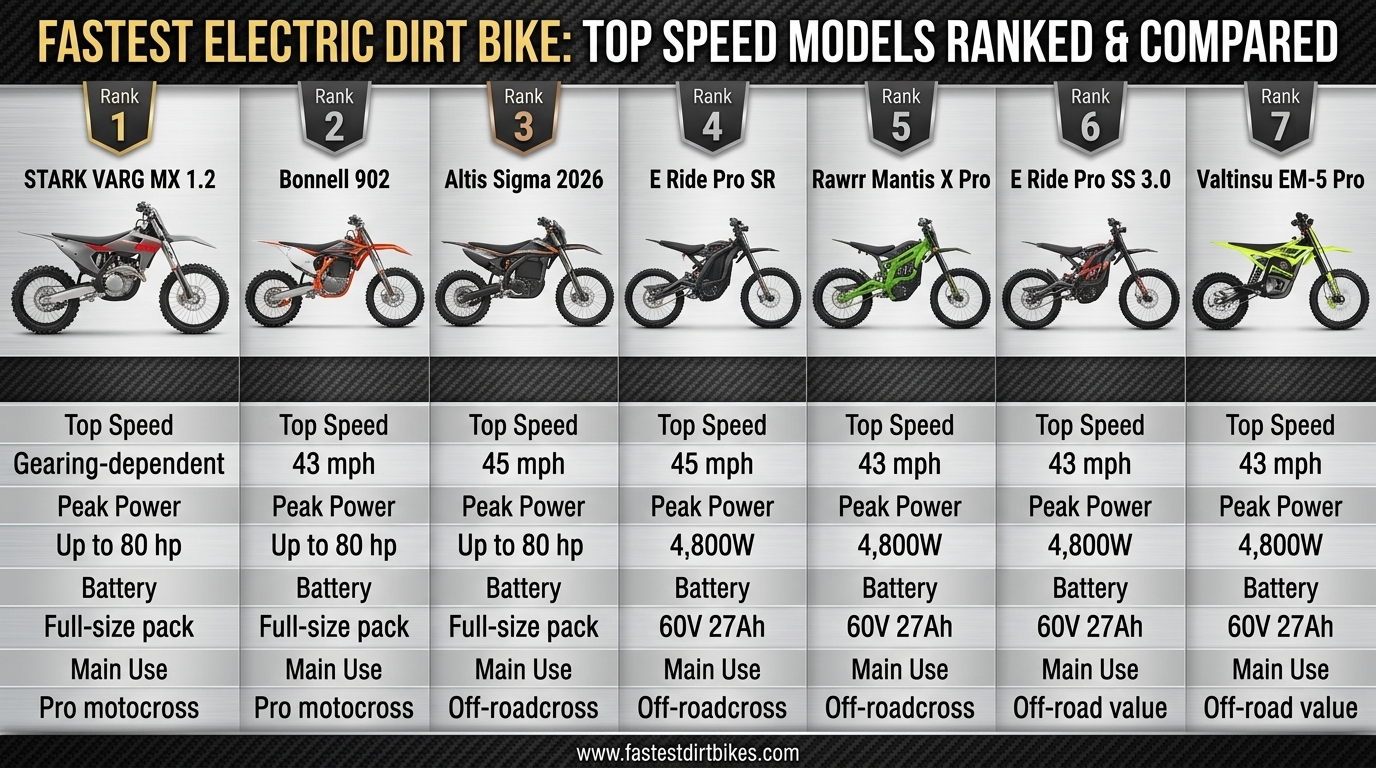
Electric Dirt Bike Top-Speed Comparison Table
Manufacturer figures where they exist. Pre-production and lightly sourced claims carry less weight than specs on a bike already in customers’ hands.
|
Rank
|
Model
|
Top Speed
|
Peak Power
|
Battery
|
Main Use
|
|
1
|
Stark Varg MX 1.2
|
Gearing-dependent
|
Up to 80 hp
|
Full-size pack
|
Pro motocross
|
|
2
|
Bonnell 902
|
90+ mph (claimed)
|
65 kW / 87 hp
|
Multiple packs
|
Race / enduro
|
|
3
|
Altis Sigma 2026
|
80+ mph (claimed)
|
25 kW
|
97.2V 35Ah
|
Fast e-moto
|
|
4
|
E Ride Pro SR
|
70 mph
|
25 kW
|
72V 50Ah
|
Track & trail
|
|
5
|
Rawrr Mantis X Pro
|
65+ mph
|
15 kW
|
72V class
|
Trail / play
|
|
6
|
E Ride Pro SS 3.0
|
62 mph
|
15.8 kW
|
72V 50Ah
|
All-around
|
|
7
|
Valtinsu EM-5 Pro
|
43 mph
|
4,800W
|
60V 27Ah
|
Off-road value
|
|
8
|
Talaria Sting R
|
~53 mph
|
8 kW
|
60V 45Ah
|
Trail platform
|
|
9
|
Sur-Ron Light Bee X
|
~50 mph
|
10 kW
|
72V (2026)
|
Mods / entry
|
Read it as a map, not a leaderboard. The Varg gears for acceleration and lap time, so a flat top-speed figure sells it short. The Bonnell and Altis numbers are claims on bikes still proving themselves. And the EM-5 Pro sits where price meets real trail speed, not where the biggest number lives.
What Actually Counts as the Fastest Electric Dirt Bike
Four numbers fight for the title. They rarely point at the same bike.
Manufacturer Top Speed vs Tested Speed
A listed top speed says what a bike was built to do. It is not a promise for every rider. Altis, E Ride Pro, Sur-Ron, Solar, all publish figures tied to a specific battery, wheel size, sprocket, and surface. Change the rear tire or the gearing and the dashboard reading drifts. A clean tested speed states whether it came from GPS or the bike’s own display. The best ones run both directions on the same ground to cancel out wind and slope.
Stock vs Modified
A stock bike runs the battery, motor, controller, gearing, and wheels the factory shipped. Pulling a closed-course limiter can still count as stock when the maker meant for the bike to be unlocked. Swapping the battery or controller does not. Most of those 70 mph Sur-Ron clips online are builds with a bigger pack and a stronger controller. Impressive riding. Just not a stock comparison.
Full-Size vs Lightweight
The Stark Varg and Bonnell 902 wear full-size motocross proportions: long-travel suspension, big wheels, strong brakes, a 450cc-style rider triangle. A Sur-Ron, E Ride Pro, or EM-5 Pro is smaller and easier to throw around on tight singletrack, but can feel nervous on a long high-speed straight. Speed without a chassis to match it is a liability.
Stark Varg MX 1.2
Nothing else here plays on the same terms. The Varg is full-size electric motocross, not a lightweight e-moto with a big battery bolted in later.

Stark gives one chassis adjustable output from 10 to 80 horsepower. Same bike, mild on slick clay, savage on dry open soil. The 80 hp Alpha makes a claimed 938 N.m at the rear wheel and spins to roughly 14,200 rpm. A single top-speed figure misses the point. Motocross gearing favors corner drive and acceleration over a paved straight, which is why real tests land anywhere from the low 50s to the mid 70s depending on setup.
Its closest gas comparison is a 450cc race bike. The price says so too, around $13,490 for the Alpha.
Pros
-
Adjustable 10-80 hp covers every track condition from one bike
-
Full-size chassis, brakes, and suspension developed as one unit
-
Outright acceleration that embarrasses many 450cc gas bikes
Cons
-
Price sits in race-bike territory, far above every other pick here
-
Top speed is gearing-dependent, not a fixed headline figure
-
Size and power overwhelm a beginner or a tight backyard loop
Altis Sigma and the High-Voltage Lightweights
80+ mph from a lightweight frame. That is the Altis Sigma’s pitch, and on paper it holds up.
The 2026 Sigma ships a 97.2V 35Ah pack and a 25 kW peak motor, with the 80 mph figure tied to its taller trail gearing. Altis lists the 2025 MX wheel setup at 63 mph. Same bike, different sprocket, 17 mph gone. No clearer reminder in this whole category that gearing has to sit next to any speed claim. The Sigma weighs about 198 pounds and runs a 35-inch seat, taller and heavier than an early Sur-Ron-style platform.

The E Ride Pro SR is the better-documented neighbor. A listed 70 mph, 25 kW peak from a 72V 50Ah Samsung pack, and a 1.8-second sprint to 30 mph. That early shove matters more on a short trail than the final number ever will.
Pros
-
Highest published lightweight speed in the class (Sigma)
-
72V and 98V architecture runs cooler under sustained load than 60V
-
E Ride Pro SR pairs a real 70 mph with clear dealer support
Cons
-
Tall seat heights demand a taller, more experienced rider
-
Top-end speed drains range fast; published miles are at 25 mph, not full throttle
-
Some figures (Ventus, Bonnell) lean on seller claims more than stable spec pages
Valtinsu EM-5 Pro
Different question entirely. Not what is the fastest, but what is fast enough for under $2,000. The EM-5 Pro answers that one.
It runs a 60V, 4,800W peak geared motor making 240 N.m, a 43 mph top speed across three modes, and a 60V 27Ah battery good for roughly 53 miles. Hydraulic disc brakes front and rear. IPX6 sealing. 18+ only. The geared motor is the part that earns its keep on dirt: torque arrives low in the rev range, where a slow technical climb needs it, instead of waiting for the motor to wind up.

It will not out-run a Stark Varg or an Altis Sigma. We are not going to pretend it does. What it does is cover real off-road ground, on a private trail or an OHV park, for less than half the price of a stock Sur-Ron. If you want to know why a torque figure beats a horsepower headline on a climb, the breakdown of what torque actually means on an electric dirt bike is worth a read.
Pros
-
Strong low-end torque from a geared motor, tuned for climbs
-
Under $2,000 with hydraulic brakes and IPX6 sealing
-
Three ride modes let a newer rider start slow and grow into it
Cons
-
43 mph top speed trails the high-voltage e-motos by a wide margin
-
Off-road only; not street legal and not a race-track machine
-
Adults only at 18+, so it is not a fit for younger teen riders
Sur-Ron Light Bee X and Talaria Sting R
Two legends. Both slower on paper than they feel.
The Light Bee X started this whole category. For 2026 it moved to a 72V system with around 10 kW peak and a top speed near 50 mph, though older 60V listings still float around at 46.6 mph. The stock number was never its edge. The aftermarket is: batteries, controllers, motors, brakes, suspension, wheels, the deepest parts shelf in the class. That same shelf is where most 70 mph Sur-Ron videos come from.

The Talaria Sting R runs an 8 kW peak motor and a 60V 45Ah battery for about 53 mph. Its geared primary drive gives it a direct feel riders like. Still a sensible mid-level trail bike, even as newer 72V machines pull ahead on raw speed.
Pros
-
Sur-Ron: unmatched aftermarket and dealer network
-
Talaria: geared drive and aluminum frame, a solid upgrade base
-
Both are easy to handle for newer riders at lower skill levels
Cons
-
Reaching 70 mph on a Sur-Ron means replacing its priciest parts
-
Stock speeds now trail the high-voltage e-motos
-
Total cost of a fast Sur-Ron build can exceed a faster factory bike
What Makes an Electric Dirt Bike Fast
Top speed comes from the whole system, not one big number on a product page. Voltage, current, motor rpm, gearing, wheel size, weight, terrain, all of it pulls on the result. Two 5,000W bikes can post very different speeds because their motors and drivetrains were built for different jobs.
Peak Power vs Continuous Power
Peak power is the short burst a motor can deliver. Continuous, or rated, power is what it holds without overheating. The E Ride Pro SR shows the gap: 10 kW rated, 25 kW peak. Treat the big number as a launch figure, not something the bike sustains all day.
Voltage and Battery Capacity
Higher voltage raises a motor’s potential speed and lowers the current needed for a given power level, which helps with heat. Capacity, in watt-hours, sets how far you go. A 97.2V Altis pack stores about 3.4 kWh. A 72V 50Ah E Ride pack stores 3.6 kWh. The lower-voltage pack holds slightly more energy, which is exactly why voltage alone never predicts range.
Gearing, Weight, and Terrain
A smaller rear sprocket raises top speed but softens the launch. A larger one flips it. Weight hurts acceleration and climbing more than steady top speed on flat ground. Soft sand, hills, low tire pressure, a heavy rider, any of these erases a chunk of any rated figure. A speed recorded on pavement should never be expected on a rough trail.
How Fast Is a 72V 5000W Dirt Bike?
Roughly 45 to 60 mph, with real room on either side. A high-rpm motor on tall gearing leans toward the top. A torque-focused motor with a big rear sprocket leans toward climbing.
At 5,000W on a 72V battery, a perfect system would pull about 69 amps. Real ones bleed energy to heat and voltage sag, so actual current runs higher, and the battery management system has to deliver it cleanly or it caps power before the motor hits its rating. For context: a 3,000W trail bike usually lands near 35 to 50 mph. A 5,000W class machine like the EM-5 Pro lists 43 mph because its tune favors dirt starts over a road-only speed run.
Same wattage, different speeds. It comes down to motor rpm, gearing, wheel diameter, weight, and software limits. Watts alone never settle it.
How We Ranked These Bikes
Speed rankings fall apart when every number is treated as equal. A manufacturer estimate, a GPS run, a dashboard reading, and a social clip can differ by several miles per hour. Here is how we weighted them.
Documentation Over Hype
We leaned on official specs tied to a clearly identified stock setup. Lightly sourced dealer or video claims got less weight. An announced prototype does not auto-outrank a fully developed, in-production model, no matter how big its headline.
Stock Setups Only for the Main List
Every figure here is a factory-delivered configuration with normal settings. Modified builds are a separate conversation. The upgrade level runs from a sprocket swap to a full powertrain replacement, and the two are not comparable.
Class-Matched Comparisons
Full-size motocross bikes against each other. Lightweight e-motos against each other. In our reviews across these classes, the bike that turns, stops, and puts power down well almost always beats the one with the bigger top number on a real trail. That is the lens we ranked through.
Riding a Fast Electric Dirt Bike Safely
A 50-to-90 mph electric dirt bike is a motorcycle. Treat it like one. The instant torque can surprise a rider before the bike has built enough speed to feel dangerous, which is its own kind of trap.

Wear a properly fitting motorcycle helmet with the DOT certification label. NHTSA notes that the DOT mark means the helmet meets Federal Motor Vehicle Safety Standard No. 218, and that novelty helmets without it will not protect you in a crash. Add goggles, gloves, over-the-ankle boots, and impact protection matched to your riding.
Start in the lowest useful power mode. Practice smooth starts, slow turns, standing balance, braking, before you touch the top setting. Check brakes, tire pressure, chain tension, and suspension before every session. And ride only where motorized off-road use is allowed: private land with permission, a legal OHV area, an approved closed course. A quiet motor grants no extra access. Beginners and younger riders fit a lower-output model like the EM-5 or the cruiser-geometry EM23 far better than a 70 mph e-moto.
Which Fast Electric Dirt Bike Should You Buy?
Start with where you ride, not the largest motor number. A full-size Varg is wasted on a backyard loop. A featherweight e-moto feels twitchy on a fast pro track.
Want the outright fastest stock figure? The announced Bonnell 902 and the Altis Sigma lead on paper, with the Sigma the clearer in-production buy. Want a documented 70 mph platform with dealer support? The E Ride Pro SR. Full-size motocross? The Stark Varg. And for strong off-road capability without race-bike money, the Valtinsu EM-5 Pro lists 43 mph, a 60V 27Ah battery, hydraulic brakes, and three modes for private-land and off-road use. Line all four Valtinsu models up by spec on the electric dirt bike collection page, or see how they place against bigger brands in our tested-and-ranked roundup for adults.

Top speed is the headline. Rider fit, battery range, brakes, and where you can legally ride are what decide whether you still enjoy the bike a year from now.
Conclusion
The fastest electric dirt bike depends on the class and the test method, not a single trophy number. The Stark Varg holds the full-size motocross benchmark. The Altis Sigma leads the lightweight class on published speed. The announced Bonnell 902 sits above both on paper, at least until production bikes get tested. Modified builds go higher still, but their numbers belong in a separate conversation from stock machines.
Chase the right number for how you ride. A documented 70 mph e-moto, a 450-rivaling race bike, a 43 mph trail machine, each wins for a different rider. For strong off-road performance without race-bike pricing, the Valtinsu EM-5 Pro lists 43 mph, a 60V 27Ah battery, hydraulic brakes, and three ride modes for private-land and off-road use. Match the bike to your terrain, your skill, and the rules where you ride. The speed sorts itself out.
FAQs
Is a Stark Varg faster than a 450?
In acceleration, usually. The Varg makes up to 80 horsepower and lays it down instantly, no gear changes, so it launches harder than many 450cc motocross bikes. Top speed and lap time are a different story. Rider skill, gearing, soil, and track layout all matter, and a well-set-up 450 can hold its own.
What are the top 5 fastest electric dirt bikes?
By published speed: Bonnell 902 (90+ mph claimed), Altis Sigma (80+ mph), Stark Varg (up to 80 hp, gearing-dependent), E Ride Pro SR (70 mph), and Solar E-Clipse 2.0 (up to 70 mph). Check the exact model year and stock setup. Gearing moves these numbers.
What electric dirt bikes go 50 mph?
Several clear it stock. The Sur-Ron Light Bee X (~50 mph in 2026 trim), Talaria Sting R (~53 mph), and E Ride Pro SS 3.0 (62 mph). The Valtinsu EM-5 Pro sits just under at 43 mph, tuned for dirt torque over a top-speed run. Real speed shifts with rider weight and terrain.
Can a Sur-Ron go 70 mph?
Not stock. The Light Bee X tops out around 46 to 50 mph from the factory. Reaching 70 mph takes a higher-voltage battery, a stronger controller, motor and gearing changes, and upgraded brakes. The full build cost often lands near the price of a faster factory e-moto.
How fast is a 72V 5000W dirt bike in mph?
Roughly 45 to 60 mph. The final figure rides on motor rpm, controller current, wheel size, gearing, combined weight, and terrain. Tall gearing and a high-rpm motor push it higher. A torque-focused setup with a big rear sprocket pulls it toward climbing instead.
Is a 3000W electric bike street legal?
Usually not as an e-bike. Most states cap motor-assisted bicycles near 750W with working pedals and a 20-to-28 mph limit. A 3,000W machine falls into motorcycle or off-highway-vehicle classification, which means different paperwork, licensing, and registration.
What dirt bike can go 120 mph?
None in this comparison, at least not stock with a verified figure. The confusion usually comes from mixing units. 120 km/h is about 74.6 mph, not 120 mph. Even heavily modified builds top out well below 120 mph in real testing.
Is the Stark Varg 80 hp road legal?
The Varg MX is a motocross model. Do not assume it is street legal. Stark sells separate VARG EX (enduro) and VARG SM (supermoto) versions built for road use in eligible markets. Adding lights to an MX does not convert it. Registration depends on your state and the exact version.
Sources
-
Stark Future, Stark Varg MX 1.2 specifications (2026)
-
Sur-Ron USA, Light Bee X and lineup specifications (2026)
-
E Ride Pro, E Ride Pro SR and SS 3.0 specifications (2026)
-
NHTSA, Choose the Right Motorcycle Helmet (U.S. Department of Transportation)
-
Federal Register, Federal Motor Vehicle Safety Standards No. 218: Motorcycle Helmets (2025)
-
altinsu, EM-5 Pro electric dirt bike and electric dirt bike collection (2026)


Looking for something else?

Electric Dirt Bike Loses Power Under Load: Causes and How to Fix It
LEARN MORE
Electric Dirt Bike Bolt Torque Checklist: What to Check and Where the Numbers Come From
LEARN MORE
How to Bleed Electric Dirt Bike Brakes Safely
LEARN MORE
Electric Dirt Bike Throttle Not Working: What to Check First
LEARN MORELooking for something else?

Electric Bike Battery Not Charging? Work Through This Before You Buy a New One
LEARN MORE
Electric Dirt Bike Error Codes: What They Mean and What to Check First
LEARN MORE
Electric Dirt Bike Brake Rotor Rubbing: Diagnose the Cause Before Adjusting
LEARN MOREYou may also like
VALTINSU EM-5 Off-Road Electric Dirt Bike
$1,405.00
$2,260.00
VALTINSU EM-5 Pro Off-Road Black Electric Dirt Bike
$2,463.00
$2,753.00
VALTINSU EM-5 Pro Green Electric Dirt Bike
$2,463.00
$2,753.00
VALTINSU EM-5 Ultra Electric Dirt Bike
$3,188.00
$3,622.00
Further reading

Electric Dirt Bike Trailside Power Loss: Recovery Plan When the Battery Is Dead
When an electric dirt bike loses power on the trail, first make the scene safe and decide whether the battery is simply depleted or the bike has a fault. Move out of the travel line if the bike can...

Electric Dirt Bike Fall Riding on Wet Leaves: Grip, Hidden Obstacles and Braking
Wet leaves reduce grip and hide the surface that determines it. A thin layer on firm soil may slide under braking; a deep layer can conceal roots, rocks, ruts and holes; decomposing leaves can beha...

How to Lift a Fallen Electric Dirt Bike Without Hurting Yourself or the Bike
Do not lift a fallen electric dirt bike until people, terrain and battery hazards are assessed. A bike on a slope, near traffic, pinning a rider or showing battery heat, smoke, hissing, odor, swell...

How to Choose an Electric Dirt Bike Repair Shop: Questions to Ask Before Service
Choose an electric dirt bike repair shop by matching the shop’s real capability to the actual job. Ask about experience with the model and component, access to manuals and parts, battery isolation ...