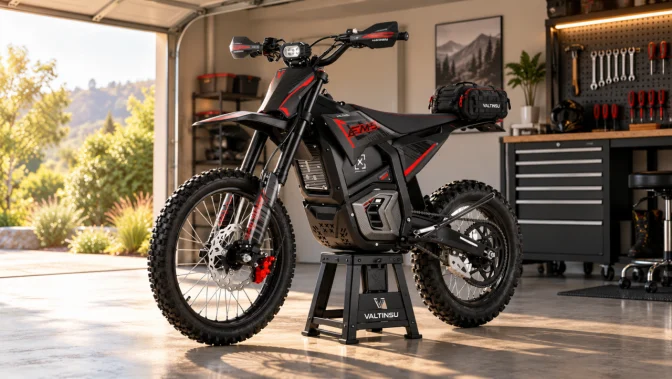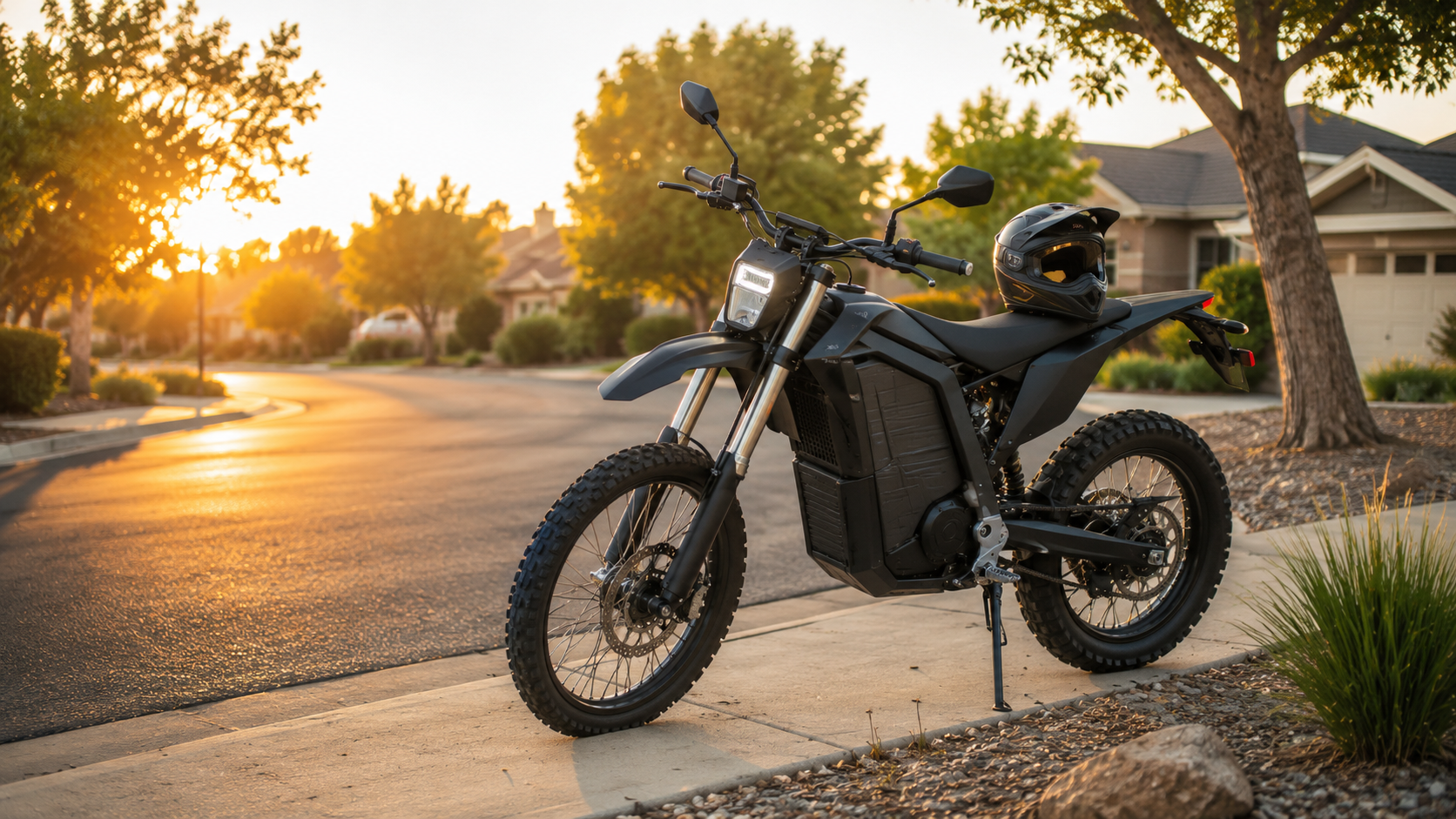
Can You Ride an Electric Dirt Bike in a Neighborhood?
Usually not. Not on public neighborhood streets, anyway, unless the bike is built and registered for the road. A quiet motor changes nothing here. In most places an adult electric off-road motorcycle gets treated like a dirt bike or a motorcycle, not a bicycle. Streets, sidewalks, bike lanes. Usually off limits.
The real answer leans on three things. The road. The bike. The local law. A gated community with private roads runs by different rules than a city street, and a 250-watt pedal e-bike runs by different rules than a 5,600-watt eMoto. We break down where you can and cannot ride below, what makes a bike street legal, how noise and HOA rules bite, and the legal spots that beat your street every time.
The Short Answer, By Location
Same bike, different rules. It depends entirely on where the wheels are. Quick version first, detail after.
|
Where |
Can you ride? |
Why |
|
Public neighborhood street |
Usually no |
Public road. Needs registration, plate, lights, insurance, a licensed rider. |
|
Sidewalk |
No |
Built for pedestrians. Most local codes ban motor vehicles. |
|
Bike lane |
Usually no |
Off-road bikes fall outside legal e-bike rules in most states. |
|
Private road (HOA / gated) |
Maybe |
The HOA board decides. Read the handbook first. |
|
Your own property |
Usually yes |
Local noise rules can still apply. |
|
OHV park / motocross track |
Yes |
Built for it. May need OHV registration or a day pass. |
One blunt rule of thumb. If a gas dirt bike would catch a ticket on your street, a similar electric one usually will too. Quiet does not buy you a license plate.
Why an Electric Dirt Bike Is Not the Same as an E-Bike
Both run on a battery. That is where it ends. Legal e-bikes are built to act like bicycles, while electric dirt bikes are built for trails, jumps, dirt, and real speed. The law looks at how the machine is built. Not how you charge it.

Pedals, power, and speed
Pedals matter. Many legal e-bikes need fully operable ones, and most electric dirt bikes skip them for foot pegs, which makes them look and behave like motorcycles.
Power matters more. The federal low-speed e-bike definition covers operable pedals, a motor under 750 watts, and a motor-only top speed under 20 mph. Now picture a 3,000-watt or 5,600-watt dirt bike. Miles past that line. So it stops being a bicycle in the eyes of the law and becomes a motor vehicle.
Class 1, Class 2, and Class 3
Three buckets, in most states. Class 1, pedal-assist, cuts out near 20 mph. Class 2 adds a throttle, also around 20. Class 3 runs assist to 28. None of that was written for a powerful off-road machine, which is why PeopleForBikes keeps a running tracker of how each state handles them.
E-bike vs electric dirt bike, side by side
Lined up, the gap is obvious.
|
Feature |
Legal e-bike |
Electric dirt bike |
|
Pedals |
Required, fully operable |
Usually none (foot pegs) |
|
Motor power |
Under 750W |
3,000W to 7,000W+ |
|
Top speed |
20–28 mph (by class) |
40–56 mph and up |
|
Where it rides |
Streets, bike lanes, many paths |
Trails, tracks, private land |
|
Treated as |
Bicycle |
Motor vehicle / OHV |
What Riders Actually Report About Electric Dirt Bikes in Neighborhoods
The law is one thing. What happens on a real street is another, and rider forums and YouTube are full of it. The short version from the community: ride quietly and slowly and you might go unnoticed for a while, push it and you risk a ticket or losing the bike. Two patterns come up again and again.
Police are cracking down, and it is documented
This is not a rumor. In Southern California, Newport Beach police cited a Sur-Ron rider, and Manhattan Beach police confiscated one at a stop. Departments in San Diego have warned publicly that Sur-Ron and Talaria bikes are being cited and towed. Manhattan Beach PD even told parents directly to make sure holiday gifts are used legally, noting officers keep finding these bikes ridden by juveniles on streets and bike paths where they do not belong.
A common thread in that reporting: riders, often teens, simply did not know the bike failed the legal test. They assumed a battery meant a bicycle. The stop, the fine, or the impound was the moment they found out otherwise.
Riders admit the workarounds, and the risk
Browse the comment sections and the honesty is striking. One rider in Michigan described fitting pedals to a Sur-Ron and pedaling whenever a cop comes into view. Riders in New Hampshire talk about adding lights and registering the bike as an on-road trail bike to ride legally. Others in California’s Orange County report the opposite outcome, cited and impounded, treated strictly as an off-road vehicle. Same bike. Different state. Different ending.
The modding angle matters too. Many of these bikes ship speed-limited for various state laws, sometimes to 20 mph, and a chunk of owners immediately remove the limiter or fit a third-party controller to go faster. That single choice can push a borderline-legal setup firmly into motor-vehicle territory.
Expert View: Legal Status of Electric Dirt Bikes in Neighborhoods
We build and ride these machines, so here is the honest read. Off-road models like ours are not street legal, full stop, and we say so on every product page. The riders who stay out of trouble treat the bike as off-road gear: trailer it to private land, an OHV park, or a track, and ride there. The ones who get burned treat a 5,600W eMoto like a neighborhood cruiser. A YouTuber put the question straight to a California Highway Patrol officer on camera, and the answer matched the law: these bikes are not Class 1, 2, or 3 e-bikes, they have no pedals, and the motors run two to three times the legal wattage, so public streets are out. That is the same answer we give every customer who asks.
How Fast Is 3000W in MPH, and Why It Matters Here
About 35 to 50 mph. The exact figure moves with the bike. Rider weight, gearing, voltage, controller limits, tire size, terrain, even a headwind all push it around, so wattage alone never lands on one clean number. For neighborhood riding the takeaway is simpler. 3,000 watts sits far above the 750-watt e-bike ceiling, so a bike at that power is almost never treated as a normal street e-bike.
Real bikes show the spread. An entry trail machine like the Valtinsu EM-5 tops out near 40 mph from a 3,840W geared motor. Step up to the EM-5 Pro and you get 52 mph on a 5,600W motor. Either one out-accelerates what a quiet street suggests. That instant torque is a thrill on a climb, and the same trait is what puts riders in trouble near driveways and parked cars.
What Makes an Electric Dirt Bike Street Legal?
A headlight bolted on does not cut it. The bike has to be accepted as a road vehicle, and the rider has to clear local license rules. And do not trust the words "street legal" on a product page. Legal in one state, illegal in the next. It happens.

|
Requirement |
What it means |
|
VIN, title, registration |
A road-ready VIN the DMV will accept, tied to a title and current registration. Many off-road bikes lack this. |
|
License plate |
Proof the bike is registered for the road. No plate usually means no street use. |
|
Insurance |
Often required before registration; a policy may not cover illegal road use. |
|
Lights and signals |
Headlight, taillight, brake light, and in many states turn signals. |
|
Mirrors, horn, DOT tires |
Road-rated parts. Knobby dirt tires grip differently on pavement. |
|
Motorcycle license |
A regular driver license may not be enough; an M endorsement is common. |
NHTSA puts it plainly: licensing rules vary by state, but every state requires a motorcycle license or endorsement before riding a motorcycle on public highways. Classified as a motorcycle? Then that rule is yours.
Neighborhood Noise and HOA Problems
Quieter than gas. Not silent. Tires hum on pavement, chains and brakes make noise, and hard starts carry across a few yards easily. In a tight neighborhood, repeated laps turn into complaints fast. Noise is about pattern as much as volume.
Repeated riding draws complaints
One quiet pass slips by. Ten laps around the same block do not. Neighbors start worrying about speed, kids, pets, and parked cars even when the bike is quiet, and a single complaint can bring HOA action or a police visit. If the bike is not street legal, that small problem grows teeth.
HOA rules can be stricter than city rules
Private roads, sure. But a gated community can still ban dirt bikes, eMotos, and mini bikes outright, and many also cap storage, parking, speed, and riding hours. Read the handbook before you ride. If the wording is fuzzy, ask the board for it in writing. A written reply settles the argument later.
Skip the dawn and late-night rides near homes. Sound travels further on a quiet street, and that is when patience runs thinnest.
Safety Risks in a Residential Area
Looks safe. Hides hazards. Cars back out of driveways, children cross without looking, and delivery trucks, blind corners, and parked cars appear with no warning. An electric dirt bike accelerates harder than most beginners expect, which shortens every reaction window.
- Children and pets do not move like traffic. Slow down at every driveway and assume someone steps out.
- Parked cars hide people and pinch the road. A small bike is harder to spot than a car.
- Speed is the main risk. A pace that feels fine on dirt is too fast for a short street.
- Gear, every time: a DOT-certified helmet, gloves, boots, eye protection. That is the floor.
NHTSA urges riders to wear a helmet and proper gear, and helmet laws shift by state and age. Check yours before any public-road use.

Where You Can Ride an Electric Dirt Bike Legally
Rarely your street. These machines were built for private land, OHV trails, off-road parks, and tracks, where there is room to ride and far less to hit.
Private property, with permission
Your own land is usually easiest. You set the route, the speed, the hours. A big rural lot beats a small suburban yard, and local nuisance rules can still apply, so leave space between the bike and the nearest house. Riding on someone else’s land? Get clear permission first. Respect the fences, the crops, the animals.
OHV trails and off-road parks
Built for motorized riding, with trail maps, staging areas, and posted rules. Some want OHV registration, a permit, or a day pass. California DMV, for one, classifies off-highway electric motorcycles (eMotos) as off-highway motorcycles subject to OHV registration before you ride approved areas. Other states run their own systems, so check before loading up. Conditions also swing with the season, and our guide on riding in snow and cold weather covers what changes once the trail turns cold.
Motocross tracks and open terrain
Tracks exist for this. Practice turns, braking, and throttle control with riders sorted by skill. Call ahead about electric bikes, helmets, age limits, and waivers. For wide-open ground specifically, a big-wheel, high-torque bike like the EM23 was built for exactly that, not tight neighborhood streets.
What Happens If You Ride Illegally?
More than a warning, often. Tickets, fines, towing, impound fees, court costs, and parents pulled in when a minor is riding. How it shakes out depends on local law and the officer who stops you. The bike gets treated as an unregistered motor vehicle more often than not.

|
Outcome |
What it can involve |
|
Warning, then citation |
A first stop may be a warning. Keep going and tickets follow: no plate, no registration, no insurance, no license. |
|
Fines and court costs |
Fines, plus towing and storage fees, can outrun the original ticket. |
|
Impoundment |
A bike used illegally on public roads can be towed like any motor vehicle. Getting it back costs time and money. |
|
Insurance and license trouble |
A crash on an illegal ride may not be covered, and motor-vehicle citations can hit your license. |
Minors carry extra risk. A powerful bike near homes, sidewalks, and parked cars is a lot to manage. Private land with adult supervision is the safer route, with speed limits and full gear every single time.
How to Check Local Laws Before You Ride
Check first. Not after the stop. Start with the bike type, then the exact place you want to ride. Skip the social-media comments and the seller claims. Use official city, county, DMV, police, and land-agency sources instead.
- Read your city and county code. Search off-road vehicle, motorized vehicle, mini bike, eMoto, sidewalk, public park.
- Call local police or the DMV. Have the specifics ready: wattage, top speed, VIN, pedals or pegs, equipment list. Ask about streets, sidewalks, and private roads separately.
- HOA or gated-community rules next. Look under motor vehicles, nuisance noise, common areas, then ask for a written answer.
- Confirm trail and park access on the land-agency site. Access shifts with season, fire risk, and vehicle type.
- Check the bike label, VIN, and manual. Many off-road models state plainly they are not for public-road use, and the User Manual is the fastest place to confirm wattage and intended use.
The Bottom Line: Can You Ride an Electric Dirt Bike in a Neighborhood?
Can you ride an electric dirt bike in a neighborhood? Mostly no. Not on public streets, sidewalks, or bike lanes unless the bike is built and registered for the road. A quiet motor does not change the legal class of an off-road machine.
Three checks before you ride: the bike’s label and VIN, your local road rules, and the rules for the exact spot you have in mind. Private property with permission, approved OHV trails, and motocross tracks beat neighborhood streets every time. Still picking a bike? Compare the full range by speed, range, and age rating, and match the machine to where you will actually ride.
FAQs
Can I ride my electric dirt bike around my neighborhood?
Usually no. Not on public streets, not unless the bike is street legal. An off-road model with no registration, plate, insurance, or road equipment belongs off public roads.
- A neighborhood street is still a public road when the city or county controls it.
- Most electric dirt bikes are too powerful to count as e-bikes, and many lack pedals, DOT tires, and a road VIN.
- Safer bets: private property with permission, OHV trails, or a track. Call local police with your model, wattage, and VIN first.
Is it illegal to ride a dirt bike around town?
It can be. Depends on whether the bike is street legal, and that catches many gas and electric dirt bikes built for trails, tracks, and private land.
- Title, registration, plate, insurance, lights, mirrors, DOT tires, a licensed rider. Town roads usually want all of it.
- Without those, the bike may be treated as an unregistered motor vehicle.
- Sidewalks, parks, and public paths are often off limits too. Search your city code before riding.
How do you tell if an e-bike is illegal?
Start with the label on the frame. Many legal e-bikes print the class, the wattage, and the top assisted speed right there. Go past the limit for a road, lane, or trail and the bike may not belong there.
- Federal low-speed rule: operable pedals, motor under 750 watts, motor-only speed under 20 mph.
- Foot pegs and motorcycle-style parts are a sign it is not a legal e-bike.
- Compare your label against your state’s Class 1, 2, and 3 rules.
Can a 12 year old ride a Sur-Ron?
Not on public neighborhood streets. A Sur-Ron and bikes like it get treated as eMotos or off-road motorcycles, not children’s bicycles. The power is the reason.
- On private property it depends on local law, supervision, the model, and the child’s skill.
- Quick acceleration and high speeds are not safe around homes, pets, or parked cars.
- Match age to bike: the Valtinsu EM-5 is rated 13+, while the EM-5 Pro is 18+, adults only.
How fast is 3000W in mph?
About 35 to 50 mph, depending on the bike. Rider weight, gearing, voltage, controller settings, tire size, and terrain all move the final speed.
- Wattage alone does not give one exact figure.
- 3,000 watts is far above the 750-watt e-bike limit, so the bike is usually not a neighborhood e-bike.
- Check the maker’s listed top speed and ask local police how that power level is classified.
Can I keep a dirt bike in my house?
Often yes. Check the building, HOA, apartment, and battery-safety rules first. Storing a bike is one thing. Riding it indoors or on public roads is another.
- Cool, dry place. Away from heat, water, and blocked exits.
- Use the charger supplied or approved by the maker, and never charge near flammable items.
- Apartment and HOA rules may limit large batteries or motorized vehicles indoors.
Is a 125cc dirt bike street legal?
Not automatically. Many 125cc dirt bikes are built for off-road use and lack the parts and paperwork for public roads.
- Street use usually needs a title, registration, plate, road lights, mirrors, horn, DOT tires, and a legal VIN.
- Some 125cc bikes ship as road-legal dual-sport models; others are trail-only.
- Engine size does not decide it. Build, title status, and state law matter more.
What kind of insurance do you need for a dirt bike?
For the road, usually motorcycle insurance. Liability is commonly required before you can even register a street-legal bike. Off-road-only bikes may take a different policy.
- Off-road vehicle insurance or powersports coverage handles theft and damage.
- A standard policy may exclude illegal road use or unlicensed riders.
- Tell the agent the model, VIN, power type, rider age, and where the bike will be used.
Sources
- U.S. Consumer Product Safety Commission, Electric and Non-Powered Bicycle Standards Summary Report (2024).
- National Highway Traffic Safety Administration, Motorcycle Safety (2026).
- California Department of Motor Vehicles, Register an Off-Highway Vehicle (OHV) (2026).
- PeopleForBikes, Electric Bike State Laws (2026).
- Electrek, Cops continue crackdown on Sur-Ron style electric bikes (2025).
- Tyler Townsend (YouTube), Surron & Talaria, are they legal? I ask the CHP (2023).
- Pennsylvania Department of Transportation, Mopeds, Motor-Driven Cycles and Motorcycles Fact Sheet (2026).


Looking for something else?

Electric Dirt Bike Replacement Parts Availability: What Buyers Should Verify Before Ordering
LEARN MORE
How to Check an Electric Dirt Bike for Safety Recalls by Model and Serial Number
LEARN MORE
How to Choose an Electric Dirt Bike Repair Shop: Questions to Ask Before Service
LEARN MORE
How to Lift a Fallen Electric Dirt Bike Without Hurting Yourself or the Bike
LEARN MORELooking for something else?

Electric Dirt Bike Fall Riding on Wet Leaves: Grip, Hidden Obstacles and Braking
LEARN MORE
Electric Dirt Bike Trailside Power Loss: Recovery Plan When the Battery Is Dead
LEARN MORE