

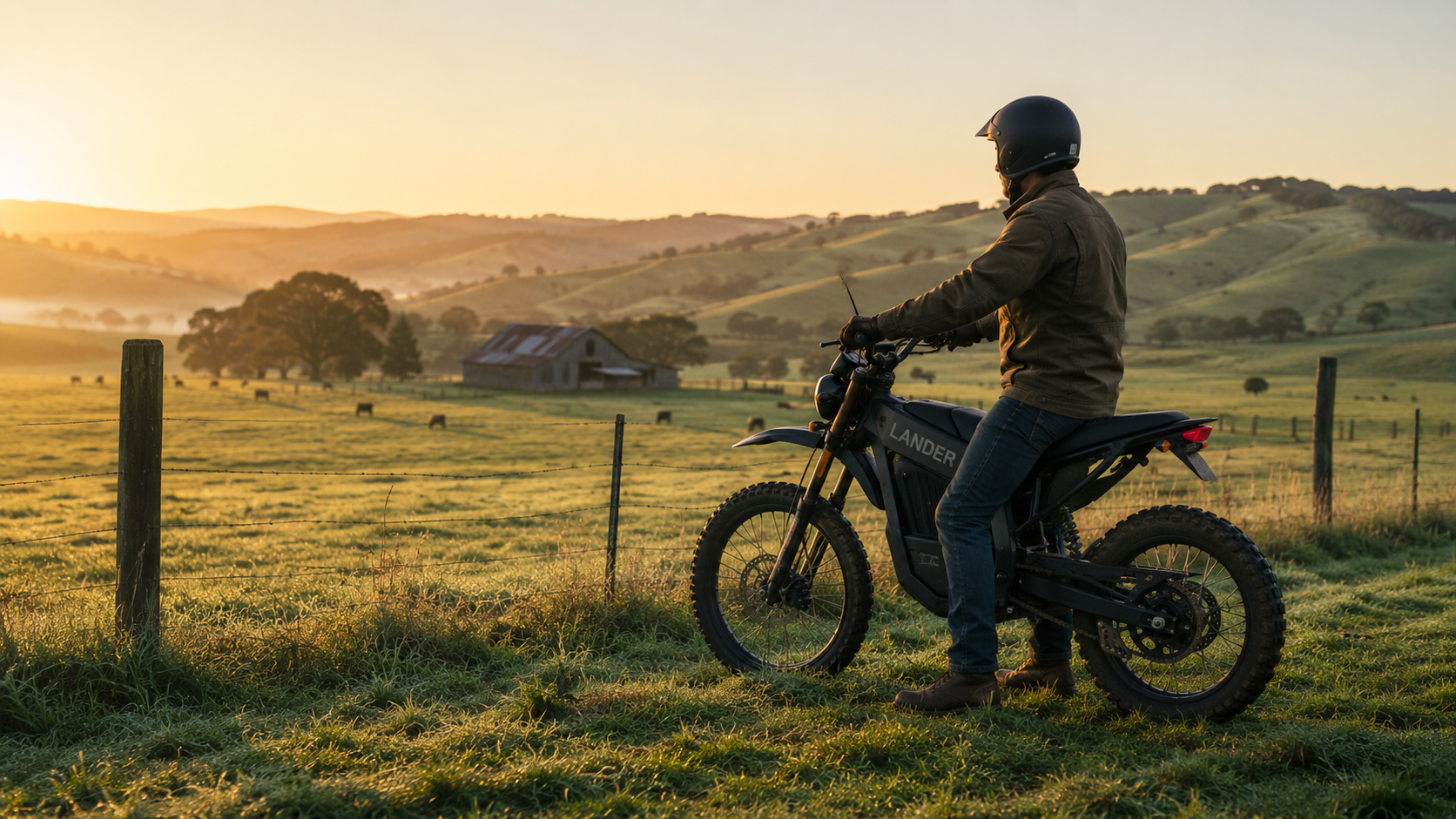
Electric Dirt Bike for Farm Use: Practical Fencing, Livestock & Land Management Guide
An electric dirt bike for farm use earns its keep on the short, repeat jobs: fence checks, water checks, livestock rounds, and the daily hops between barn, gate, field, and shed. Not the heavy hauling. That still belongs to a tractor, a side-by-side, or an ATV. What a light, quiet machine buys you is speed and access, an adult electric off-road motorcycle you can hop on, ride to the problem, and ride back without starting anything loud.
It will not tow a loaded trailer up a wet grade. It was never meant to. Think of it as a fast farm runabout that saves steps across the same routes every day, a person and a small tool kit, moved quickly and without the fuel stop.
Below: where these bikes fit, the jobs they handle, the specs that actually matter on a farm, and how a few real models stack up, our own among honest competitor picks.
electric dirt bike for farm use
Different farms, different needs. A flat vegetable plot with short paths asks for almost nothing. A hilly ranch with mud and long fence lines asks for range, torque, and brakes. Here is the short version before the detail.
- Best around livestock: Valtinsu EM-5. Lower seat, smooth 40 mph delivery, quiet. Easy to control at the 5 to 20 mph where chores actually happen.
- Best all-round farm value: Valtinsu EM-5 Pro. 52 mph and a 59-mile range cover big acreage and long fence runs in one charge.
- Open-ground and rough tracks: Valtinsu EM23. Big 19-inch front wheel, highest torque in the lineup, planted on washboard and ruts.
- Lightest way in: Heybike Villain, a compact mini eMoto around $1,299. Capable for the money, with the size limits of a pit bike.
- Race-class option: Sur-Ron Light Bee X. Benchmark trail bike, deep aftermarket, but more than twice the price of a value model.
Farm-Use Comparison at a Glance
Specs first, then the reading. Every figure for the Valtinsu models below was checked against the live spec sheet. Competitor numbers move with the season, so spot-check before you buy.
|
Model |
Peak power |
Torque |
Top speed |
Range |
Best farm use |
|
Valtinsu EM-5 |
3,840W |
148 lb-ft |
40 mph |
50 mi |
Livestock, beginners, 13+ |
|
Valtinsu EM-5 Pro |
5,600W |
177 lb-ft |
52 mph |
59 mi |
Big acreage, long fence lines, 18+ |
|
Valtinsu EM23 |
4,000W |
184 lb-ft |
43.5 mph |
Confirm on page |
Open ground, rough tracks, 16+ |
|
Heybike Villain |
4,160W |
n/a |
45 mph |
n/a |
Smallest budget, mini frame |
|
Sur-Ron Light Bee X |
~10kW |
n/a |
~47 mph |
~40 mi |
Race-class trail, premium |

What Actually Counts on a Farm an electric dirt bike (It Is Not Top Speed)
Top speed sells bikes. It does not do chores. A farm rider spends the day starting, stopping, turning, and crawling over uneven ground, not riding wide open. So the number on the spec sheet that matters least is the one most people read first.
Torque for hills and loaded starts
Torque is the pulling force that gets you moving from a dead stop, up a slope, and rolling again after you stop at a gate. On a farm that matters more than peak horsepower. A bike with strong low-end pull crawls up a grade, moves across soft ground, and restarts under a light load without drama.
Watch the delivery, not just the watt number. A geared motor multiplies torque low in the rev range, which is why the EM-5 Pro lays its 177 lb-ft down where a slow climb needs it. Smooth beats jerky every time near animals and tools. A bike that lunges forward is harder to trust.
Battery range on a single charge
Range on a single charge should match your real route, not the best-case number on a product page. Hills, mud, cold, rider weight, and cargo all pull it down. Stop-and-go farm movement chews through a battery faster than a steady cruise.
Buy more range than your daily loop needs. If your normal run is 10 miles, do not pick a bike that barely manages 10 in perfect conditions. The Valtinsu off-road models land at 50 to 59 miles per charge, enough headroom for most working days with margin to spare.
Tires, wheels, and ground contact
Tires decide traction, comfort, and control. Wider tires float better over loose dirt, grass, and sand, though they add drag and can drain the battery sooner. Bigger wheels roll over ruts and rough tracks; smaller wheels feel nimble at low speed in tight spaces.
- Rough pasture and tractor ruts: larger wheels, grip over style.
- Tight gates and pens: smaller wheels turn around in less room.
- Wet grass and mud: tread pattern and steady throttle matter more than width alone.
Brakes, suspension, and low-speed control
Good brakes are not optional. Farm riding throws hills, wet grass, gates, and animals at you, and quick stops are routine. Hydraulic disc brakes hold up to heat better on long descents than mechanical ones. Suspension soaks up ruts and roots and cuts the fatigue that builds when you use the bike five times a day.
Low-speed control ties it together. Smooth throttle, steady brakes, stable tires. That is the bike you actually reach for at 6 a.m., not the one that looks fastest on paper.

The Models, Read for Farm Work
A spec table tells you what a bike is. It does not tell you how it behaves on your land. Here is how the picks above actually fit the daily job, our bikes woven in with the competitors worth knowing.
Valtinsu EM-5 - the quiet one for livestock
Calm is its whole case. The EM-5 with light runs a 48V 3,840W geared mid-drive motor to 40 mph in three modes, 22, 32, and 40, so a rider can start gentle and stay gentle near animals. A 28.3-inch seat makes it easy to plant a foot at a gate. Rated 13+, it is the one model in our range a younger family member can grow into, which suits a farm where chores get shared.
Around cattle, horses, sheep, or goats, the quiet matters as much as the speed. You can move through a pasture, past a water trough, or near a calving area without setting off a rush. Early-morning fence checks happen without waking the whole property.
|
Pros |
Cons |
|
Smooth, controllable power at chore speeds |
Lower top speed than the Pro for big acreage |
|
Low seat, easy to handle and park |
48V system has less headroom under heavy load |
|
Quiet around livestock and neighbors |
Smaller wheels less planted on rough ruts |
Valtinsu EM-5 Pro - the all-round farm value
This is the bike most adult riders should buy for a working property. The EM-5 Pro hits 52 mph from a 60V 5,600W geared motor and carries a 59-mile range, so long fence lines, far pastures, and remote water points fit inside one charge. It matches a Talaria Sting on top speed for under half the price. For most farms, that headroom is the difference between finishing the loop and stopping to charge.
Adults only, rated 18+. The torque, 177 lb-ft delivered low in the rev range, is what you feel starting a climb with a loaded rear rack, not the top number. Comes in our signature Volt Green or stealth black.
|
Pros |
Cons |
|
59-mile range covers large acreage in one charge |
18+ only, not for younger riders |
|
52 mph and strong low-end torque for grades |
Taller 31.5-inch seat than the EM-5 |
|
287 lb max load handles rider plus a packed rack |
More bike than a small flat plot needs |

Valtinsu EM23 - open ground and rough tracks
Big wheels, hidden muscle. The EM23 carries a 19-inch front and 17-inch rear, the most stable stance in the lineup over washboard and old tractor ruts, plus the highest torque of any model at 184 lb-ft and a 4-second sprint. Top speed sits at 43.5 mph. Rated 16+, it reads like a cruiser but pulls harder than it looks.
The trade-off is its IPX4 rating, lighter water resistance than the IPX6 off-road models, so it leans toward dry tracks and packed ground rather than deep wet crossings. Range is not published on the current spec sheet; confirm it on the product page for your route.
|
Pros |
Cons |
|
Big 19-inch front wheel rolls over ruts and rocks |
IPX4 water rating, less suited to wet crossings |
|
Highest torque in the range for loaded starts |
Range not listed on the spec sheet |
|
Planted, stable feel on open ground |
30 climb angle lower than the Pro |
Heybike Villain and Sur-Ron Light Bee X - the bookends
Two competitors frame the range. The Heybike Villain is the cheapest real way in at around $1,299, a 4,160W mid-drive that hits 45 mph. Genuinely capable, but it is a compact mini eMoto on 12 and 14-inch wheels, closer to a pit bike than a full-size machine. Fun, with the size limits the price implies.
At the other end, the Sur-Ron Light Bee X is the benchmark lightweight race bike, a roughly 10kW motor on a featherweight frame, around $3,999. You pay for race pedigree, the deepest aftermarket parts ecosystem, and strong resale. Real advantages for a competitive rider, harder to justify for fence checks and water rounds.
Farm Jobs an Electric Dirt Bike Handles Well
These bikes fit the daily work that needs movement more than muscle. Repeat trips, quick checks, light tool carrying. They earn their place by saving steps, time, and fuel on the same routes every day.

Fence line checks and small repair runs
Fencing starts with finding the problem. Ride the line, spot broken wire, check posts, inspect gates, flag what needs work. For small fixes, carry pliers, clips, staples, gloves, a short roll of wire, and a marker. A rear rack or tool bag makes it easy. For bigger repairs, the bike scouts the damage first, so you know what to load before bringing the truck.
Livestock checks and pasture movement
Quiet, steady movement is the goal, not chasing animals. Check water, count head, inspect shade, look for injury or a stray separated from the group. Move calmly, stop often. Low-speed control matters here, which is why a smooth-throttle bike like the EM-5 beats a high-speed machine around a herd.
Irrigation, crop scouting, and land inspection
Irrigation checks send you over the same ground many times a week, inspecting pumps, lines, valves, leaks, wet spots, and dry rows. Crop scouting fits the same pattern, moving between rows and stopping at problem areas. For land inspection, the bike covers trails, pasture paths, and field roads while still giving a close look at the ground.
Moving light tools, feed, and supplies
With the right rack setup, the bike carries hand tools, gloves, water, fence kits, a small sprayer, first-aid items, a small feed bag. Weight changes how it rides. A bike that feels planted solo can feel different once the rear rack is loaded, so keep heavy items low and tight. Bulky or awkward loads belong on a trailer or ATV instead.
Cargo, Racks, and Tool Carrying
Cargo decides how useful the bike is beyond moving a person. Keep tools secure, balanced, and easy to reach. Loose tools or a high load shift weight and make the bike harder to control. Solid mounting points matter because farm vibration loosens weak hardware faster than smooth road riding, so check the racks and accessories rated for your bike before loading.
- Rear rack: tool bags, small feed, fence kits, rain gear, water.
- Tie-down points keep cargo from bouncing off; cover sharp tools so wire and pliers cannot cut a rider or animal.
- A small trailer extends light loads, within the bike limits. Heavy, wide, or unstable means switch to an ATV.
- Balance every load low and centered. Test it slowly near the barn before riding out to the fence line.

Electric Dirt Bike vs ATV vs Utility E-Bike
Each vehicle has a place. An electric dirt bike is best for quick access and light work, fence checks, water checks, scouting, livestock observation, light tool runs, and anywhere noise is a problem. It fits narrow trails, small gates, and short daily routes.
A utility e-bike can be enough on smoother farms with shorter routes. Fat-tire models carry racks and trailers and add pedal assist as a backup if the battery runs low, though they are slower and less rugged than a high-power electric dirt bike. An ATV still wins for heavy loads, bigger trailers, rough towing, and jobs that need a larger, more stable platform. A farm electric dirt bike should not be asked to do every job; it works best beside the bigger machines, not instead of them.
|
Vehicle |
Best at |
Noise |
Watch-out |
|
Electric dirt bike |
Fast access, light tool runs, livestock |
Quiet |
Limited cargo and towing |
|
Utility e-bike |
Smooth farms, short routes, pedal backup |
Quiet |
Less rugged on rough terrain |
|
ATV / side-by-side |
Heavy loads, towing, big platforms |
Loud |
Wide, heavy, more fuel and upkeep |
How to Choose the Right Farm Setup
Start with the job list, not the spec sheet. Write down where you ride, how far you go, what you carry, and what ground slows you down. Then match the bike to the work. A good farm bike feels steady, useful, and easy to manage every day.
Small farms and flat plots
Simple and stable wins. A moderate-power bike with good tires, strong brakes, and a rear rack is often enough. Range need not be extreme if trips are short; easy charging and steady low-speed control matter more. Pick something every worker can handle, because a machine that is too tall, too heavy, or too quick sits unused in the shed.
Livestock-heavy properties
Quiet riding, smooth throttle, safe stopping. The bike should move slowly without jerking forward, and a lower seat helps when you stop near animals or swing a gate. Stable tires earn their keep on grass and uneven pasture. A setup built only for speed is the wrong tool here; control is worth more than a high top number.
Rough land and big acreage
More grip, stronger suspension, better ground clearance. Hills, roots, rocks, and ruts punish a light-duty bike, so look for a solid frame, quality brakes, and torque for slow climbs. Build in extra range, because rough ground drains power faster. If your loop is long, compare battery and range across the lineup before you commit.
A beginner-friendly pre-ride check
Easy to mount, easy to stop, easy to control at low speed. Adjustable ride modes help a new rider build confidence. Before daily use, run a quick check:
- Tire pressure and any tire damage
- Brake feel and pad wear
- Chain tension and a clean drivetrain
- Battery charge and a secure battery mount
- Rack bolts, straps, and cargo balance
- Helmet, gloves, boots, and eye protection
Start on flat ground before riding near animals, hills, or cargo. A slow practice loop near the barn prevents mistakes out by the fence.
Upkeep on a Working Farm
An electric drivetrain cuts most engine chores. No oil, no spark plugs, no fuel system, which means fewer mechanical issues than a gas machine (U.S. DOE). The trade-off is range and charge time rather than a long maintenance list.
You still care for the parts that wear. Tires, brakes, chain, bolts, suspension, and battery charging all need attention, and farm dirt, mud, grass, and dust wear parts faster when the bike is ignored. The daily habit is short: charge it, check tire pressure, look over the brakes, keep the drivetrain clean. That basic routine makes the bike easier to live with than another small gas engine in the barn.
How We Picked
We ranked these for farm work, not for the racetrack. The criteria below reflect what a working property actually needs from a daily machine.
Control at chore speed
Most farm riding happens between 5 and 20 mph, so we weighted smooth throttle response, low-speed balance, and braking over peak speed. In our experience across the models we have ridden, a bike that crawls calmly up a grade is worth more on a farm than one that simply goes fast.
Range and load for real routes
We looked at usable range against typical farm loops and at max load with a packed rack, not just bare-rider figures. Verified range and load numbers carried more weight than marketing claims, and where a figure was not published, we said so rather than guess.
Durability and support
Farm use is hard on equipment, so frame strength, brake quality, water resistance, and parts availability all factored in. A bike is only as good as the replacement brakes, throttles, and controllers you can get when something wears out.

Bottom Line: Which Electric Dirt Bike for Farm Use?
An electric dirt bike for farm use makes the most sense as a fast, quiet tool for daily movement, fence checks, livestock rounds, irrigation runs, crop scouting, and light land work when a truck or tractor is too much machine for the job. The best setup is rarely the fastest bike.
Match the bike to your land first, then weigh motor power, range, racks, and trailer support. For livestock and beginners, the EM-5 is the calm pick. For big acreage and long fence lines, the EM-5 Pro covers the most ground per charge. For public-road crossings between parcels, check local rules before you ride. Get the fit right and a light electric machine quietly takes a real chunk of work off your day.
Farm-Use FAQs
What electric dirt bike can go 50 miles an hour?
Plenty of them. Many high-power models reach about 50 mph, though it depends on motor output, battery voltage, rider weight, terrain, and mode. For farm work, 50 mph is usually more than you need.
- Most chores happen at 5 to 20 mph, where control beats speed.
- A fast bike with harsh throttle or weak racks is a poor farm tool.
- For reference, the Valtinsu EM-5 Pro tops out at 52 mph with a 59-mile range.
How fast does a 3000W electric dirt bike go?
Roughly 30 to 45 mph, depending on the controller, battery, gearing, rider weight, tires, and ground. The same motor feels very different on flat dirt versus mud or a hill.
- Judge it by how it climbs and starts with cargo, not the watt number.
- A 3,000W setup suits short routes, moderate hills, and light tools.
- Ask the seller for real-world range and hill performance on your terrain.
What is the best electric dirt bike for hunting?
Quiet, stable, long-range, and able to carry gear without going top-heavy. Hunters want silence near wildlife for the same reason farmers want it near livestock.
- Cargo setup matters, since hunting gear is bulky and game adds weight.
- For heavy loads, a trailer-ready machine or ATV may be the safer call.
- Match the bike to terrain and load, not to top speed.
What is the cheapest full-size electric dirt bike?
It shifts with brand, season, battery size, and dealer stock. Lower-priced full-size models usually trim the battery, suspension, motor output, or parts to hit the number.
- Cheap can work for light farm movement, with trade-offs.
- A farm bike needs durability, braking, safe battery mounting, and grip.
- Compare range, brakes, tires, frame, and warranty before price alone.
What is the fastest street-legal electric dirt bike?
It depends on your state, registration, equipment, and how the vehicle is classified. Some electric motorcycles register for road use; many electric dirt bikes are sold off-road only.
- Street legal is not a universal label; requirements vary widely.
- Road use can require a title, lights, mirrors, signals, DOT tires, and insurance.
- Confirm legal status in writing before you pay if public roads matter.
How fast is 5000W in mph?
Around 40 to 55 mph, but voltage, controller settings, gearing, tire size, rider weight, and terrain all move it. Mud, hills, grass, and cargo lower the real figure.
- Two 5,000W bikes can feel different depending on tuning.
- On a farm, the calmer-climbing bike usually wins.
- Use watts as a starting point, then ask for real trail performance.
Is a 48V 1000W bike legal?
Often not as a standard e-bike. Federal guidance points to low-speed electric bicycles under 750 watts and under 20 mph motor-only, so a 1,000W machine can fall outside that and be treated as a moped or motorcycle.
- On private farm land the concern is usually lower.
- Public roads, shoulders, and shared trails are where rules tighten.
- Check state and local rules before leaving private property.
Do electric dirt bikes need a lot of maintenance?
No, far less than a gas bike. With no oil, spark plugs, or fuel system, routine upkeep drops to the wearing parts and a charge routine.
- Daily: charge, tire pressure, brake glance, clean drivetrain.
- Periodic: chain tension, bolts, suspension, battery health.
- Farm dirt and mud wear parts faster, so do not skip the basics.
Sources
- U.S. Consumer Product Safety Commission, Bicycle Requirements Business Guidance (2026)
- PeopleForBikes, State-by-State Electric Bike Laws (2026)
- U.S. Department of Energy, Alternative Fuels Data Center, Maintenance and Safety of Electric Vehicles (2026)


Looking for something else?

Electric Dirt Bike Loses Power Under Load: Causes and How to Fix It
LEARN MORE
Electric Dirt Bike Bolt Torque Checklist: What to Check and Where the Numbers Come From
LEARN MORE
How to Bleed Electric Dirt Bike Brakes Safely
LEARN MORE
Electric Dirt Bike Throttle Not Working: What to Check First
LEARN MORELooking for something else?

Electric Bike Battery Not Charging? Work Through This Before You Buy a New One
LEARN MORE
Electric Dirt Bike Error Codes: What They Mean and What to Check First
LEARN MORE
Electric Dirt Bike Brake Rotor Rubbing: Diagnose the Cause Before Adjusting
LEARN MOREYou may also like
VALTINSU EM-5 Off-Road Electric Dirt Bike
VALTINSU EM-5 Pro Off-Road Black Electric Dirt Bike
VALTINSU EM-5 Pro Green Electric Dirt Bike
VALTINSU EM-5 Ultra Electric Dirt Bike
Further reading

Electric Dirt Bike Trailside Power Loss: Recovery Plan When the Battery Is Dead

Electric Dirt Bike Fall Riding on Wet Leaves: Grip, Hidden Obstacles and Braking

How to Lift a Fallen Electric Dirt Bike Without Hurting Yourself or the Bike
