

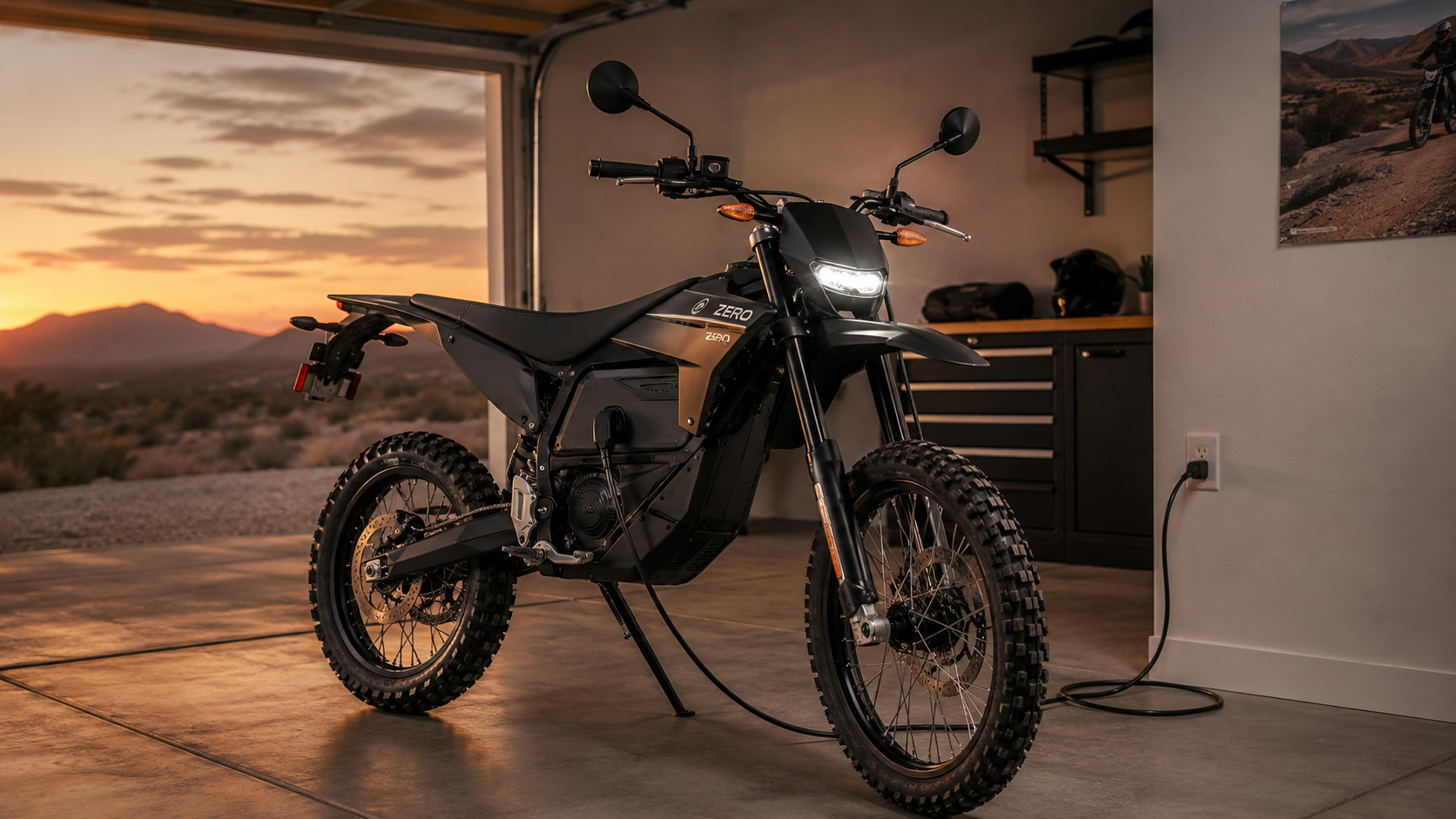
How to Charge an Electric Dirt Bike: Time, Outlets, Solar and Battery Care
How electric dirt bikes charge in six to eight hours. Standard wall outlet, the charger from the box. That covers daily riding. The rest matters because these run a high-capacity lithium-ion pack, not a phone battery, and how you plug in decides how long the pack lasts.
Wrong charger. Hot pack. A cheap power strip. Those shorten battery life and, now and then, start fires. Below: the prep, the home routine, charge times by pack size, whether a normal outlet is enough, solar for camp, and the habits that hold range over the years you own the bike.
Charging at a Glance
Short on time? This is the whole routine in one place. Each section below explains the why.
|
Step |
Do this |
Skip this |
|
Charger |
The one matched to your pack voltage |
Random or universal chargers |
|
Outlet |
Grounded wall outlet, plugged in direct |
Power strips, thin cords |
|
Before |
Cool the pack 20-30 min after a hard ride |
Charging a hot battery |
|
During |
Stay near for the first 30 min |
Leaving it overnight, unattended |
|
After |
Unplug at full, store dry |
Days plugged in at 100 percent |
The U.S. Fire Administration puts the safe charging window at roughly 32 to 105 degrees Fahrenheit, on a hard surface, clear of anything that burns. Dull rules. They are the ones that keep the bike out of trouble.
What to Know Before You Charge
Two minutes of prep stops overheating, slow charging, and a wrecked port. Check the pack, the cable, and the spot first.

Check Voltage and Capacity
Voltage first. Off-road packs run 48V, 60V, or 72V, and the number is printed on the case and the product page. Capacity is the amp-hour figure, usually 20 to 30Ah. Volts times amp-hours gives watt-hours, the size that drives charge time.
A 60V 27Ah pack is about 1,620Wh. A 48V 23.4Ah pack, about 1,123Wh. Bigger number, longer charge. If you are still shopping, the compare electric dirt bike battery packs lists each pack so you can compare before buying.
Use the Charger From the Box
It has to match the pack on voltage, amperage, connector, and chemistry. A mismatch pushes too much current, skips the stop at full, or cooks the cells. It can also fry the battery management system. CPSC has warned riders off “universal” chargers for micromobility products for exactly this reason.
Lost it, or want a spare? Buy from the brand or an authorized dealer, matched to your pack. Two chargers can share a plug shape and run different voltages.
Inspect the Port and Cable
Look at the port. Dirt, bent pins, rust, burn marks, any of those means stop. Then the cable.
Cracks, exposed wire, melted plastic, a loose plug. A small fault grows under a multi-hour load. Something looks off, call support before you plug in.
Let the Pack Cool
Climbs, top-mode runs, mud and sand all heat the battery. Charging on top of that heat wears the cells fastest. Park it shaded and dry. Twenty to thirty minutes, longer in summer. The pack should feel normal before the charger goes on.
How to Charge an Electric Dirt Bike at Home
Home charging is the easy default. Safe spot, real outlet, connect, watch the light, unplug at full. Five steps.

Park in a Dry, Ventilated Space
Flat and dry. A garage floor or concrete pad, not carpet or a wooden deck. Keep it clear of gas cans, cardboard, and curtains, with room around the charger for heat to escape. NFPA's rule for larger devices is blunt: charge away from exits, on a non-combustible surface, never where a fire would block your way out.
Plug Into a Safe Wall Outlet
Grounded, in good shape, holds the plug firmly, stays cool. A warm faceplate or a spark on insertion points to wiring that needs an electrician. Charger straight into the wall. Nothing in between.
Connect the Charger to the Bike
Some packs charge on the bike. Others come out and charge on a bench, handy when the outlet is nowhere near where the bike lives. Follow your manual for the order. Many models want the charger in the wall first, then the bike. Seat the connector fully. Bent pins are an avoidable repair.
Watch the Light, Then Unplug
Red for charging, green for full or standby, though colors vary, so check the manual. Stay near for the first stretch. Buzzing, odor, smoke, popping, sudden heat, any of those, unplug if it is safe and step back. At full, pull the charger from the bike first, then the wall. Not days plugged in.
How Long Does an Electric Dirt Bike Take to Charge?
Six to eight hours full, on most adult electric dirt bikes, on the charger they ship with. Real time depends on pack size, charger output, starting level, and temperature. Near-empty takes the full window. A top-up from 60 percent is quick.
Charge Time by Pack Size
Watt-hours set the time. Here is how a few common pack sizes land on a standard charger, with three Valtinsu models as real reference points.
|
Pack |
Watt-hours |
Full charge |
Example |
|
48V 23.4Ah |
~1,123Wh |
7-8 hours |
EM-5, 50-mile range |
|
60V 27Ah |
~1,620Wh |
6-8 hours |
EM-5 Pro / EM23 |
|
72V 25Ah |
~1,800Wh |
7-8 hours |
72V flagship class |
Same-size packs can differ. A different controller and tune is why one 60V bike finishes a little sooner than another. Trust the product page over a rounded average. For the spec story on a fast 60V model, the EM-5 Pro page lays it out.

Standard vs Fast Charging
A standard charger is the everyday tool. Lower current, less heat, easier on the cells. A fast charger cuts the wait but runs hotter, so use one only if the brand approves it for your pack.
|
Standard charger |
Fast charger |
|
|
Speed |
Full in 6-8 hours |
Noticeably quicker |
|
Heat |
Runs cool |
Runs hotter, needs airflow |
|
Battery wear |
Gentlest over many cycles |
More stress per charge |
|
Best for |
Daily riding, long pack life |
Approved packs, quick turnaround |
We see the same mistake on repeat. A cheap third-party “fast” charger to save an hour, missing the balancing the pack needs, and the cells go unbalanced. Saving fifty dollars is not worth a four-figure pack.
Why the Last 20 Percent Crawls
Lithium packs charge fast from low to mid, then slow near the top. The BMS is balancing cells and capping current on purpose. For a short ride, 80 or 90 percent is plenty and saves time. Full charges for long days. The slow finish is a feature.
Can You Use a Regular Outlet to Charge an Electric Dirt Bike?
Yes. Most charge from a normal home outlet with the correct charger. The outlet feeds the charger; the charger decides what reaches the pack. The catch is a healthy outlet and no junk in the chain.
110V vs 220V, and What Each Means
In the US, most chargers are built for a 110V or 120V wall outlet, the same one your household gear uses. Some accept higher input. Here is the practical difference.
|
Outlet |
Works? |
Faster? |
What to know |
|
110V / 120V |
Yes, standard |
Baseline |
Fine for overnight or same-day |
|
220V / 240V |
Only if the label allows |
Not on its own |
Output sets speed, not the outlet |
|
Power strip |
No |
n/a |
Heats up, loose connections |
|
Extension cord |
Last resort |
n/a |
Heavy-duty, outdoor-rated, uncoiled |
Check the charger label before plugging in. Many read 100 to 240V input, which matters if you travel. A higher-voltage outlet does not turn a low-output charger into a fast one. NFPA's e-bike guidance says it plainly: extension cords and power strips should not be used to charge these devices. Reach a problem? Move the bike, not the risk.
Choosing the Right Charger
The right charger protects charge time, battery life, and your house. It has to match the pack, work with the BMS, and come from somewhere you trust.
Match Voltage, Amperage, Connector
Voltage first, and it is not negotiable. A 60V pack needs a 60V-rated charger, not 48V or 72V. Amperage sets speed, but only if the pack can take it. The connector has to fit properly. A plug that almost fits is not a fit, and it wrecks the port.
Smart Chargers and the BMS
A smart charger eases current or switches modes as the pack fills. The battery management system guards against overcharge, over-discharge, and temperature trouble, and the two work as one system. Never bypass it. Wiring around a BMS turns a routine charge into a real hazard.
Certified, and From the Right Place
Clear labels, a listing from a recognized lab. NFPA and CPSC push the same point: buy gear listed by a nationally recognized testing laboratory, and read the mark before you plug in. Replacement chargers, brakes, and controllers are worth sourcing through the brand's replacement chargers and parts. Avoid no-name listings with missing specs. A low price is not worth a damaged pack.
Charging Without the Original Charger
Only with the correct approved replacement. No safe shortcut, and the wrong move damages the pack, ruins the port, or starts a fire.
If You Lost the Charger
- Check the pack label or manual for voltage, amperage, connector, and chemistry.
- Contact the brand or dealer with the model name and a photo of the label.
- Buy the approved replacement before charging again. Waiting beats testing.
Car Charger? Dead-Pack Tricks?
No on both. A car charger is built for a 12V lead-acid battery, not a 48 to 72V lithium pack, so it cannot match the profile and may overheat the cells. And do not try to wake a dead lithium pack with jumper wires or a mismatched charger. A deeply discharged pack can hide damage. If a smart charger refuses it, that refusal is the safety system working. Call the brand or a battery pro.
Solar and Off-Grid Charging
solar charging and portable power stations for electric dirt bikes.Solar helps when you camp, hunt, or ride far from a wall outlet. The safe setup is indirect: panels charge a power station, then your own charger charges the bike. Never wire a panel straight to the pack.

Can Solar Panels Charge the Bike?
They can, through a buffer. Solar output swings with sun, shade, heat, and angle, so a charge controller or power station has to manage it before it reaches the pack. Panel to power station, station to your bike's charger. Slower than the wall, far safer than a direct connection.
Sizing It: Watt-Hours, Not Watts
Start from pack size. A 60V 27Ah pack is about 1,620Wh, so a power station needs roughly that plus headroom to refill it once. Panels rarely hit rated output all day. Real-world losses from heat, dust, and angle run 25 to 35 percent, so a 400W panel needs several strong sun hours. Plan for extra, then add more for cloud.
Charging at camp works because the bike sits for hours. Charging while riding does not; small bike-mounted panels cannot keep up with the motor. Want more off-grid range? Carry a spare pack.
Generator vs Solar Power Station
Two ways to refill a power station off-grid. The honest trade-offs, not a sales pitch.
|
Pros |
Cons |
|
|
A generator works at night and through cloud, which solar cannot. Either way, the bike's own charger does the final step into the pack.
Charging Habits That Protect Battery Life
Good habits add years to a pack. Control heat, avoid the extremes, use the right charger. That is most of it.

Skip the Daily 100 Percent
Full charges are for long rides. For short daily laps, 80 to 90 percent is easier on the cells, since sitting full all the time adds stress over many cycles. Charge to what the next ride needs, then unplug. In our experience, riders who top to 90 and unplug see steadier range a year in.
Do Not Store It Empty
Lithium packs hate sitting empty. Leave one at 5 or 10 percent for weeks and the cells can sleep or degrade, shrinking range for good. Fifty to sixty percent is the storage sweet spot. Recharge after a ride if it is low, and check a stored pack monthly. Our guide on five habits that quietly kill your range covers the rest.
Charge at Moderate Temperatures
Room temperature is best. Heat raises pack temperature; freezing cold slows the charge and stresses cells. The U.S. Fire Administration puts the safe window at roughly 32 to 105 degrees Fahrenheit. Stored cold? Let it warm first. Ridden hot? Let it cool. A dry garage that is not an oven is fine.
Let the BMS Do Its Job
The battery management system watches cell balance, voltage, current, and temperature through every charge. Use approved chargers so it can work. Do not bypass it to force a damaged pack to take a charge. That strips out the pack's main safety layer.
Common Charging Mistakes to Avoid
Most trouble traces back to heat, a bad charger, a damaged part, or a poor spot. The quick do-and-don't on each.
|
Pros |
Cons |
|
|

How We Approach Charging
This comes from riding these bikes and fielding the support tickets, not a spec sheet. Three things we hold to.
Match the Charger to the Pack
Every figure here is checked against the live spec sheets and the charger that ships with each model. We do not generalize across voltages.
Heat Is the Enemy We Watch
Across the tickets we see, avoidable failures cluster around heat and cheap chargers. So cool-down and certified gear lead the advice.
Cite the Authorities
On safety we lean on CPSC, NFPA, and the U.S. Fire Administration rather than asking you to take our word. Sources are linked below.
The Short Version
Right charger, healthy wall outlet, clean dry space. Get those three right and charging is easy. For daily rides, avoid deep drains, top to the level you need, unplug at full. Off-grid, run panels into a power station and let your own charger finish.
Inspect the pack, charge where you can see it, stop at the first sign of heat, swelling, or smell. Those habits protect the battery, the house, and every ride after. Picking a bike, or a spare charger? Compare the electric dirt bike lineup and match the pack to how you ride.
FAQs
How do I charge my electric dirt bike?
Quick answer: original charger, safe wall outlet, connect to the bike, watch the light, unplug at full.
Why: park somewhere dry and clear of anything flammable, check the port is clean and the cable intact, and follow your manual for the order. Many packs charge on the bike; some come out and charge on a bench.
Tip: stay near for the first 30 minutes so you catch heat, odor, or a charger error early.
How long does an electric dirt bike take to charge?
Quick answer: six to eight hours full on most adult models.
Why: time scales with watt-hours, charger output, temperature, and starting level. A 48V 23.4Ah pack runs seven to eight hours; a 60V 27Ah pack six to eight. The last 20 percent always slows as the BMS balances cells.
Tip: plan charging by pack size, not a guess, before trail days.
Can you plug an electric dirt bike into a regular outlet?
Quick answer: yes, a regular 110V or 120V outlet works with the correct charger.
Why: the outlet feeds the charger, and the charger controls what reaches the pack, so a normal household outlet handles overnight or same-day charging. It must be grounded and in good shape, with no spark or warmth.
Tip: check the charger label first and skip power strips on long charges.
Can I charge a dirt bike battery with a car charger?
Quick answer: no, not unless the maker says so.
Why: most car chargers are built for 12V lead-acid batteries, and an electric dirt bike runs a 48, 60, or 72V lithium pack. The profiles do not match, so it can fail, damage the cells, or create unsafe heat.
Tip: read the pack label; if it is lithium, use only the charger made for it.
Do you have to charge an electric dirt bike?
Quick answer: yes, the motor runs on stored battery power.
Why: no charge means no throttle, no assist, no range. How often depends on pack size, terrain, rider weight, and how hard you ride. Steep climbs and top-mode runs drain it faster.
Tip: top up after a ride or before the next one so the bike is ready.
Does pedaling or coasting recharge the battery?
Quick answer: almost never on an off-road bike.
Why: these are throttle machines, not pedal-assist bicycles, and even where regenerative braking exists it gives back very little, especially on loose dirt where it is least effective.
Tip: treat easy riding as a way to save charge, then refill from an outlet or power station.
How should I store the battery between rides?
Quick answer: partly charged, around 50 to 60 percent, somewhere cool and dry.
Why: an empty lithium pack can drop too low to recover; a full one held for months adds stress. Mid-charge is the sweet spot.
Tip: keep it out of direct sun and check it monthly during long storage.
What should I do if the battery swells, smells, or gets hot?
Quick answer: stop, unplug if it is safe, and keep people clear.
Why: swelling, a sharp or sweet smell, hissing, smoke, or heat off the pack all mean a possible failure. A damaged lithium pack can fail fast.
Tip: if there is smoke or flame, evacuate and call emergency services. Never bin a damaged battery; follow local hazardous-waste rules.
Sources
- U.S. Consumer Product Safety Commission, CPSC Micromobility Information Center (2026)
- U.S. Consumer Product Safety Commission, CPSC charging-safety guidance (2026)
- National Fire Protection Association, NFPA lithium-ion battery safety (2026)
- National Fire Protection Association, NFPA e-bike and e-scooter safety (2026)
- REI Co-op, REI charging guidance (2026)


Looking for something else?

Electric Dirt Bike Loses Power Under Load: Causes and How to Fix It
LEARN MORE
Electric Dirt Bike Bolt Torque Checklist: What to Check and Where the Numbers Come From
LEARN MORE
How to Bleed Electric Dirt Bike Brakes Safely
LEARN MORE
Electric Dirt Bike Throttle Not Working: What to Check First
LEARN MORELooking for something else?

Electric Bike Battery Not Charging? Work Through This Before You Buy a New One
LEARN MORE
Electric Dirt Bike Error Codes: What They Mean and What to Check First
LEARN MORE
Electric Dirt Bike Brake Rotor Rubbing: Diagnose the Cause Before Adjusting
LEARN MOREYou may also like
VALTINSU EM-5 Off-Road Electric Dirt Bike
VALTINSU EM-5 Pro Off-Road Black Electric Dirt Bike
VALTINSU EM-5 Pro Green Electric Dirt Bike
VALTINSU EM-5 Ultra Electric Dirt Bike
Further reading

Electric Dirt Bike Trailside Power Loss: Recovery Plan When the Battery Is Dead

Electric Dirt Bike Fall Riding on Wet Leaves: Grip, Hidden Obstacles and Braking

How to Lift a Fallen Electric Dirt Bike Without Hurting Yourself or the Bike
