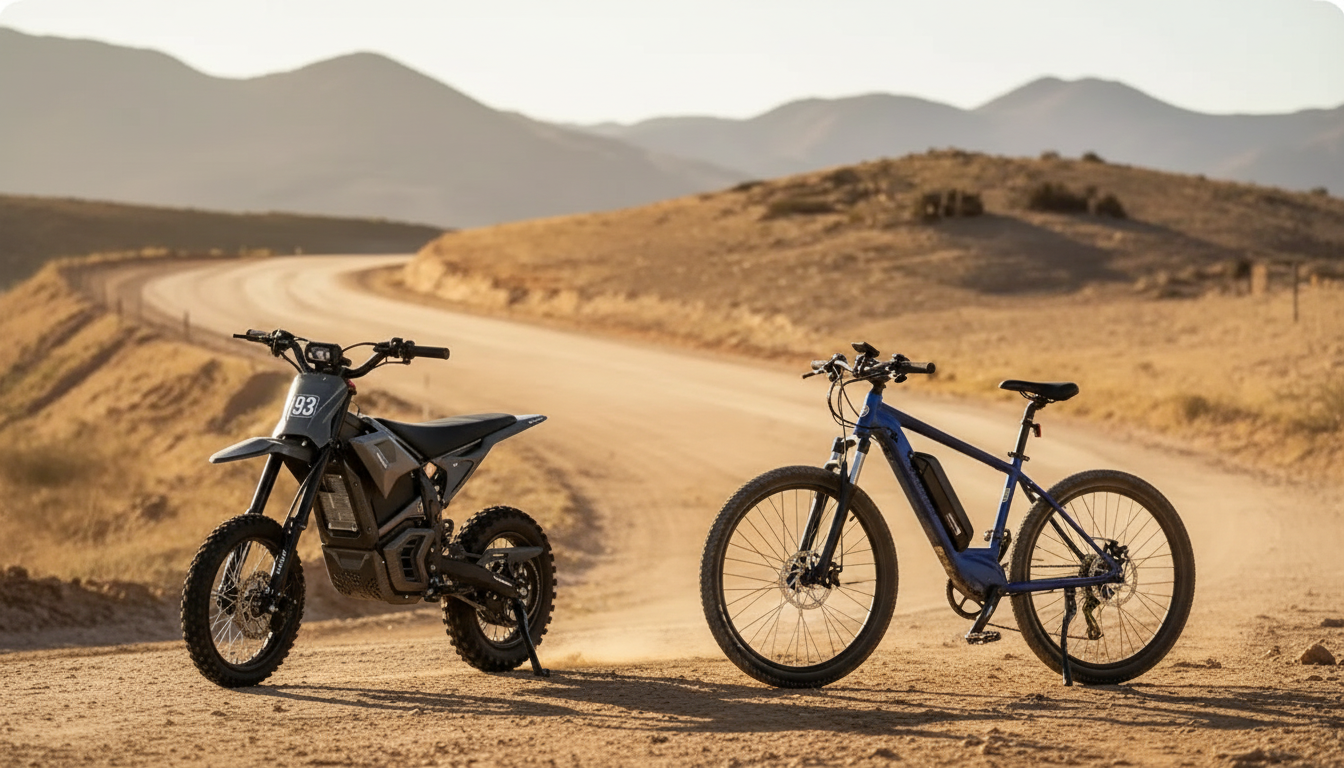
Class 2 Ebike vs Electric Dirt Bike: Why Off-Road Models Are Different
Class 2 ebike vs electric dirt bike starts with one simple difference: same battery, two very different machines. A Class 2 ebike is a bicycle with pedals and a throttle that quits at 20 mph. An electric dirt bike skips the pedals and runs off-road, built more like a small motorcycle than a bike.
That gap decides almost everything. Where you can ride. What gear you need. Whether the thing needs registering. Get it wrong and you own a fast machine with nowhere legal to ride it. Below is the plain version, model by model, with the numbers that actually separate the two.
Class 2 Ebike vs Electric Dirt Bike: The Quick Answer
The split is simple: a Class 2 ebike is treated as an electric bicycle under local regulations, while an electric dirt bike is classified as a motorized off-road vehicle built for higher power and off-road use. An electric dirt bike, what we make as an adult electric off-road motorcycle, is built for off-road power and stays off public roads.
A Class 2 ebike still rides like a bicycle. Pedals. A throttle for help up to the legal cap. Access to most bike-friendly areas. The dirt bike trades all of that for jumps, loose dirt, steep climbs, and speed. Quiet, sure. Still not a bicycle.
|
Feature
|
Class 2 Ebike
|
Electric Dirt Bike (Off-Road)
|
|
Pedals
|
Working pedals
|
Footpegs, no pedals
|
|
Throttle
|
Yes, cuts off at 20 mph
|
Yes, no cap
|
|
Motor power
|
Up to ~750W (low-speed limit)
|
3,000W+ peak common
|
|
Top speed
|
20 mph under motor power
|
40–56 mph depending on model
|
|
Where it belongs
|
Bike lanes, streets, some paths
|
Private land, OHV parks, tracks
|
|
Registration
|
Usually none
|
Often required for road use
|
Keep that table in mind. Everything below answers one question: bicycle, or motorcycle wearing trail tires? You can compare the off-road models side by side if you already know which side you want.
Note: Class 2 ebikes are defined by a 750W motor limit and a 20 mph maximum assisted speed under bicycle regulations. Electric dirt bikes, by contrast, are off-road machines with no 20 mph cap and are intended for private land, OHV parks, and track use only.
What Is a Class 2 Ebike?
Working pedals, a throttle, and motor help that cuts out at 20 mph. That is a Class 2 ebike. Most people ride them for commuting, errands, casual loops, and light trail use where the local rules allow it.

Class 2 Ebike Speed Limit
20 mph under motor power. That is the line. The throttle should not keep pushing past it.
Coast faster downhill all you want, same as any bicycle. The motor just stops adding power above the cap. That is what keeps these bikes close to bicycle behavior, and what earns them a spot in bike lanes and on shared paths in the first place.
Throttle and Pedal Assist, Briefly
Pedal assist means the motor helps while you pedal. The bike reads your effort and adds power at the level you set. A throttle works differently. Thumb lever or twist grip, and you move without pedaling at all.
Class 2 bikes usually have both. Handy from a stop, on a climb, or limping home tired.
The 750W Motor Line
750 watts. In most U.S. rules that is the line for a low-speed electric bicycle. Go far past it and the bike may stop fitting the standard class system at all. According to the U.S. Consumer Product Safety Commission, a low-speed electric bicycle is a two- or three-wheeler with fully operable pedals and a motor under 750W. Two conditions, both required.
|
Quick gut check: if a listing leads with 35, 45, or 60 mph and barely mentions pedals, you are looking at an off-road machine, not a Class 2 bicycle, whatever the title says.
|
What Is an Electric Dirt Bike?
Battery power, built for dirt. That is the short version of an electric dirt bike. Usually no pedals, a twist throttle, suspension stiffer than any standard ebike. Made for private land, OHV areas, and tracks. Not treated like a Class 1, 2, or 3 electric bike.

Throttle Only, No Pedals
Throttle only, on most of them. You meter power with a twist grip, much like a gas bike. That is what gives the fast response and the hard launch you want on dirt, sand, and a steep climb.
Footpegs replace pedals. A stable platform to stand on over bumps and ruts, shift your weight, soak up hits. For the legal side, though, no pedals is the deal-breaker. Without them, the machine usually cannot qualify as an electric bicycle.
Higher Power, Higher Speed
Power is the other gulf. A Class 2 bike tops out near 750W and 20 mph. The EM-5 we build pulls 3,840W and 40 mph; the EM-5 Pro, 5,600W and 52 mph. Ride them back to back, as we have, and the gap is not subtle. The dirt bike just eats distance a 20 mph bicycle never will.
Riders love that off-road. Same reason it stays off shared paths. Put a fast machine on a narrow trail with walkers, dogs, and kids and the hazard is obvious.
Dirt-Bike Frame, Suspension, and Tires
The parts take harder hits. Suspension travels further, the tires bite, the hydraulic brakes haul it down, and the seat sits taller, motorcycle height. A Class 2 bike might wear fat tires and a front fork too. Its whole geometry still leans toward bicycle handling and that 20 mph ceiling. The big-wheel EM23, 19-inch front, 17-inch rear, is shaped for open ground, not the bike path.
|
Where Valtinsu fits: the EM-5 Pro is our value sweet spot, a 60V 5,600W geared motor, 52 mph, and a 59-mile range for $1,699. It matches a Talaria Sting on top speed at well under half the price.
See the EM-5 Pro in Volt Green or black.
|
Class 2 Ebike vs Electric Dirt Bike: The Main Differences
The main differences between a Class 2 ebike vs electric dirt bike are pedals, speed, power, frame, and legal access. Five lines separate the two clearly. Five lines, and they separate the two cleanly. One stays inside bicycle rules. The other is built for off-road motor power. Neither wins outright. They just live in different places.

|
Dimension
|
Class 2 Ebike
|
Electric Dirt Bike
|
|
Pedals vs pegs
|
Working pedals, can be ridden by leg power
|
Footpegs only, motor does the work
|
|
Speed
|
20 mph motor cap
|
40–56 mph (e.g. EM-5 to EM-5 Pro)
|
|
Frame intent
|
Bicycle handling and loads
|
Impact and motor torque
|
|
Legal home
|
Bike lanes, many shared paths
|
Private land, OHV areas, tracks
|
Do not use noise as your legal test. An electric dirt bike can be near-silent and still be banned from a bike lane. The spec sheet decides, not your ears. Local regulations and land-manager rules decide where Class 2 ebikes and electric dirt bikes can ride, including mountain bike trails, shared paths, and off-road use only areas such as OHV land and designated riding zones.
Pros and Cons, Side by Side
Neither loses this one. They win on different ground. Here is the honest trade, the way we’d lay it out for a friend stuck between the two.
|
|
Class 2 Ebike
|
Electric Dirt Bike
|
|
Pros
|
Legal almost everywhere bikes go. No registration, license, or insurance in most states. Light enough for a car rack. You can pedal it home if the battery dies.
|
Real off-road power and instant torque. Built for jumps, climbs, and rough ground. Hydraulic brakes and long-travel suspension. A platform you can grow into and mod.
|
|
Cons
|
Capped at 20 mph under power. Not built for jumps or hard trail abuse. Less fun if open dirt is the whole point.
|
Off-road only, needs legal land or an OHV park. Heavier, usually needs a truck or trailer. No pedals means a dead battery is a long push. Full safety gear is a must.
|
|
Best for
|
Commuting, errands, casual paths, riders who want legal access first.
|
Trail riders, private-land owners, anyone chasing real off-road performance.
|
Read it top to bottom and the pattern is plain. Daily access on one side. Dirt capability on the other. Pick the column that matches where you actually ride.
Why Off-Road Models Are Different
Terrain, torque, impact. That is what off-road models are built around, and it is why they are different. The legal question is not how the bike looks. Knobby tires can sit on a Class 2 ebike. A machine sold online as an “ebike” can be far too powerful for bicycle rules.
Off-Road Looks Don’t Decide the Class
Fat tires. A front fork. Disc brakes. A beefy frame. All of it can sit on a perfectly legal Class 2 ebike, and it makes gravel and dirt-road riding more comfortable. None of it, on its own, turns an ebike into a dirt bike. The full spec sheet does that. Pedals, motor power, throttle speed, assisted top speed, those matter far more than tread pattern.
When a High-Power Bike Loses Ebike Status
Push a high-power throttle bike past the legal speed or motor limit and it can lose ebike status on the spot. This catches buyers out with bikes sold in an “off-road mode” or behind an unlock. It ships street-legal. Then a settings change makes it illegal for public use.
|
Watch for this: tiny decorative pedals, an “unlockable” controller, or a vague “street capable” claim with no class label. If the headline number is raw top speed, treat it as off-road only until proven otherwise.
|
Where Can You Ride Each One?
It comes down to the vehicle class and the land rules. A Class 2 ebike usually has more daily options. A dirt bike needs dedicated motorized space. Trail signs matter. City rules matter. State law matters most.

|
Place
|
Class 2 Ebike
|
Electric Dirt Bike
|
|
Streets & bike lanes
|
Usually allowed, follow traffic law
|
No, unless registered for road use
|
|
Shared-use paths
|
Sometimes, local signs decide
|
Poor fit, often banned
|
|
Mountain bike trails
|
Varies; throttle can mean more limits
|
Motorized trails only
|
|
Private land
|
Yes, with permission
|
Yes, with permission
|
|
OHV parks & tracks
|
Usually overkill
|
The right home
|
Federal land is its own maze. Per the National Park Service, superintendents may allow e-bikes where regular bicycles are allowed, and they can restrict them too. The Bureau of Land Management sets its own rules district by district. Call the local ranger station before you load up.
Street-Legal Rules Buyers Should Check
Rules shift by state, city, and vehicle type. Before you buy, figure out whether your bike is legally an electric bicycle, a moped, a motorcycle, or an off-highway vehicle. Easier to buy the right model than to fix the wrong one later.

Registration, License, Insurance
Most standard Class 2 ebikes need no registration when they fit the rules. Half their appeal, that. No driver’s license either, usually, just the local bicycle rules and age limits.
Dirt bikes are the other story. Ridden on public roads or in some OHV areas, they may need registration, a sticker or permit, sometimes a license and insurance if the state treats the machine as a motorcycle or moped. Do not guess from the brand name. Check your state DMV or OHV agency.
Helmets and Road Equipment
Helmet rules vary by state, age, and class. Wear one regardless. These machines run heavier and faster than a regular bicycle. For dirt, a full off-road kit beats a bicycle lid. The PeopleForBikes state-by-state tracker is a solid place to confirm the current rules where you live.
Conversion is its own project. DOT lighting, mirrors, signals, a plate mount, more. Bolting parts on does not always make a dirt bike road legal. Some models simply cannot be registered for the street.
Which One Should You Buy?
It comes down to how you ride most days, not top speed. A Class 2 ebike wins on legal access and daily use. A dirt bike wins for real off-road riding, if you have legal places to ride it.
Choose a Class 2 Ebike If
-
You want a practical ride for streets, bike lanes, errands, and easy paths.
-
Storage and transport matter, no truck or trailer needed.
-
Legal access comes first, and you’d rather ride often than chase speed.
Choose an Electric Dirt Bike If
Off-road power, and a legal place to use it. Private land, a dirt track, an OHV park. For jumps, steep climbs, and rough ground, the frame, suspension, and tires are built for the job in a way no bicycle is. Plan for transport and gear too: a truck or hitch carrier, a full-face helmet, gloves, boots.
New to it? A manageable starting point beats a big number. Our EM-5 Pro is the bike most adult riders should actually buy, real speed and range without race-machine money. The EM-5 is the gentler 13+ entry point.
Buyer Checklist Before You Pay
-
Does it have working pedals?
-
What is the motor wattage, rated and peak?
-
What is the throttle-assisted top speed?
-
Is it labeled Class 1, 2, or 3, or no class at all?
-
Can it be unlocked past legal limits?
-
Where do your city and state allow it, and are local trails open to that class?
The Bottom Line
Both run on a battery. Neither does the other’s job. A Class 2 ebike is a bicycle first. Pedals, pedal assist, throttle help that quits at 20 mph. A dirt bike is an off-road machine, more power, higher speed, rough trails, private or OHV land only.
Start with where you ride, not the spec that looks biggest in the ad. Want daily access to streets and paths? Class 2 ebike. Have legal dirt and the gear to handle real power? Then an off-road bike earns its keep. If you’re leaning that way, the EM-5 with light is a confidence-building place to start, and you can compare the full lineup from there.
FAQs
What’s the difference between an e-bike and an electric dirt bike?
The difference between a Class 2 ebike and an electric dirt bike comes down to design and legal classification. Class 2 ebikes use pedal assist with a throttle capped at 20 mph and are treated as bicycles under local regulations. Electric dirt bikes skip the pedals and are generally classified as motorized vehicles, not bicycles, which means they fall under different rules for where they can be ridden and how they are used.
What is a Class 2 e dirt bike?
Not a clean legal term, honestly. A Class 2 ebike can wear off-road parts, but a real dirt bike rarely fits the Class 2 box at all.
Bolt fat tires and a rugged frame onto a Class 2 ebike and people call it “dirt-style.” The class label hasn’t budged, though. Strip the pedals and let it run past 20 mph and now you’ve got an off-road motorcycle or OHV.
-
A Class 2 ebike still has pedals and a 20 mph cap.
-
A real dirt bike has neither.
-
Don’t buy by nickname; read the class label and spec sheet.
Are electric dirt bikes considered e-bikes?
Usually not. No pedals, too much power, or speed past the ebike caps, and it gets treated as a motorized off-road vehicle.
Battery power, so people say e-bike in casual talk. Legally it’s tighter than that. The standard electric bicycle has to keep its pedals and stay inside the speed and motor limits.
-
Throttle-only + high power + dirt build = outside Class 1, 2, and 3.
-
Treat “electric dirt bike” as a flag to check road-legal vs off-road only.
Should I get a Class 2 or Class 3 ebike?
Class 2 caps throttle help at 20 mph. Class 3 stretches pedal assist to 28 mph on the road, where your rules allow it.
Class 2 suits casual riders, or anyone who wants a hand from a stop, up a hill, or when the legs give out. Class 3 leans road-focused and tends to hit more trail limits, plus tougher helmet or age rules in some states.
-
Class 2: 20 mph, throttle, most flexible.
-
Class 3: 28 mph pedal assist, road-focused.
-
Pick Class 2 for flexibility, Class 3 for long road commutes.
Can a Class 2 ebike go 25 mph?
Not under motor power. A true Class 2 ebike should stop assisting at 20 mph; you can coast faster downhill, but the throttle shouldn’t push you to 25.
Some bikes can be unlocked, or they ship with an off-road setting. Change one to run faster under motor power and it may no longer count as a Class 2 ebike. Warranty and insurance headaches follow after a crash.
-
20 mph is the motor cap; downhill coasting doesn’t count.
-
Unlocking can void the class, the warranty, and trail access.
-
Keep public-road settings legal.
Is a 3000W ebike street legal?
Usually not, as a standard Class 1, 2, or 3 bicycle. A 3,000W machine is often treated as a moped, motorcycle, or OHV, depending on state law and how it’s equipped.
Motor size isn’t the only factor. Speed, pedals, lights, mirrors, brakes, tires, a VIN, registration, a title, all of it can decide street legality.
-
Many high-power bikes are sold for private land or off-road only.
-
Riding one on public streets risks a stop, fine, or impound.
-
Ask your DMV before buying any 3,000W model for street use.
Why are e-bikes banned on some trails?
Speed, user conflict, trail wear, and wildlife. Some trails were built and approved for non-motorized use, so land managers limit or ban motor-assisted bikes.
Rules differ everywhere. One trail allows Class 1 only. Another adds Class 2. Another bans all e-bikes. Class 2 models can face extra limits because they carry a throttle.
-
Electric dirt bikes are usually restricted to motorized trails or OHV land.
-
Managers balance access, safety, and land protection.
-
Check the trail sign or land-manager site before you ride.
What e-bikes should I stay away from?
Anything that hides its specs, leads with extreme speed, or skips the class label. Be wary of machines that look like motorcycles but are marketed as bicycles.
A trustworthy listing shows motor wattage, battery size, top assisted speed, throttle limit, brake type, the class, and intended use. Be careful when a seller only talks about speed or “no rules” riding.
-
Red flags: tiny decorative pedals, unlocked controllers, vague “street capable” claims.
-
Buy the bike you can legally ride near home, not the fastest one in the ad.
Sources
- U.S. Consumer Product Safety Commission, Bicycle Requirements Business Guidance (low-speed electric bicycle definition) (2026).
- National Park Service, Electric Bicycles (e-bikes) in National Parks (2025).
- Bureau of Land Management, E-bikes Recreation Policy (2026).
- PeopleForBikes, Federal E-Bike Rulemaking and the Three-Class System (2026).


Looking for something else?

Electric Dirt Bike Replacement Parts Availability: What Buyers Should Verify Before Ordering
LEARN MORE
How to Check an Electric Dirt Bike for Safety Recalls by Model and Serial Number
LEARN MORE
How to Choose an Electric Dirt Bike Repair Shop: Questions to Ask Before Service
LEARN MORE
How to Lift a Fallen Electric Dirt Bike Without Hurting Yourself or the Bike
LEARN MORELooking for something else?

Electric Dirt Bike Fall Riding on Wet Leaves: Grip, Hidden Obstacles and Braking
LEARN MORE
Electric Dirt Bike Trailside Power Loss: Recovery Plan When the Battery Is Dead
LEARN MORE
Electric Dirt Bike Plastics Replacement Guide: Fitment, Color Kits and Install Order
LEARN MOREYou may also like
VALTINSU EM-5 Off-Road Electric Dirt Bike
$1,699.00
$2,099.00
VALTINSU EM-5 Pro Off-Road Black Electric Dirt Bike
$2,599.00
$2,899.00
VALTINSU EM-5 Pro Green Electric Dirt Bike
$2,599.00
$2,899.00