

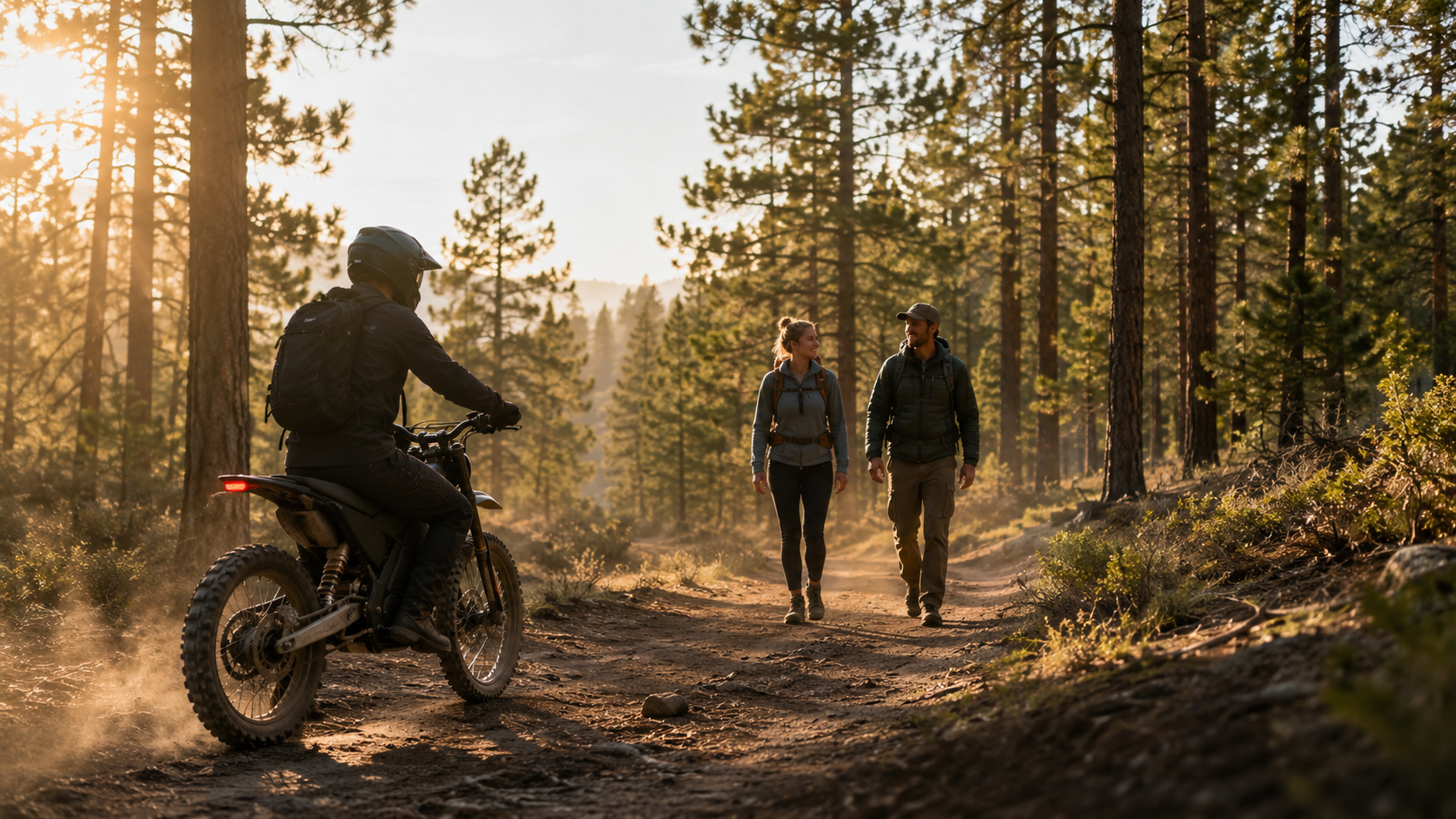
Electric Dirt Bike Trail Etiquette: Rules Every Rider Should Know
Share the electric dirt bike trail etiquette or lose it. That is trail etiquette in five words, and on an electric dirt bike it carries more weight, not less. These adult electric off-road motorcycles run quiet. They launch fast. They are easy to ride. Put those together and you close on a hiker, a horse, or another rider before they ever hear you.
Trail conflict tends to start small. One fast pass. One muddy shortcut. One ride on a closed route, and a land manager has reason to post signs or shut the gate. Ride with a little care and the opposite happens, you make the case that electric dirt bikes belong on legal motorized trails. Here is what that looks like in practice.
Why Electric Dirt Bike Trail Etiquette Matters
Every trail is shared by people moving at different speeds. A quiet motor can put you behind a hiker before they know it, so the safe habits have to start well before you reach them.

Quiet Bikes Still Surprise People
Less engine noise. Same risk. Hikers, runners, and riders on horseback may not hear you until you are close, and a near-silent machine arriving at speed feels sudden even when you think your pace is gentle.
Use your voice early. Slow down before you pass, not as you draw level. A calm “coming up behind you” buys people the seconds they need.
Bad Etiquette Closes Trails
Access changes when riders ignore the rules. Damage, complaints, trespass, an unsafe pass, any one of them gives a land manager a reason to close a route. Electric riders draw the same scrutiny as gas riders the moment they cut off-trail or speed through a shared area.
One deep rut. One spooked horse. That single moment becomes signage, fines, and closures down the line. Good etiquette protects next season as much as today.
Respect Is How Mixed Users Share Public Land
Public land works when everyone on it feels safe. Hikers want space. Cyclists want a clear line to pass. Equestrians need calm movement near their animals, and riders want legal routes without a fight. Respect is the bridge, slow down, yield, wave, keep a friendly tone. Small habits, repeated, are what earn motorized riders their welcome.
Quiet should mean less conflict. Not less responsibility.
Know Where You Can Ride Before You Unload
Confirm the trail allows your kind of ride before the tailgate drops. A lot of electric dirt bikes, especially the high-power throttle models built for off-road, get treated as motorized vehicles. That narrows where you are legal.

The table below sorts the common land types most U.S. riders deal with, and what to check before you ride each one.
|
Land type |
Usually open? |
What to check first |
|
OHV park / riding area |
Yes, easiest |
Posted skill levels, one-way routes, speed limits, staging rules |
|
National forest |
Sometimes |
The Motor Vehicle Use Map (MVUM) for the exact road or trail |
|
BLM land |
Sometimes |
OHV-designated areas; non-motorized trails need a local decision |
|
Non-motorized trail |
No |
Signs reading “non-motorized” or “no motor vehicles” end it |
|
Private property |
Only with permission |
Written OK from the owner; stay inside the area allowed |
Motorized Trails vs Non-Motorized Trails
A dirt path is not automatically yours. Some trails are posted for hikers, horses, or mountain bikes only. If a sign reads “non-motorized,” “no motor vehicles,” or “closed to OHVs,” that is the end of it.
What you want instead: “motorized trail,” “OHV route,” “motorcycle trail,” or “open to motor vehicles.” Those are your routes. When a sign is unclear, check the official map before you ride. Shopping for a bike and want to match it to the terrain you can legally reach? Compare the our current electric dirt bike lineup for trail use against the trails near you first.
BLM Land and National Forest Rules
Both can offer excellent riding. The rules are not uniform. A road or trail can be open to motor vehicles while the singletrack beside it is closed, and a route that looks legal on a phone app may still be restricted by the land manager.
In national forests, the Motor Vehicle Use Map is the legal source for which roads and trails are open to motor vehicles. On BLM land, e-bikes are allowed on roads and trails open to OHV use, while access on non-motorized trails takes a specific local decision, so check the field office rules, OHV areas, and seasonal closures before you go. The .gov sources at the end of this guide are the ones that actually count.
OHV Park or Open Public Land?
Most new riders start at an OHV park for a reason. It is the simplest legal choice, with routes posted by skill level. Open public land gives you more variety and solitude, but more homework too. Here is the trade-off.
|
Pros |
Cons |
|
|
Private Property and Written Permission
Private land is not open just because it has a trail. Get clear permission from the owner first, and a text or a written note beats a verbal “sure” from someone who may not even own the parcel. Stay inside the area the owner allows. Do not open gates, cross fences, or bring extra riders without asking. Leave ruts, trash, or broken gear behind, and that land can close to riders for good.
|
Quick legal check before you unload Read the posted signs first — “non-motorized” ends it before you start. Confirm on the official map (the MVUM on national forest land). Treat a high-power throttle bike as an OHV unless the manager says otherwise. Still unclear? Call the ranger district or park office. One call saves the day. |
Right-of-Way Rules on Shared Trails
These rules keep people safe where the trail pinches down. The short version, be ready to slow, stop, and let others pass. The table sets the order of who yields to whom.
|
Situation |
You should |
Why it matters |
|
Hikers or runners ahead |
Slow, yield, pass wide |
They are slower and more exposed than you |
|
A horse on the trail |
Slow to a crawl, stop, ask the rider |
Horses spook at sudden sound, motion, or dust |
|
A rider climbing uphill |
Yield, let them hold the line |
Restarting on a loose climb is hard |
|
Trail too narrow to pass |
Wait for a safe spot |
Forcing a pass creates fear and trail damage |
Yield to Hikers, Runners, and Horses
Motorized riders yield to slower, more exposed users. You slow for hikers, runners, and horses, and on a narrow trail you pull to a safe side when you can do it without riding off the path. Do not expect walkers to dive out of your way. They may have kids, dogs, packs, or simply no room to step. A slow pass keeps the dust down and the trail feeling safe.
Give Uphill Riders the Right of Way
Climbing riders need steady momentum to keep control. Coming downhill, slow and give them room, because restarting on a loose, rocky, or rooted climb is genuinely hard. Same goes for cyclists. Let the uphill rider hold the line, and if you stop, pick a visible spot that does not block the trail.
Stop and Wait Around Horses
Horses spook at sudden sound, motion, or dust. Slow to a crawl the moment you see one. Stop, speak calmly, ask the rider what they want you to do. No revving. No horn. No rushing past. Hold the bike still until the horse and rider are clear, and if they ask you to shut it off or move to one side, do exactly that.

Never Force Another User Off the Trail
Nobody should get pushed into brush, rocks, mud, or a steep edge. If the trail is too narrow, wait for a safe spot. A few seconds of patience will not ruin your day. Force the pass and you create both fear and trail damage when people step or ride off the edge.
Passing Etiquette for Electric Dirt Bike Riders
Passing is where most trail problems begin. The safest pass is slow, early, clear, and friendly, in that order.
Slow Down Before You Reach Others
Reduce speed the moment you see another person. Do not wait until you are close enough to spray dust or gravel. Early slowing shows respect and buys you time to react to dogs, kids, loose rock, and sudden turns. A smooth throttle hand beats a quick pass every time.
Say “On Your Left” Early
“On your left” tells people where you intend to pass. Say it early, in a calm voice, and give them time to move or answer. No reaction? Slow more and wait. A loud call from close range startles people, while a friendly voice from a distance works far better than a command.
Pass Wide, Calm, and Patient
Give as much space as the trail allows, keep your wheels on the marked route, and do not spin the rear tire as you go by. Crowded trail? Stop and let the group sort itself out. Families, horses, and new riders may need more time, and a patient pass is always safer than a quick squeeze.
Thank People After You Pass
A short “thanks” resets the mood of an encounter. It tells the other person you saw them and cared about their space, and it makes electric riders look better as a group. A wave works when your voice will not carry. Keep it brief, then ease back to speed once you are well clear.
Speed, Blind Corners, and Trail Control
Electric dirt bikes build speed fast, and quiet power can make a bike feel easier to manage than it is. Control is the whole game on a shared trail.
Ride Slower Near Trailheads
Trailheads are crowded. People unload bikes, adjust helmets, walk dogs, read maps, and move between parked trucks. Keep your speed low until you are clear of the staging area, watch for posted limits before you leave the lot, and save the throttle for legal open sections.
Ease Off Before Blind Turns
A blind corner hides hikers, horses, downed trees, and oncoming riders. Slow before the turn, not halfway through it. Stay on your side. Be ready to stop. Do not drift wide into the other lane or cut the inside edge, because both create crash risk and chew up the trail.
This is where smooth, modulated power earns its keep. In our experience, riders who learn the lowest of a bike’s three ride modes first, the way the EM-5 Pro’s lower-speed mode starts in a tamer 26 mph mode before opening up to 52, carry far better corner discipline onto busy trails than riders who start in the top mode.

Match Speed to Traffic and Terrain
Your speed should change with the trail. Loose dirt, wet roots, dust, rock, crowds, all of it calls for less throttle, and open ground does not mean full speed when your sight line is short. One rule covers tight woods, desert, and mountain alike. Ride at a pace that lets you stop inside what you can see. If you cannot stop safely, you are going too fast.
Trail Protection Rules Every Rider Should Follow
Protecting the trail keeps it open and rideable. An electric dirt bike makes no exhaust, but the tires can still tear soil, plants, and water crossings.

Stay on Designated Trails
Hold the marked line from start to finish. Do not cut a new path because the main trail looks rough, and do not ride around a gate, sign, rock pile, or closure marker. Trail edges protect drainage, plants, and habitat. When riders spread out, one trail becomes many scars.
Do Not Cut Switchbacks
Switchbacks let a trail climb without washing out. Cut across them and you carve steep fall-line tracks that funnel water and erode fast, wrecking the design the trail crew built. Take the full turn even when it feels slower. A clean switchback is the mark of a skilled rider.
Avoid Muddy or Waterlogged Trails
Mud is more than a mess. Soft soil takes deep ruts that dry hard and last for months, and riding around the mud just widens the trail. Whole route waterlogged? Turn back and ride another day. On a single puddle on an open motorized trail, go through the center slowly rather than skirting the edge, and check local closure alerts after heavy rain or snowmelt.
Pack Out Trash and Broken Gear
Everything that comes in leaves with you. Bottles, wrappers, zip ties, tubes, snapped levers, battery packaging. Litter makes riders look careless and hands land managers another reason to restrict access. Carry a small bag in your pack or tool pouch and pick up what you safely can.
Group Ride Etiquette for Electric Dirt Bikes
Group rides are a good time. They also multiply the dust, noise, and traffic you put on a trail. A good group rides like a team, not a race pack.
Done well, a group ride is safer than riding alone. Done badly, it is the fastest way to draw complaints. The difference is a few habits.
|
Pros |
Cons |
|
|
Keep Safe Space Between Riders
Leave enough room to stop if the rider ahead brakes or falls. Tailgating on dirt is dangerous, because dust hides rocks, holes, and turns, and it pressures newer riders into mistakes. Open the spacing on dusty trails, close it only at safe stops or intersections, and aim to finish together rather than crowd each other.
Wait at Trail Intersections
Intersections are where groups split. The lead rider waits until the next rider sees the turn, which keeps everyone on the planned route without forcing fast catch-up riding. Do not block the whole trail while you wait. Pull to a safe side, leave room for others, and count riders if the group is large.
Brief New Riders Before You Roll
New riders need the rules before the trail gets busy. Who yields. How to pass. Where to stop. What to do if they get separated. Keep it short. Set the pace for the least experienced rider in the group, and do not push beginners into steep climbs, blind corners, or crowds too soon.
Matching the bike to the newest rider matters too. A lower seat and smoother power, the way the EM-5 is set up for first-timers at 13+, builds the kind of calm first ride that turns into good trail habits.

Electric Dirt Bike Safety Checks Before the Trail
A two-minute check prevents long walks, crashes, and trail delays. An electric dirt bike needs the same basics as any dirt bike, plus battery and wiring care.
Check Battery Charge and Connections
Start with the charge level. Plan the route with enough range to get back, plus a buffer for wrong turns, hills, cold, and soft dirt. Do not begin a long ride on a low battery. Confirm the pack is seated and locked, and look for loose plugs, cracked covers, swelling, burnt smells, or error warnings. Anything off, do not ride until it is checked.
Inspect Brakes, Tires, and Suspension
Squeeze both brakes before you move. The levers should feel firm and the bike should stop smoothly at low speed. Check tire pressure and tread, and look for cuts, missing knobs, loose spokes, and damaged rims. Bounce the suspension and listen for clunks or grinding. When a worn brake pad, chain, or lever needs replacing, the accessories catalog carries the parts to keep the bike trail-ready.
Carry Tools, Water, and Offline Maps
Pack water, basic tools, tire repair items, and a charged phone, and add a small first-aid kit for group rides and remote routes. Download offline maps before you lose service. Tell someone where you are riding and when you expect to be back, and turn back earlier than you think you need to. A simple plan keeps a small problem from becoming a rescue.
Common Trail Mistakes to Avoid
Most trail problems trace back to a few fast choices. Steer clear of these and you ride safer while keeping access open.
Riding on Closed Trails
Closed means closed, whether the reason is wildlife, fire danger, flooding, repairs, private land, or a non-motorized rule. Ride there and you invite fines and more closures. Do not trust tire tracks as proof of access, because someone may have broken the rule first. Follow the signs, the maps, and the land manager’s updates.
Ignoring Posted Speed Limits
Speed limits protect people and the trail, and they cluster near trailheads, campgrounds, shared roads, and busy areas. A quiet bike still needs stopping distance. Watch for signs every ride, since conditions change after storms, events, and seasonal openings, and slow down wherever dust, kids, horses, or blind corners appear.
Passing Horses Too Fast
Fast passing near horses is one of the worst mistakes on the trail. A startled horse can jump, spin, or bolt, and that puts the rider, the horse, and you at risk. Slow early. Stop when needed. Talk to the rider in a calm voice, and wait until they tell you it is safe.
Assuming Quiet Means Rule-Free
A silent motor cancels no rules. The bike still has speed, weight, tires, and torque, so it can still scare people, damage trails, or wander into places motorized vehicles are not allowed. Ride as if your behavior represents every electric rider out there. Check access, yield often, keep the speed in hand.
Ride So the Next Rider Can Too
Electric dirt bike trail etiquette comes down to one idea. Ride in a way that keeps trails safe and open. Confirm your route allows motorized vehicles before you unload, then ride with control around hikers, horses, cyclists, and other riders.
A quiet bike still needs a careful rider. Slow early, pass with space, hold the marked line, and respect the signs on BLM land, in national forests, at OHV parks, and on private property. Do that and you protect today’s ride and the next one. Not a bad trade for a few seconds of patience.
FAQs
Are electric dirt bikes good for trails?
Yes, on legal motorized trails, when ridden with care. They run quieter than gas bikes and make no exhaust at the trail, so they often feel less disruptive in shared areas. What separates a good trail bike from a problem one is the rider, not the machine:
- Quiet running and instant torque help on climbs and tight, low-speed control.
- They can still damage a trail if you spin tires, cut corners, or ride wet soil.
- Stay on the marked route and a smooth rider causes fewer problems than a careless one on anything.
Can you make an electric dirt bike road-legal?
Sometimes, depending on the bike and your state. Many are sold for off-road use only and are not street legal without the right equipment and paperwork. A typical road-legal checklist looks like:
- Equipment: DOT tires, mirrors, lights, a brake light, a horn, turn signals, reflectors, a speedometer.
- Paperwork: title, registration, plate, insurance, and an inspection in many states.
- Reality check: some bikes still fail on certification, and your DMV’s rules beat any parts kit sold online.
What should you not do on a trail with an electric dirt bike?
Plenty, and most of it is avoidable. The habits that close trails and start conflicts:
- Riding where motorized vehicles are banned, or assuming every dirt trail is open.
- Passing too fast, surprising people from behind, or carrying speed near trailheads.
- Cutting switchbacks, riding off-trail, or going around a closure marker.
- When you are unsure whether a trail allows your bike, do not ride it until you confirm the rule.
Why do riders say “on your left”?
To warn the person ahead that you plan to pass on their left side. It is a short phrase that prevents a surprise, a sudden step, or a handlebar-to-handlebar tangle. On a quiet electric bike it matters even more, since people may not hear you coming. How to use it:
- Say it early, from a distance, in a calm voice.
- Give them time to respond or hold a steady line.
- No reaction? Slow down more and wait, rather than treating it as an order to move.
What is the biggest problem with electric dirt bikes on trails?
Confusion over access rules, mostly. Riders assume quiet electric power lets them use any trail, but most public land still separates motorized and non-motorized routes. The recurring issues:
- Access: motorized and non-motorized trails are not interchangeable.
- Speed: fast, quiet passing creates fear and complaints even without a crash.
- Range: hills, sand, mud, and cold use more power than new riders expect.
Check the rule, slow near others, and plan extra range, and most of it disappears.
What are the odds of an electric dirt bike battery catching fire?
Low, but not zero. Lithium-ion battery fires are uncommon and usually trace to damage, poor manufacturing, the wrong charger, or rough handling, and off-road riding adds vibration, water, dust, and impact. Watch for the warning signs and handle the pack right:
- Warning signs: swelling, leaking, heavy heat, a burnt smell, sparks, odd sounds, charging errors.
- Charging: use the charger made for the battery, and never charge a damaged pack or leave it near anything flammable.
- After a crash: inspect the case and wiring before you charge or ride again.
This one is a safety topic. If you suspect a damaged pack, stop using it and contact the maker.
What is the lifespan of an electric dirt bike?
It depends on the battery, motor, frame, suspension, riding style, and upkeep, and a well-kept bike lasts for years. The battery is the part most riders watch. What shortens it, and what wears like any bike:
- Battery enemies: hard riding, deep water, heavy impacts, poor charging habits, long storage at very low or full charge.
- Normal wear: tires, brake pads, chains, sprockets, bearings, and suspension.
- Easy wins: keep it clean and check bolts, wiring, and battery mounts to head off bigger repairs.
Do you need to register an electric dirt bike to ride on public land?
Often, yes. Many states classify electric dirt bikes as off-highway vehicles, which can require registration, an OHV sticker, or a permit to ride designated public areas. Because it varies, check before you load up:
- Rules change by state and even by individual park or riding area.
- Start with your state’s OHV program, then the entry requirements for the specific area.
- When in doubt, a quick call to the managing office settles it.
Sources
- U.S. Forest Service, Electric Bicycle Use — trail and motorized access policy (2026)
- Bureau of Land Management, E-Bikes on BLM-Managed Public Lands — trail etiquette and OHV access (2026)
- Tread Lightly!, T.R.E.A.D. Principles for responsible trail use (2026)
- U.S. Consumer Product Safety Commission, statement on lithium-ion battery fire safety (2025)


Looking for something else?

Electric Dirt Bike Loses Power Under Load: Causes and How to Fix It
LEARN MORE
Electric Dirt Bike Bolt Torque Checklist: What to Check and Where the Numbers Come From
LEARN MORE
How to Bleed Electric Dirt Bike Brakes Safely
LEARN MORE
Electric Dirt Bike Throttle Not Working: What to Check First
LEARN MORELooking for something else?

Electric Bike Battery Not Charging? Work Through This Before You Buy a New One
LEARN MORE
Electric Dirt Bike Error Codes: What They Mean and What to Check First
LEARN MORE
Electric Dirt Bike Brake Rotor Rubbing: Diagnose the Cause Before Adjusting
LEARN MOREYou may also like
VALTINSU EM-5 Off-Road Electric Dirt Bike
VALTINSU EM-5 Pro Off-Road Black Electric Dirt Bike
VALTINSU EM-5 Pro Green Electric Dirt Bike
VALTINSU EM-5 Ultra Electric Dirt Bike
Further reading

Electric Dirt Bike Trailside Power Loss: Recovery Plan When the Battery Is Dead

Electric Dirt Bike Fall Riding on Wet Leaves: Grip, Hidden Obstacles and Braking

How to Lift a Fallen Electric Dirt Bike Without Hurting Yourself or the Bike
