

12 Best Electric Bikes for Kids Ages 8-14: Safe & Fun Top Picks
Three machines wear the same label. One is a throttle-only mini that rides like a tiny moped. One is a real pedal bicycle with a helper motor. The third is a knobby-tired dirt bike built for trails. All three get sold as e bikes for kids, and you will see the same machines listed as electric bikes for kids too.
For the 8-to-14 range, the right one comes down to how your child rides and where. Match it well and an e-bike is one of the best things a kid can own. Match it badly and you have bought either a toy outgrown by fall or a machine too fast for the rider to hold.
So we put the names aside for a minute. First the three types, the age each one fits, the single wattage number that matters most, and the 2026 laws that decide what a kid can legally ride. The picks come after that, because the type has to be right before the brand ever matters.
The 3 Types of E-Bike for Kids
Almost every kids' e-bike falls into one of three buckets. Age and terrain point you at the right one.
Electric Balance Bikes (Ages 3-5)
No pedals, barely any speed. A learning tool, geared so a small child works on balance and throttle feel at a walking-to-jogging pace, usually capped between 5 and 10 mph. Light enough to lift after a tip.
This is where the youngest riders start. It sits below the 8-to-14 band most parents reading this are shopping for.
Pedal-Assist Electric Bikes for Kids (Ages 7-14)
This is the real bicycle, and for the 8-to-14 group it is the one most families actually want. The motor helps only while the child pedals. Stop pedaling and it quits, so speed stays tied to effort. Safety groups recommend this type for kids for exactly that reason.
A 250W motor and a 20-inch wheel is the common budget setup, like the JOYSTAR Glidex 20-inch. Step up and the premium end runs a torque-sensing mid-drive, theTwo Wheeling Tots testers' preferred build, on bikes like the Woom UP. Both have a pedal-assist mode for hills and a plain cycling mode when you want the kid to do the work.
Kids' Electric Dirt Bikes / E-Motos (Off-Road)
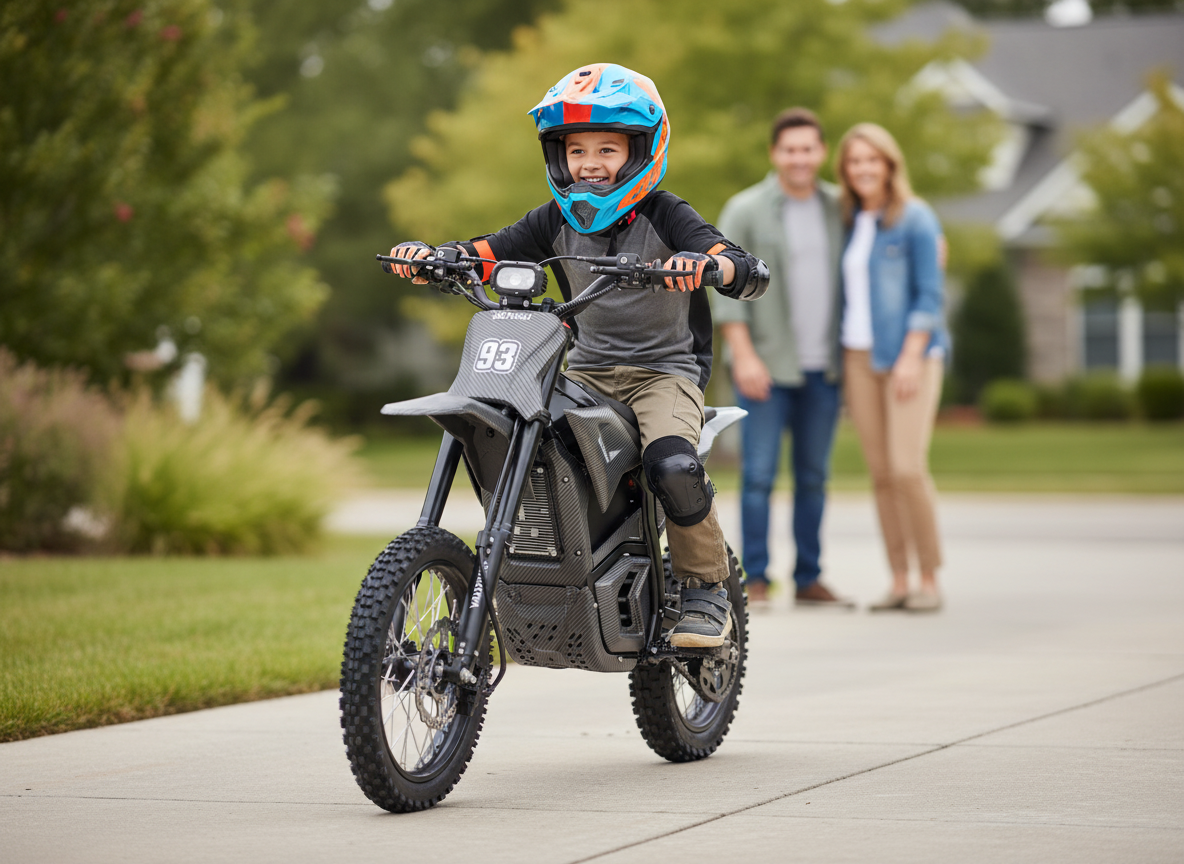
Throttle-only, no pedals, built for dirt. A GoTrax Fitz16 or a Razor Dirt Rocket is not a bicycle. It is a scaled-down electric motorcycle for the trail. Genuinely fun, and a different risk profile, which is why these suit older kids under supervision and never belong on a public road. Off-road toys, not transportation.
Quick Comparison: E-Bikes for Kids by Type
The three types side by side, with the rider each one fits. Prices are 2026, verified live.
|
Type
|
Power & speed
|
Age range
|
Price band
|
Best for
|
|
Electric balance bike
|
100-250W, 5-10 mph
|
3-5
|
~$180-1,050
|
Learning balance before pedals
|
|
Pedal-assist kids' bike
|
180-350W, ~15.5 mph
|
7-14
|
~$390-3,800
|
True cycling skills, streets and paths
|
|
Off-road e-moto
|
350W+, 14-15.5 mph
|
8-13, supervised
|
~$298-699
|
Dirt and trails, never the road
|
What Age Should a Kid Get an E-Bike?
So what age should a kid get an electric bike for kids? Age points you at the type, and the type points you at the wheel size. There is also a hard floor worth knowing. The CPSC does not recommend e-bikes for children under 9, and says kids 9 to 12 should not ride anything that tops 10 mph. The American Academy of Pediatrics repeats that guidance. So for the youngest end of the 8-to-14 band, a hard speed cap is not optional.
Maturity carries as much weight as the birthday. A careful nine-year-old on a quiet cul-de-sac is a different rider than a fearless nine-year-old near a busy road. Start every new rider in the lowest mode, on flat ground, helmet on. Move them up only when the control is obvious. Riders on r/ebikes say the country-versus-city split matters too: a rural kid with open space can often handle more, sooner, than a kid riding around traffic.
Age, Height, and Wheel Size
Fit the wheel to the child, not the birthday and not the price tag. Standover height and inseam decide the size; age is just a rough proxy. As a starting guide:
|
Child height
|
Inseam
|
Wheel size
|
Rough age
|
Bike type
|
|
3'0"-3'7"
|
14-17 in
|
12-16 in
|
3-5
|
Balance bike
|
|
3'7"-4'5"
|
17-22 in
|
16-20 in
|
6-9
|
Pedal-assist kids' bike
|
|
4'5"-5'0"
|
22-26 in
|
20-24 in
|
9-12
|
Pedal-assist kids' bike
|
|
5'0" and up
|
26 in+
|
24 in+
|
12-14
|
Larger pedal bike or supervised e-moto
|
Check that the seat and bars adjust. A bike that grows with the kid earns its price over two or three seasons instead of dying in one.
Maturity and Readiness
Schwinn frames the readiness test well, and it lines up with the AAP advice. Can the child balance confidently, wear a helmet without fuss, follow the rules of the road, and pick the bike up when it tips? An e-bike is heavier than the analog version, so strength matters. If the answer to any of those is no, wait a season. The goal is to keep it fun, not to rush a birthday.
The One Spec That Matters Most: 250W
If you remember a single number, make it wattage. For younger kids, 250 watts with pedal-assist is the sweet spot. Enough to help on a hill, never enough for the bike to run away from a small rider. Riders on r/ebikes put it bluntly: for most eight-year-olds, 250W and pedal-assist is a must, with top speed capped until the skills catch up. For most 8- to 14-year-olds, the best e bike for kids is a 250W pedal-assist model with a capped top speed.
Bigger motors, 350W and up, are for older or experienced riders, and usually off-road. More motor means more bike to escape a kid who is not ready for it. The federal e-bike ceiling is 750W, and anything past that stops being an e-bike in the eyes of the law, which matters for the next section.
Torque Sensor vs Cadence Sensor
Wattage is half the story. How the motor decides to help is the other half. A cadence sensor flips the motor on once the pedals turn, in a steady surge, which is what the budget bikes use. A torque sensor reads how hard the child is actually pushing and matches it, so the power comes on smooth and predictable. For a young or nervous rider, that smoother delivery is safer and easier to learn on. It is the main thing the $2,000-plus bikes buy you over the $400 ones.
Kids' E-Bike Laws in 2026: Know the Class First
US e-bikes sort into three classes, and the class decides who can legally ride. The 2026 e-bike laws for kids tightened this year, and the changes land squarely on young riders.
The Three Classes and the Age-16 Line
Class 1 is pedal-assist only, cutting off at 20 mph. Class 2 keeps that 20 mph cap but adds a throttle. Class 3 runs pedal-assist up to 28 mph, and that tier is the one to watch. PerPeopleForBikes and the state trackers, under-16 riders are barred from Class 3 in most states. Class 1 and 2 usually carry no statewide age minimum, though some cities are adding their own. For an 8-to-14-year-old, Class 1 is the kid-friendly tier.
What Changed in 2026
Enforcement got real this year, led by California. AB 875 lets police impound a Class 3 e-bike on the spot when a rider under 16 is on it, with a minimum 48-hour hold. The under-16 ban itself is older. What AB 875 added is the impound power. A second law, AB 965, makes selling a Class 3 bike to anyone under 16 a point-of-sale infraction, with a base fine up to $250.
Two more worth knowing. California's SB 1271, a 2024 law that takes effect January 1, 2026, requires new e-bikes sold in the state to meet UL 2849 or EN 15194 testing and carry a certification label. Tennessee went a different route, raising its minimum Class 3 operating age from 14 to 16, effective July 1, 2026, perWSMV. And a few states are moving the opposite way, with Oregon weighing a drop to 14, so the map is not uniform. Check your state, then check your town.
How to Choose the Best E-Bike for Your Child
Past type, age, and class, a handful of things separate a good buy from a regret. The best e bike for kids really comes down to three calls: a UL-certified battery, a speed limit you can hold, and a frame that fits the child.
UL Certification
Look for UL 2849, the e-bike electrical-system standard, or UL 2272 on some e-rideables. It means the battery, charger, and wiring passed a real safety test against fire and electrical risk. UL's own data ties certified packs to far fewer fire incidents. The Himiway C1 carries UL 2849. Any bike claiming no certification at all, walk away. In California it is now the law anyway.
Speed Modes and a Parental Lock
The good ones let a parent cap the speed. The Himiway C1 is the clearest budget example: three modes starting at 7 mph, with 13 and 15 mph unlocking only as the child earns them, plus a remote that kills the motor instantly. At the premium end, the Specialized Turbo Levo SL Kids holds a 10 mph or 15.5 mph ceiling set in an app. That control beats almost any spec on the sheet.
Pedal-Assist vs Throttle
For most kids, pedal-assist is the safer default. The child has to pedal for the motor to help, so speed stays tied to effort. Throttle-only bikes, the cute moto-style ones included, move whether the rider is ready or not. That is not automatically wrong, it just raises the bar on supervision and the right age.
Helmet, Brakes, and Weight
Three things the spec sheet hides. A helmet is non-negotiable, and a CPSC-certified one is the floor, with a MIPS shell the upgrade for rotational impacts. Pick the right gear before the first ride, not after the first fall. Brakes have to suit a child's grip, so test the lever pull. And weight matters more than parents expect: a bike a kid cannot pick up after a tip is a bike they will ride scared.
Range, Battery, and Budget
Kids' bikes do not need adult range. A 12-to-16-mile real-world figure covers an afternoon for most riders this age. Spend the money on the certified battery and the brakes instead. Under about $180, you are usually buying a toy that will not survive a season.
Best E-Bikes for Kids in 2026
These are the best e bikes for kids ages 8–14 in 2026, and each one is matched to a specific age and riding style. Our standout picks, sorted by what each child actually needs. Every one clears the bar on a sensible speed for its age and a battery we would trust.
Best Moto-Style Starter (Ages 4-12): Himiway C1

Alt: Himiway C1 moto-style kids electric bike
The C1 is the safest moto-style starter we would put a younger kid on. It is throttle-based with a 350W hub and no pedals, so it rides like a tiny, gentle motorcycle, not a bicycle. UL 2849 battery.
Three modes from 7 mph. A remote that cuts the motor instantly. Dual disc brakes on a 32-pound frame a kid can actually pick up. The seat and bars fit riders from about 3'3" to 4'9", so it grows across the early years. At $799 it is not the cheapest, but the safety hardware is the reason it leads its lane.
-
Pros: UL 2849 battery; three speed modes from 7 mph; instant kill remote; light 32 lb frame.
-
Cons: throttle, not pedal-assist; no pedals to build cycling skill; $799 is a stretch for a starter.
Best Pedal-Assist Value (Ages 6-12): JOYSTAR Glidex 20in or Kent Torpedo 20in

Alt: JOYSTAR - Glidex 20 Inch Kids Electric Bike for Boys Girls Ages 6+
Want a true bicycle on a budget? These are the value picks, roughly $390 to $500. The JOYSTAR Glidex runs a 350W hub to about 15.5 mph with a pedal-assist mode and a normal cycling mode. The Kent Torpedo is gentler, a 180W bike better suited to a younger or smaller rider, with no published top speed to speak of.
Neither carries a UL listing we could confirm, so they sit a notch below the certified picks on safety. But when the battery dies, each just becomes a normal pedal bike, which is exactly what a kids' e-bike should be. For a 6-to-12-year-old learning real bike skills, this is the honest entry point.
-
Pros: true pedal-assist bicycles; cheapest real picks here; revert to a normal bike when the battery dies.
-
Cons: no confirmed UL listing; cadence assist is less smooth than a torque sensor; heavy at ~57 lb.
Best Premium Pedal-Assist (Ages 7-11): Woom UP 5 or Specialized Turbo Levo SL Kids

Alt: Woom UP 5 kids pedal-assist mountain bike
Spend more and the experience changes. The Woom UP 5 runs a Fazua mid-drive with a torque sensor, cuts assist at 15.5 mph, and weighs a genuinely light 34 pounds, fit for riders roughly 7 to 11. The Specialized Turbo Levo SL Kids does the same trick and adds the best parental control on this page: a 10 mph or 15.5 mph speed cap you set in an app.
Both are pedal-assist only, no throttle, and both are real off-road-capable kids' bikes rather than toys. The catch is the sticker. The Woom runs about $3,799 and the Specialized about $2,999. Neither lists UL 2849, which is the one knock at this price.
-
Pros: torque-sensor power that is smooth and easy to learn on; light frames; Specialized adds an app speed lock.
-
Cons: $3,000 to $3,800 is serious money for a bike a kid outgrows; no UL 2849 claim.
Best Balance Bike (Ages 3-5): Hiboy BK1 or STACYC 16eDRIVE

Alt: Hiboy BK1 Electric Balance Bike For Kids
For the youngest, before the 8-to-14 window, a low-speed electric balance bike builds confidence and throttle feel without pedals to manage. The Hiboy BK1 is the budget route at around $180 to $250, a 100W bike capped near 9 mph for ages 3 to 5. The STACYC is the premium name, though its 16eDRIVE actually fits ages 5 to 7, with the smaller 12eDRIVE covering the littlest riders. Treat either as a stepping stone to a pedal-assist bike, not a destination.
-
Pros: low speed and light weight; build balance early; Hiboy BK1 is genuinely cheap.
-
Cons: no pedals, so no real cycling skill; STACYC runs over $1,000; outgrown fast.
Best Off-Road, Supervised (Ages 8-13): GoTrax Fitz16 or Razor Dirt Rocket MX350

Alt: GoTrax Fitz16 off-road kids e-moto
For an older kid who wants dirt, these two. The GoTrax Fitz16 is a 350W off-road e-moto with dual suspension and 16-inch tires, good for about 16 miles at 15.5 mph, often around $516. Its certification is murky, GoTrax lists UL 2272 while some retailers say UL 2849, so we will not call it settled. The Razor Dirt Rocket MX350 is the long-running budget option, around $298, with a low 10 mph mode for ages 8 and up and a 14 mph mode for 13 and up. Both are throttle-only and built for trails. For where this category goes for adults, see our electric dirt bike collection.
-
Pros: real off-road fun; dual suspension on the Fitz16; the Razor is cheap and durable.
-
Cons: throttle-only and street-illegal; Fitz16 UL status unclear; Razor runs a sealed lead-acid battery.
When a Teen Outgrows a Kids' E-Bike
A kid stops being a kid eventually. Say a younger teen has worn out a 20-inch pedal bike and wants real off-road capability. The honest next step, what you might call a step-up teen e-bike, is a different category: an adult electric off-road motorcycle, off-road only and supervised, with full gear. Valtinsu's EM-5 is rated for 13 and up, with a geared motor and real suspension instead of toy-grade parts. It sits well past a kids' e-bike, so know about it as the step after this guide, not during it. For most readers here, a pedal-assist kids' bike is still today's answer.

Alt: VALTINSU EM-5 Electric Dirt Bike
How We Picked These E-Bikes for Kids
Years of riding and following the kids' e-bike market shaped this list. We leaned on verified specs, current prices, and the safety guidance from groups like PeopleForBikes and the CPSC, not marketing copy. Three things guided the picks.
Safety Hardware First
Every pick clears a baseline: a battery we would trust, brakes that work for a child's grip, and a way to limit the speed. A fast, cheap bike with none of that did not make the page, however fun it looked in the ad.
Age and Skill Match
A four-year-old and a thirteen-year-old need different machines. We sorted picks by who they fit, from a balance bike to a supervised off-road e-moto, and flagged the right age on each one.
Value That Lasts a Few Seasons
Price alone is the wrong lens. Each pick had to grow with the rider, with adjustable fit and parts you can actually replace. The cheapest bike on a marketplace rarely wins that test.
Choosing the Right E-Bike for Your Kid
If you are choosing the best e bike for kids ages 8–14, match the type to the age first, then hold the line on the basics. A balance bike for the little ones. A 250W pedal-assist bike for the 7-to-12 crowd, which is what most parents searching this really want. A supervised off-road e-moto only for older riders. Confirm the class rules where you live, insist on a certified battery and a helmet, and the right e bike for kids is the one sized to your child and capped to their skill. No more bike than that.
FAQs
What is the best e-bike for a kid?
The best e bike for kids depends heavily on age and riding style. For a moto-style starter, the Himiway C1, ages 4 to 12, UL 2849, parent-controlled speed, $799. For a true pedal bicycle on a budget, the JOYSTAR Glidex 20-inch or Kent Torpedo 20-inch at $390 to $500. Money no object, the Woom UP 5 or Specialized Turbo Levo SL Kids.
-
Moto-style starter: Himiway C1 (4-12)
-
Pedal-assist value: JOYSTAR Glidex, Kent Torpedo
-
Premium pedal-assist: Woom UP 5, Levo SL Kids
What age can a child have an e-bike?
Not under 9, per the CPSC, and kids 9 to 12 should stay under 10 mph. Balance bikes start around age 3. Legally, Class 3 e-bikes are off-limits under 16 in most states, while Class 1 and 2 usually have no statewide minimum. Local rules still apply.
-
CPSC: not recommended under age 9
-
9 to 12: cap the speed at 10 mph
-
Class 3: 16 and up in most states
What is a good wattage for a kids' e-bike?
250 watts, with pedal-assist, for younger kids. It helps on hills without overpowering a small rider. Bigger motors, 350W and up, suit older or experienced riders, usually off-road. Past 750W it stops being a legal e-bike.
-
250W plus pedal-assist for young kids
-
350W and up for older or off-road riders
-
Over 750W is no longer a legal e-bike
Is a torque sensor or cadence sensor better for a kid?
Torque, if the budget allows. It reads how hard the child pushes and matches the power, so it comes on smooth and predictable. Cadence sensors surge on once the pedals move, which is fine but jumpier. The smoother delivery is easier and safer to learn on.
-
Torque sensor: smooth, matches effort
-
Cadence sensor: simpler, jumpier surge
-
Premium kids' bikes use torque sensors
Are e-bikes safe for kids?
They can be. Size it right, cap the speed, use a certified battery, helmet on every ride. The CPSC warns against high-speed machines for young children. A pedal-assist bike with a parental speed cap is the safest start.
-
Certified battery and wiring
-
Speed-limiting modes and a helmet
-
Avoid fast e-motos for young kids
What's the difference between a kids' e-bike and an electric dirt bike?
Pedals, mostly. A kids' e-bike has them and uses pedal-assist, built for streets and paths. An electric dirt bike is throttle-only, built for off-road trails. The dirt bike sits closer to a small motorcycle, so it suits older, supervised riders.
-
Kids' e-bike: pedals, pedal-assist, paths
-
Electric dirt bike: throttle, off-road
-
Dirt bike means higher risk, older riders
How much does a good kids' e-bike cost?
Roughly $180 to $400 for balance bikes. Around $390 to $700 for budget pedal-assist bikes, and $3,000-plus for a premium torque-sensor model. Off-road e-motos run about $298 to $699. Under about $180, you are buying a toy that will not last a season.
-
Balance bikes: about $180 to $400
-
Budget pedal e-bikes: about $390 to $700
-
Premium pedal e-bikes: $3,000 and up
Should an 8 to 14 year old get an e-bike?
Usually yes, on a pedal-assist Class 1 bike, supervised at first. Check state law, since some restrict e-bikes under 16, and pick a speed-limited, certified model. A 250W pedal-assist bike is the standard call for this age.
-
Class 1 pedal-assist, supervised
-
Check state age rules first
-
250W, speed-limited, certified battery
Sources
- PeopleForBikes, Should You Buy Your Kid an E-Bike? (2026)
- U.S. CPSC, E-Scooter and E-Bike Injuries Soar (age and speed guidance) (2024)
- American Academy of Pediatrics, Are Electric Bikes Safe for Children? (2026)
- Two Wheeling Tots, Electric Bikes for Kids: Buying Guide (2026)
- Electric Bike Report, Best Electric Bikes for Kids (2026)
- WSMV, Tennessee Raising Minimum Age for Class 3 E-Bikes (2026)


Looking for something else?

Electric Dirt Bike Loses Power Under Load: Causes and How to Fix It
LEARN MORE
Electric Dirt Bike Bolt Torque Checklist: What to Check and Where the Numbers Come From
LEARN MORE
How to Bleed Electric Dirt Bike Brakes Safely
LEARN MORE
Electric Dirt Bike Throttle Not Working: What to Check First
LEARN MORELooking for something else?

Electric Bike Battery Not Charging? Work Through This Before You Buy a New One
LEARN MORE
Electric Dirt Bike Error Codes: What They Mean and What to Check First
LEARN MORE
Electric Dirt Bike Brake Rotor Rubbing: Diagnose the Cause Before Adjusting
LEARN MOREYou may also like
VALTINSU EM-5 Off-Road Electric Dirt Bike
$1,405.00
$2,260.00
VALTINSU EM-5 Pro Off-Road Black Electric Dirt Bike
$2,463.00
$2,753.00
VALTINSU EM-5 Pro Green Electric Dirt Bike
$2,463.00
$2,753.00
VALTINSU EM-5 Ultra Electric Dirt Bike
$3,188.00
$3,622.00
Further reading

Electric Dirt Bike Trailside Power Loss: Recovery Plan When the Battery Is Dead
When an electric dirt bike loses power on the trail, first make the scene safe and decide whether the battery is simply depleted or the bike has a fault. Move out of the travel line if the bike can...

Electric Dirt Bike Fall Riding on Wet Leaves: Grip, Hidden Obstacles and Braking
Wet leaves reduce grip and hide the surface that determines it. A thin layer on firm soil may slide under braking; a deep layer can conceal roots, rocks, ruts and holes; decomposing leaves can beha...

How to Lift a Fallen Electric Dirt Bike Without Hurting Yourself or the Bike
Do not lift a fallen electric dirt bike until people, terrain and battery hazards are assessed. A bike on a slope, near traffic, pinning a rider or showing battery heat, smoke, hissing, odor, swell...

How to Choose an Electric Dirt Bike Repair Shop: Questions to Ask Before Service
Choose an electric dirt bike repair shop by matching the shop’s real capability to the actual job. Ask about experience with the model and component, access to manuals and parts, battery isolation ...