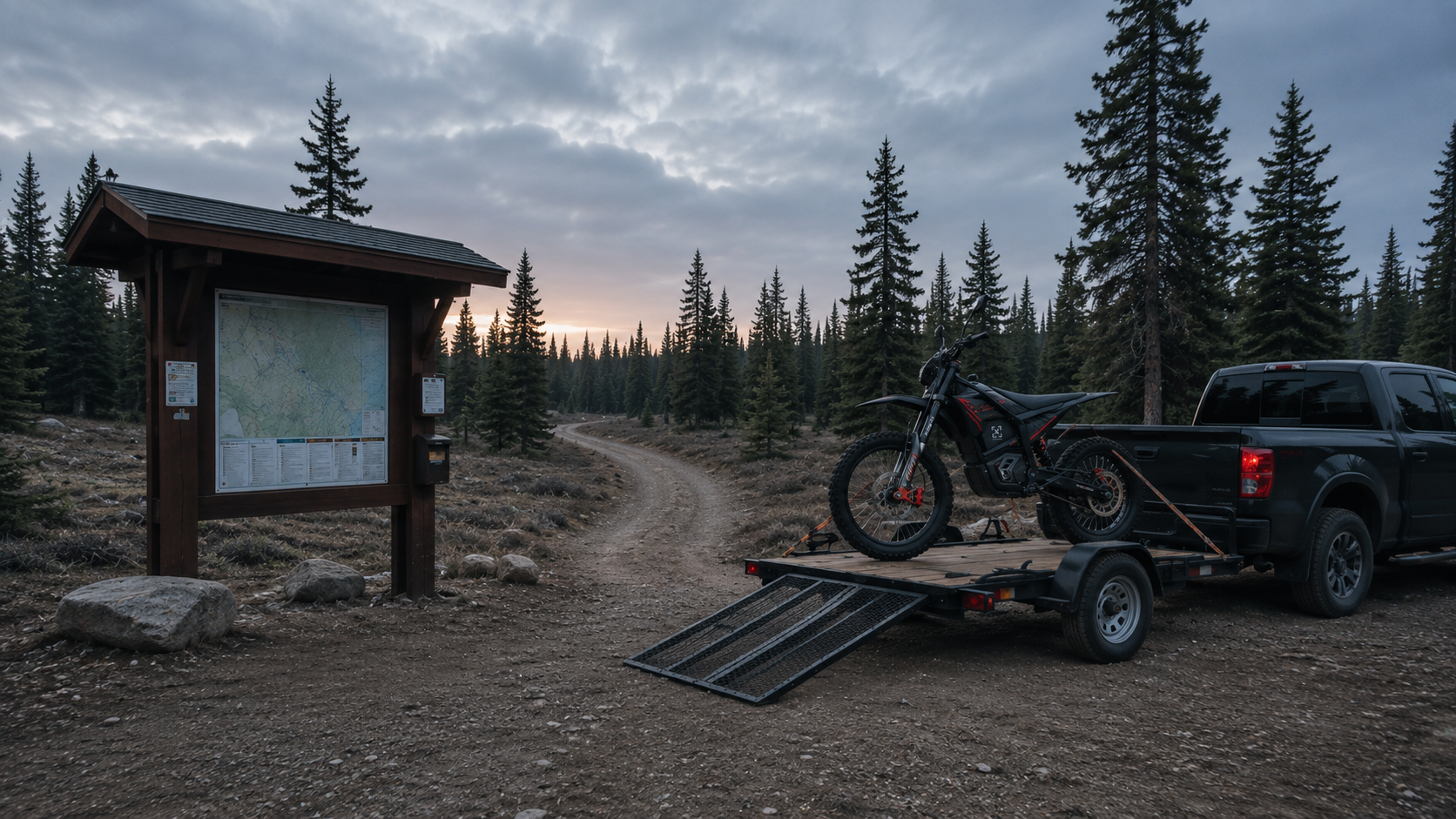
How to Find Legal Electric Dirt Bike Trails Near You
That order is the whole thing. Most riders searching for legal electric dirt bike trails near them open a trail app, pick the closest dirt line, and load up. The app was almost certainly not written for their machine. An adult electric off-road motorcycle with foot pegs instead of pedals and a motor rated in kilowatts falls outside the federal e-bike definition, placing it in the off-highway vehicle bucket. Different rules apply. Different maps apply. So do different penalties.
The good news is that the verification process is short once you know the order. Classify the bike. Identify who manages the land. Confirm the exact route for your vehicle class. Check permits and current closures. Then confirm you can legally reach the trailhead and leave it again.
Five steps. Roughly ten minutes at a kitchen table, and it holds up at a ranger station.
The 60-Second Check Before You Load the Bike
Run this before the ramps come out. If any row lands on uncertain, resolve that row before the trip rather than at the trailhead.
|
Question |
What counts as a pass |
Where to confirm it |
|
Is motorized motorcycle use allowed here? |
Wording that names motorcycles, motor vehicles or OHVs. Not "bikes allowed". |
The land manager's current map or posted rules |
|
Does my bike match the allowed vehicle class? |
The route lists a class your machine actually fits. |
MVUM legend, park rules, field office |
|
Do I hold the permit or registration? |
Valid on the ride date, displayed as required. |
State OHV program plus the site entry page |
|
Is the route open today? |
No active fire, storm, seasonal or emergency order. |
Agency alerts page, checked within a day or two |
|
Can I reach it and leave it legally? |
Legal staging, plus every connector and crossing. |
Same map, plus the road authority |
Four passes and one uncertain is not four fifths of a legal ride. It is an illegal ride with paperwork.
Why Your Electric Dirt Bike Is Probably Not an E-Bike

This is where most riders go wrong, and it is not their fault. The word electric does a lot of unhelpful work.
The Federal Definition Has Three Parts, Not One
Under the Bureau of Land Management rule at 43 CFR 8340.0-5, an electric bicycle is a two or three wheeled cycle with fully operable pedals and an electric motor of not more than 750 watts. Three classes sit inside that. Class 1 assists only while the rider pedals and stops assisting at 20 mph. Class 2 can propel the bicycle on its own and stops at 20 mph. Class 3 assists only while pedaling and stops at 28 mph.
Pedals. Wattage. Speed cutoff. All three, not one of three. BLM states the point directly in its e-bike rule questions and answers: the rule covers Class 1, 2 and 3 only, and every other type of electric vehicle continues to be managed as an off-highway vehicle under 43 CFR Part 8340. That explicitly includes machines above 750 watts or above 28 mph.
What Happens When the Bike Falls Outside It
It generally enters the motorized or off-highway vehicle system used by that land manager. The definition and accepted vehicle classes still need to be checked for the exact route. The EM-5 Pro, for example, is listed at 5,600 watts with footpegs, so it does not fit a federal land-manager e-bike category built around fully operable pedals and no more than 750 watts.
So the useful move is to stop searching for trails that allow e-bikes and start searching for trails that allow motorcycles. Riders who compare wattage and top speed across the lineup usually reach the same conclusion in about a minute. Every full size machine in the category clears the line by a wide margin.
There is one narrow exception worth knowing, because it explains a lot of confusing signage. A qualifying e-bike can be excluded from the off-road vehicle definition, but only when three conditions hold at once: it is on a route where mechanised non-motorized use is allowed, the motor is not doing all the propelling for an extended stretch, and an authorized officer has expressly decided in a planning document that e-bikes get treated like non-motorized bicycles. Miss any one and the exclusion does not apply.
None of which helps a bike with no pedals.
Identify the Land Manager Before You Pick the Trail
Access is not a property of the trail. It is a decision made by whoever manages the ground under it. Work from the riding area down to the segment, never the reverse.
National Forest Land
The controlling document is the Motor Vehicle Use Map for that forest. The Forest Service is unambiguous about its weight: routes not shown on the MVUM are not open to public motor vehicle travel. It is a legal designation map, not an inventory of what exists on the ground.
BLM Land
Finding BLM land on a map tells you nothing about access. The travel designation for that specific area does. BLM also notes on its off-highway vehicle pages that all off-highway vehicles must comply with state regulations and restrictions, and that vehicles must be registered with the appropriate state agency where required. Federal permission does not replace a state sticker.
State, County, Commercial and Club Land
Dedicated OHV parks are often the easiest ground to verify, because one operator sets the vehicle rules and publishes them. Commercial motocross tracks and trail parks are similar, though not every facility accepts electric machines, and charging policy is worth a phone call. Clubs can offer consistent access under a membership. Private land needs clear permission from the owner, ideally in writing, and a conversation about exactly where you may ride and how you may enter.
A vacant lot with no gate is not public riding ground. It is somebody's property.
How to Read a Motor Vehicle Use Map
The MVUM is the single highest value skill in this whole process, and it takes about fifteen minutes to learn. It exists because of the 2005 Travel Management Rule, and it shows designated routes, allowed uses by vehicle class, seasonal allowances and distance allowances.
Get the Right Forest, and the Current Map
Large forests contain several ranger districts and more than one map, so a neighboring district map may not cover your trailhead at all. The Forest Service requires the most recent versions to be posted on the individual forest pages, which makes the forest site the correct starting point rather than a saved copy from last season.
Read the Vehicle Class Legend, Not Just the Line

A route line on its own tells you almost nothing. The legend is where the answer lives. Typical MVUM designations run like this:
- Roads open to highway legal vehicles only.
- All vehicles, licensed and unlicensed, on the same road.
- Trails for vehicles 50 inches or less in width, which covers ATVs and motorcycles.
- Full size vehicle trails, often rugged and narrow, aimed at four wheel drives.
- Single track. Motorcycles only.
That first line catches people because a highway-legal designation can exclude a factory off-road machine even when the surface is dirt. Vehicle class is not wheel diameter: “vehicles 50 inches or less” refers to width or route designation, while “motorcycles only” refers to vehicle type. Confirm the bike's actual overall width and the legend on that specific map; a 19-inch wheel tells you neither.
The Forest Service adds a line worth taping to your toolbox: legal does not mean prudent. A low standard road may permit all vehicles without being a sensible place to take one.
Trace Every Segment, Including the Connectors
Zoom in at junctions. Two legal motorized trails can sit a few hundred feet apart with a non-motorized or privately owned link between them, and that link breaks the loop. Tire tracks on the ground prove that somebody rode there. They do not prove it was authorized.
Then check the season. MVUMs can show seasonal allowances, and the reasons the Forest Service gives are wildlife disturbance, unsafe or impassable conditions, and impacts to soil, water and vegetation. A trail that is legal for motorcycles in October may be closed in April.
BLM Designations: Open, Limited and Closed

Three words carry most of the meaning on BLM ground, and the middle one causes the most trouble because riders read it as a mild version of open. It is not. Limited is a container for a long list of possible restrictions, all defined in regulation.
|
Designation |
What it means |
What to check before riding |
|
Open |
All types of vehicle use permitted at all times, anywhere in the area, subject to the operating rules and vehicle standards in the regulations. |
Confirm the area really carries the Open designation in the current plan, not just on a forum post. |
|
Limited |
Restricted by time, area or vehicle use. Categories include number of vehicles, type of vehicle, season, permitted or licensed use only, existing roads and trails, and designated roads and trails. |
Find which restriction applies. Licensed use only and designated routes are the two that most often exclude an off-road only machine. |
|
Closed |
Off-road vehicle use is prohibited. Use may be allowed for certain reasons, but only with the approval of the authorized officer. |
Treat as a stop. Do not read a closure as a formality. |
Cross-country travel is its own question. BLM limits e-bike cross-country travel to areas designated open unless an authorized officer says otherwise, and the same logic applies with more force to a machine managed as an OHV. In a Limited area that usually means staying on a defined network rather than picking any visible track.
Trail Apps Find Trails. They Do Not Grant Access.
Trail apps are useful for discovery, land-boundary context, and offline navigation. They still do not grant access: a rendered route can cross private land, a closed segment, or a vehicle-class restriction. Use an app to build a shortlist, then verify every segment on the current land-manager source.
The failure mode is treating a rendered route as permission.
Use them to build a shortlist, inspect the terrain, and save maps for offline navigation. Then take that shortlist to the land manager's current information and check it segment by segment. Where an app and an official source disagree, the official source wins, every time, with no exceptions. Community condition reports are worth reading for what the ground is like. They carry no authority over who may ride it.
One practical habit: check the date and title on any official map you save offline. A correct map from three seasons ago is a wrong map today.
Permits, Registration and Entry Rules

Finding a legal route does not finish the job. The bike or the rider may still need paperwork, and the requirements stack rather than replace one another.
- State OHV registration or an off-highway permit, searched using the classification you established at the start rather than the marketing name on the box.
- A site specific trail permit or day pass, which a statewide registration does not automatically cover. Check whether it must be bought online, displayed on the machine, or collected at the gate.
- Rider age and safety course rules, which vary by state, by riding area, by vehicle and by rider age. Do not plan a young rider's day using the adult rules.
- Park specific equipment rules, which can be stricter than statewide law. A facility can set entry conditions of its own.
Age matters more here than most guides admit, because the number is set by the machine as well as by the venue. The EM-5 is rated 13 and up, the EM23 is 16 and up, and the EM-5 Pro is 18 and up for adults only. Those ratings are not interchangeable, and a park that permits a 16 year old rider does not turn an adults only machine into a legal choice for one.
Do not copy another rider's requirements from a different state. Registration rules can depend on residency and on how that state classifies the vehicle.
Four Shortcuts We Will Not Give You
We build adult electric off-road motorcycles, so we read a lot of trail advice written about them. Four shortcuts show up often enough to be worth refusing in print.
A wattage number that decides legality for you. We will not publish one. The 750 watt figure is a federal e-bike ceiling, not a national trail rule. Your state may classify the same machine differently, and a park can be stricter than both. The number tells you which rulebook to open, and nothing else.
A universal setup or maintenance figure. No tire pressure, no chain slack, no torque value, no service interval. Those are model specific and they belong in your model's user manual, which is also the fastest place to confirm the wattage and intended use a ranger will ask about.
The quiet operation argument. A near silent motor is a reason to slow down earlier at blind corners, because other trail users will not hear you coming. It is not an exemption from anything. Land managers write rules about vehicle class, not decibels.
An assumption about spark arresters. BLM best practices list an approved spark arrester and muffler for motorcycles, and the regulation defines a spark arrester as a device that traps or destroys 80 percent or more of exhaust particles. A machine with no exhaust clearly cannot carry one. Whether that counts as compliance or as a gap in a checklist written for gas engines is the field office call, not ours, and asking takes one phone call.
We would rather send you to a phone number than hand you a number that gets you cited.
Check the Whole Trip, Not Just the Trail

A legal trail can still produce an illegal day. The gap is almost always the approach.
Find the authorized staging area and work out where public motorized operation actually begins. Unloading at a campground, a roadside pull off, a hotel lot or a friend's driveway and riding to the trail entrance is the most common way a careful plan falls apart. If the connecting road requires street legal vehicles, an off-road only machine stays on the trailer until you reach approved staging.
Road crossings and road riding are separate questions governed by different rules, and permission to cross at one marked point is not permission to travel a mile of pavement. This is the same wall riders hit when they try riding in a neighborhood, and the answer is usually the same. Transport the bike.
For on-road motorcycle operation, NHTSA notes that every state requires a motorcycle license endorsement in addition to an automobile license. Off-highway licensing and safety-certificate rules are separate and vary by state and riding area. A legal trail does not create permission to ride an off-road-only machine on a public-road connector.
Last item, and it is the one people forget until they are circling a full lot. Confirm the trailhead takes your tow vehicle, your trailer or your carrier, and check gate hours and parking fees. The best legal trail in the state is no use if you cannot legally park at it.
How We Built This Guide
Because the cost of being wrong here is a citation rather than a bad afternoon, here is the method.
Primary Sources Only, Fetched Live
Every regulatory statement above traces to a federal source we opened on 10 August 2026: the Forest Service MVUM guidance, the BLM e-bike rule and OHV pages, the definitions at 43 CFR 8340.0-5, and NHTSA licensing guidance. No aggregator, no forum, no summary of a summary.
Nothing Published That We Could Not Source
The most dangerous access claims are confident answers without a current map, agency page, or named office behind them. Where a rule varies by state, district, or machine, this guide sends the rider to the authority that owns the answer instead of filling the gap with an average.
Written From the Rider Side of the Counter
A trailhead conversation becomes much shorter when the rider can state four things precisely: vehicle class, route number, designation, and ride date. Those terms let the managing office answer the actual access question without guessing from the word “bike.”
Before You Load the Bike
Classify the machine. Name the land manager. Confirm the route for your vehicle class on the current official map. Check permits and today's closures. Then trace the trip from where you park to where you turn around and back.
Do that once and it becomes fast. Do it every trip and access stays open, which is the part that matters for everybody riding behind you. Ride the designated route, slow down early around other users, stay off saturated ground, and pass in a way that does not widen the trail.
Still deciding which machine fits the ground you actually have nearby? Check the age rating and the vehicle class before the top speed. Those two decide where you can legally ride it.
FAQs
Where can you legally ride an electric dirt bike?
Ride on private land with permission or on public and commercial routes specifically open to your vehicle class.
For National Forest land, use the current Motor Vehicle Use Map for the correct ranger district. For BLM land, check the field office's open, limited, or closed designations. State parks, counties, clubs, and private OHV parks may add registration, passes, age rules, or equipment requirements.
Practical tip: Verify the complete route, including road connectors and the return leg—not only the main trail.
How do you know whether the bike is treated as an e-bike or an OHV?
Check pedals, motor output, assisted speed, and design intent against the definition used by the agency managing the land.
Federal land-manager e-bike rules generally describe pedal-equipped machines within specific power and speed limits. A footpeg-equipped electric dirt bike with several thousand watts normally falls outside that category and must use motorized routes that accept its vehicle class.
Practical tip: Carry a factory specification page and origin document when the classification is likely to be questioned.
What map controls motorized use in a National Forest?
The current Motor Vehicle Use Map for the exact forest and ranger district controls designated motorized routes.
A route absent from the map is not open merely because it has tire tracks or appears in a trail app. Read the vehicle-class legend and seasonal designations, then trace every connector. The map can be available digitally, but the official forest page is the right place to obtain the current version.
Practical tip: Do not rely on last season's saved map without checking the revision date.
Can trail apps prove that an electric dirt bike route is legal?
No. Trail apps are useful for discovery and navigation, but they do not grant access.
User-uploaded tracks can include closed routes, private land, non-motorized connectors, or stale seasonal information. Use the app to find a candidate, then verify it against the current land-manager map, closure order, and permit page.
Practical tip: If the app and official map disagree, follow the official map and call the managing office.
Do you need registration or a permit for public trails?
Frequently, but the credential can be a state OHV registration, nonresident permit, trail pass, site-entry fee, or a combination.
Registration identifies the vehicle; a trail permit funds or authorizes use of a particular system. Neither one overrides a closed route. Check the vehicle, rider, and location requirements separately.
Practical tip: Carry proof in the form the agency accepts—paper, digital receipt, decal, or certificate.
How do you check closures, trail connectors, and road crossings?
Trace the trip segment by segment on current official sources and confirm the date of each closure notice.
- Check the trailhead and parking rules.
- Verify every forest road or highway connector by vehicle class.
- Read seasonal, fire, weather, and maintenance closures.
- Confirm the return route remains open at the expected time.
Practical tip: When a short connector is unclear, call the ranger district or local road authority before the trip.
Sources
- USDA Forest Service, Motor Vehicle Use Map (MVUM) Information and Frequently Asked Questions (2026).
- Bureau of Land Management, BLM Final E-Bike Rule: Questions and Answers (2026).
- Bureau of Land Management, Off-Highway Vehicles on Public Lands (2026).
- Office of the Federal Register, 43 CFR 8340.0-5, Definitions (2026).
- National Highway Traffic Safety Administration, Motorcycle Safety (2026).


Looking for something else?

Electric Dirt Bike Replacement Parts Availability: What Buyers Should Verify Before Ordering
LEARN MORE
How to Check an Electric Dirt Bike for Safety Recalls by Model and Serial Number
LEARN MORE
How to Choose an Electric Dirt Bike Repair Shop: Questions to Ask Before Service
LEARN MORE
How to Lift a Fallen Electric Dirt Bike Without Hurting Yourself or the Bike
LEARN MORELooking for something else?

Electric Dirt Bike Fall Riding on Wet Leaves: Grip, Hidden Obstacles and Braking
LEARN MORE
Electric Dirt Bike Trailside Power Loss: Recovery Plan When the Battery Is Dead
LEARN MORE