Electric Dirt Bike Water Crossings: Depth, Electrical Risk and Recovery
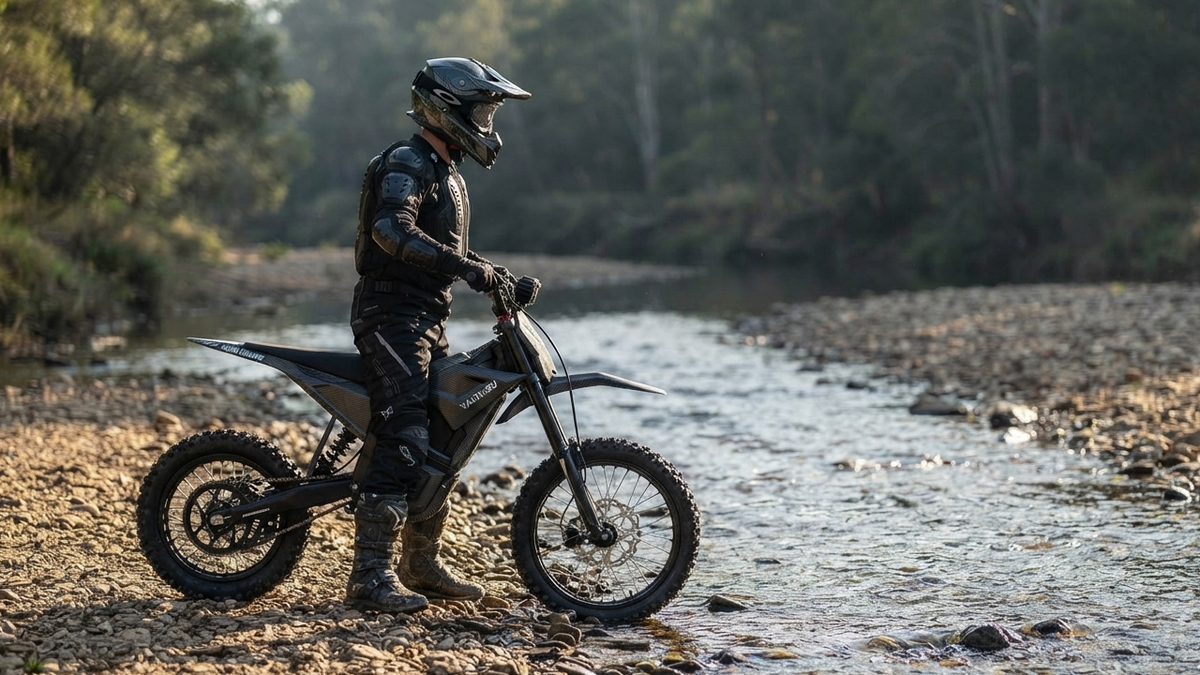
Do not infer a safe crossing depth from an IP rating. Consider a water crossing only when the route and crossing are authorized, the water and bottom are fully observable, recovery consequences are low and the exact motorcycle documentation permits the expected exposure.
A running motor does not confirm that the current, bottom, banks, electrical system or recovery plan are safe. Motorcycle weight also becomes harder to manage on slippery footing and in moving water. There is no universal safe depth that transfers across models and crossings.
There is also no universal crossing speed, exposure time or current limit. Use the go/no-go gate below for creeks, designated fords and standing-water sections, followed by the shutdown, recovery and charging steps for unexpected exposure.
The Water-Crossing Gate: Every Row Has to Pass
All six conditions must pass. If route status, water movement, bottom, exit, motorcycle limits or recovery is unknown, use a dry authorized alternate. A parking-lot puddle does not establish that a natural channel is safe.
Cross Only When Every Condition Is Known
Authorization first. Motorized use open on that route; that specific crossing designated. Then the physical read: bottom condition, water movement, the line you intend to hold, the far bank, an exit with somewhere to stop past it.
Your skill and your group's recovery plan have to match the feature in front of you, not the one you were hoping for. Last, expected exposure sits inside the manufacturer's documented limits. That part is not optional.
Choose the Dry Alternate When Anything Is Unclear
Any single item below ends the discussion.
- Depth unknown, or a bottom hidden under silt, algae, or tannin-stained water.
- Recent flooding. Channels move, and last season's line may not exist.
- You cannot confirm the access rules on a current map or at the sign.
- The manual says nothing about water exposure, so any limit would be invented.
- Damaged seal. Loose cover, wet connector, or a warning on the display.
Do not assume the visible shallow edge continues across the channel. Unknown depth or bottom condition is a no-go result.
|
Condition |
Go only when |
No-go trigger |
|
Route status |
Motorized use and that specific crossing are currently authorized |
Closure, barrier, unclear designation, or an off-route approach |
|
Water |
Conditions are stable and fully observable |
Floodwater, strong movement, rising level, floating debris, or doubt |
|
Bottom and exit |
The supported line and a usable exit are both known |
Hidden hole, soft bottom, undercut bank, downstream drop, or a blind exit |
|
Motorcycle |
Documentation permits the expected exposure, and the bike is undamaged |
No-submersion statement, unclear limit, damaged seal, loose connector, warning light |
|
Rider and group |
Skills and recovery resources match a low-consequence feature |
Riding solo, weak footing, downstream hazard, or no workable recovery plan |
|
Environmental impact |
The designated surface can carry the traffic |
Bank damage, heavy sediment, habitat disturbance, or widening of the ford |
One trigger ends it. Not two, and not a majority of rows.
IPX6 Is a Lab Test, Not a Crossing Depth
IPX6 records performance in a controlled water-jet test for an enclosure. It does not establish a safe immersion depth, crossing duration, current limit or permission to enter a natural waterway.
What the IPX6 Test Actually Involves
Under IEC 60529: a 12.5 mm nozzle, roughly 100 litres per minute plus or minus 5%, about 100 kPa, from 2.5 to 3 metres away, from every practicable direction. Three minutes minimum, calculated at one minute per square metre of exposed surface.
Then the enclosure is dried, opened and inspected for harmful ingress. Notice what is absent. No depth. No time submerged. No grit, and no seal that got dragged across a rock in March and has sat slightly proud of its groove ever since.
|
Rating |
Protects against |
How it is tested |
|
IPX4 |
Splashing water |
Spray from all directions, no harmful effect |
|
IPX5 |
Water jets |
6.3 mm nozzle, about 12.5 L/min, 3 min minimum |
|
IPX6 |
Powerful water jets |
12.5 mm nozzle, about 100 L/min at about 100 kPa, 3 min minimum |
|
IPX7 |
Immersion to 1 m |
Submerged 30 minutes at 1 metre depth |
|
IPX8 |
Immersion beyond 1 m |
Conditions set by the manufacturer, deeper than 1 metre |
Jet Ratings and Immersion Ratings Are Not Interchangeable
Different test, different physics. A jet delivers impact force against one face. Immersion applies static pressure to every seal at once, for as long as the bike is under.
A gasket that shrugs off 100 kPa of moving water can still weep under a column of standing creek. IEC 60529 does not treat a higher second digit as containing the lower ones either, which is why products that pass both tests get marked for both.
One Rating Rarely Covers the Whole Motorcycle

Battery enclosure. Motor, controller, display, charge port, and the connector blocks behind the number plate. Separate housings, separate seals, and nothing requires them to share a protection level.
Do not apply a rating for one enclosure or component to the whole motorcycle unless the manufacturer explicitly does so. Check the documented protection and condition of the battery enclosure, controller, display, charge port, wiring, and connectors separately.
Follow the Most Restrictive Documented Limit
Four documents: the motorcycle manual, the battery instructions, component paperwork, warranty terms. Valtinsu keeps these on one user manual and spec sheets hub, and most brands have an equivalent.
If documents appear to conflict, pause and obtain model-specific clarification from the manufacturer. Until then, follow the most restrictive published instruction; an IP rating does not cancel a written no-submersion limit.
Legality Comes Before Capability
Capability is not permission. Motorized access varies by route, by season, by vehicle class, and by whatever the land manager decided after the last washout, and none of that is visible from the saddle.
Verify the Route and the Designated Crossing
Check the current trail map, posted signs, seasonal closures, and responsible land-manager guidance. Confirm that the motorcycle’s vehicle class is allowed and that the crossing itself is designated; a visible track is not proof of authorization.
Never Cut a New Entry or Exit
Stay on the managed surface. Do not ride around a gate, cut down a bank, or widen a ford for a different line. If the designated entry or exit is blocked or unsuitable, use an authorized alternative.
What Fords Actually Do to a Stream
The damage is measurable. Forest Service researchers surveyed 15 ford-type crossings in an off-highway vehicle trail complex in the Ouachita National Forest. Every one of the 14 sites designated for OHV use showed roughly 30 to 45 cm of soil loss on the trail segments on either side.
In-channel effects turned up at 93% of sites: bank erosion, mud coatings on the coarse bed material, fine sediment accumulating, and in places large channel-filling sediment plugs. That is repeated passage at crossings chosen and managed for the purpose.
So turn back when passage would tear vegetation, collapse a bank, or stir heavy sediment. Tires move things too. Mud, seeds and aquatic organisms travel between watersheds on a rear tire, which is the slower problem and the harder one to undo.
Inspect the Whole Crossing From Dry Ground
Assess the entire feature from dry ground before the front tire touches water. The near edge may not represent the depth, current, bottom stability, or exit conditions farther across.
Confirm the Line, the Far Bank and the Exit
You need an uninterrupted view of the line, the opposite bank, a usable exit, and flat ground past it. A blind bend disqualifies it. So does a submerged ledge, an undercut bank, or an exit screened by brush.

Check that the line does not point you at a downstream drop if you lose drive halfway across. The exit also has to be climbable without wheelspin, because spinning a rear tire up a wet bank damages the bank and may not get you out of the water.
Unknown Depth Is a Stop Condition
Do not judge safety by comparing the visible waterline with the axles, motor, or battery. Depth and bottom condition can change across the channel and after flooding, traffic, or erosion.
The National Weather Service makes the same point about flooded roads: judging exact depth, or the condition of the surface underneath it, is close to impossible from outside. Six inches of fast-moving water knocks an adult off their feet. Six. Do not wade into moving, opaque or contaminated water to measure anything.
Read the Current and What Happened Upstream
Watch for standing waves, floating debris, changing colour, and a level that creeps up while you stand there. Check rain upstream. Not the sky above you. Current pushes wheels sideways and undermines footing. It turns a routine recovery into a rescue, at depths that look harmless from the bank.
Leave Recovery Margin
Think through the version where the bike stops in the middle. Plan on the full ready-to-ride weight of your own machine, taken from the manual rather than from memory. Then add what no spec sheet lists. Water held in the tires and bodywork, a rider in soaked gear, and a slick bottom underfoot. Nobody should end up standing downstream of a stalled motorcycle, wading deeper, lifting past their ability, or dragging a bike toward a drop.
A crossing fails the gate if the group cannot recover a disabled motorcycle from stable ground without entering unsafe water, exceeding lifting capability, or damaging the bank.
Prepare the Bike Without Changing Its Protection
Documented inspection and setup. Nothing else. Tape and sealant do not create an immersion rating, and treating them as though they do is how riders end up sealing water inside a housing.
Inspect Seals, Covers and Connectors

Look for displaced covers, damaged gaskets, cracked housings, loose plugs, exposed conductors, wet battery contacts, and cable abrasion. Inspect any area affected by an accessory installation, and verify that added mounts or wiring follow the manufacturer’s sealing and routing instructions.
Improvised Waterproofing Makes It Worse
Plastic wrap, tape, unapproved sealant or grease, and altered drainage paths do not create an immersion rating and may trap moisture or conflict with maintenance and warranty terms. Confirm instead that covers, battery retention, display, and approved accessories are installed as the manual specifies.
Technique When the Gate Says Go
A clear go means authorized, shallow, observable, low-consequence. Ride it deliberately even then. There is no universal crossing speed, and momentum does not rescue a bad read of the bottom.
Pick the Ride Mode on Dry Ground, After the Gate Passes
Most adult e-motos ship with staged power modes. Mode choice sits underneath the gate, not beside it. Only once every row has passed and the model documentation permits the expected exposure, select a manufacturer-approved mode whose throttle response you have already practised on dry ground.
No mode changes the water-exposure limits, and none of them makes an unknown crossing safe. Do not change settings mid-crossing unless your model supports it on the move.
Steady Inputs, Known Line
Use the designated approach and hold steady momentum. Avoid direction changes that widen the crossing or load the tires sideways on slick rock. Sudden torque breaks rear grip. Abrupt braking throws weight onto a front wheel that may be on gravel, or on nothing much at all. Know how throttle-off and regen feel before you need that information.
The Exit Is Still the Decision Point
Do not enter unless the far-side exit is open and staying open. Conditions change while a group queues up. They change fast. If something shifts, stop on dry ground and reassess, rather than committing because three riders already made it across.
What Water Actually Does to an Electric Dirt Bike
Water exposure can create immediate electrical faults or delayed corrosion and mechanical wear. The outcome depends on exposure, contamination, seal condition, component protection, and the manufacturer’s shutdown and inspection procedure.
Battery and High-Voltage System
Moisture past a damaged seal produces isolation faults, odd Battery Management System behaviour, abnormal heat, and eventual cell failure. NHTSA is blunt on the principle for owners. Assume the high-voltage battery and its components are energized and fully charged. Treat a flooded pack as capable of shorting and starting a fire, with ignition that may be immediate or delayed by weeks. Never open a battery housing yourself.
Controller, Display, Wiring, Connectors
Water and contaminants can enter damaged housings or connector blocks and later produce intermittent faults, corrosion, or changed operation. Treat power loss, display warnings, fuse problems, or new behavior after exposure as reasons to stop and obtain qualified inspection.
Motor, Bearings, Brakes, Drivetrain
Water and suspended grit can affect bearings, brakes, chain, and sprockets. After permitted exposure within the documented limit, clean, dry, inspect, and service the motorcycle using the manufacturer’s procedure before the next ride.
Freshwater Is Not Harmless
Saltwater is generally more corrosive than freshwater, but freshwater can still carry silt and dissolved contaminants. Neither should be treated as harmless around damaged seals, connectors, bearings, brakes, or the battery system.
|
Expert View: the most expensive sentence in e-moto ownership A motorcycle that restarts after water exposure may still have trapped moisture, damaged seals, contamination or delayed corrosion. Continued operation does not prove that the battery, controller, connectors or charging system are safe. Follow the manufacturer's shutdown and inspection procedure before riding or charging again. Which is why the charging gate below sits apart from the riding decision. A successful restart tests whether the bike moves. It does not test whether water is sitting inside a sealed enclosure with 60 volts across it. |
Recovery Without Adding Power
If the bike stalls, stops, or goes over in a crossing, the sequence matters. First step: not touching the motorcycle.
People First
Do not enter swift, rising or contaminated water to recover a motorcycle. Move people clear of downstream hazards and call trained emergency or recovery services when conditions exceed the group's safe capability.
Make It Inert If You Can Reach It Safely
Follow your model's documented shutdown procedure so a stray throttle input cannot do anything. Do not touch damaged conductors. If the battery is hissing, smoking, swelling, leaking, or heating, leave it where it is and move people back.
Do Not Keep Cycling Power
Do not repeatedly cycle power or apply throttle after a stall, submersion, suspected short, or mechanical obstruction. Keep the motorcycle shut down and follow the model’s recovery and inspection procedure.
Pull From Stable Ground, or Stop
Helpers stay out of the fall path and off the downstream side. Approved lifting or towing points only. Never cables, wheels, brake hoses, or electrical housings. Then know the stopping condition. If recovery needs somebody standing in unsafe water, a lift beyond the group's strength, a pull toward exposure, or tearing up the streambank, call for professional help instead of making one more attempt.
The Charging Gate After Water Exposure
A working display proves very little. Neither does a spinning motor, and neither confirms that the battery and its internal connections are dry. Charging is a separate decision, made later, on documentation rather than optimism.
Shut It Down and Leave It Down
Stop riding after submersion, a fall in water, unexplained power loss, an electrical warning, or suspected water entry into a housing. Use the documented shutdown procedure when it is safe and do not restart until the manufacturer or an authorized service provider has assessed the exposure.
Keep It Outside and Away From Structures

Scope first. A splash on a permitted route is not the same event as a submersion, and the two do not get the same response. Treat flooding, full submersion, an impact, or suspected damage to the battery enclosure as the serious case: keep people back, do not charge or restart, and follow the manufacturer's emergency procedure for that model.
Under those conditions NHTSA's guidance for a severely damaged vehicle with a lithium-ion battery is not to store it inside a structure, or within 50 feet of any structure, vehicle or combustibles, because damaged packs can ignite well after the event.
Call 911 for heat, odour, smoke, flames, leaking fluids, sparks, swelling, or gurgling and bubbling from the pack, and tell the dispatcher a lithium-ion traction battery is involved. Contact the manufacturer or an authorized service centre promptly either way, since there may be steps they can take to secure and discharge the pack.
No Charging Until the Manufacturer Clears It
Check the manual, then contact the manufacturer or an authorized service provider. A dry exterior, a clean startup and a night on the bench are not clearance. Do not dismantle, heat, puncture or bypass the battery, controller or motor. No improvised repairs. Internal inspection belongs to whoever will honour the warranty.
Isolate Visible Battery Hazards
UL Research Institutes lists the signs to act on immediately: swelling or punctures, hissing or popping sounds, excessive heat, a strange odour. White or grey wispy smoke means immediate danger of fire. Any of those signs, and the instruction is to stop using the device. At once, not after the ride home. Keep people away, leave the bike where it is, and call emergency services when conditions call for it.
Document the Exposure, Then Watch It
Keep the bike shut down while gathering information for the manufacturer or service provider. From a safe position, record whether it fell, stopped, displayed a warning, or went fully under; note the water type and exposed areas, and photograph visible residue, loose covers, damaged seals, connectors, or display messages.
- Corrosion or residue appearing around connectors and contacts.
- Intermittent power, or a display fault that comes and goes.
- Motor behaviour that changed, including new noise under load.
- Brake response that is not what it was.
- Heat, odour, or a charge cycle that behaves differently.
Stop riding if operation changes. Routine cleaning and inspection, covered in the general maintenance guide, resumes after the system has been cleared.
Where the Valtinsu EM-5 Pro Fits, and Where It Does Not
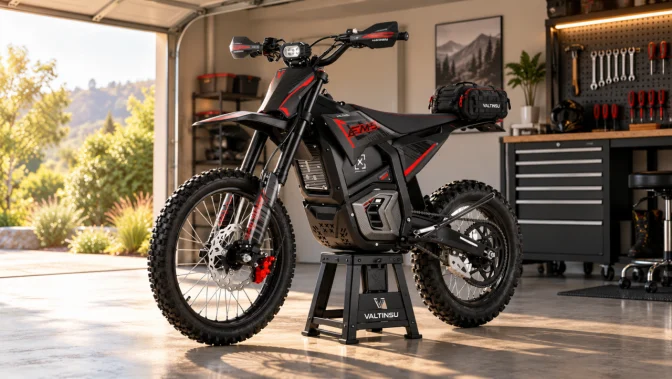
Use current model documentation as the boundary. The EM-5 Pro page and manual describe water exposure limits, and those instructions—not motor power, wheel size, or a general IP label—determine whether a wet-weather situation is permitted. Confirm the current documents before planning a crossing.

Apply the same document-first test to every brand and model. Do not assume another electric dirt bike has a published crossing depth or equivalent enclosure protection; verify its motorcycle, battery, and component instructions separately.
Match the Route to the Documented Limit
Consider the EM-5 Pro only where expected exposure stays within every published limit. Its IPX6 rating supports a defined water-jet test, while its documentation says not to submerge the bike or use it for deep-water crossings. Do not convert those statements into an unpublished crossing depth or call the motorcycle waterproof.
Capability Is Not Permission
Specifications do not override a closure, flooded channel, unknown bottom, or unacceptable stream damage. A crossing must pass the route, water, bottom and exit, motorcycle, rider and group, recovery, and environmental checks.
How We Built This Guidance
Three inputs, weighted in this order.
Manufacturer Documentation First
Use manufacturer documentation and public-safety guidance rather than judging limits from a video. When a specification table and manual appear to conflict, obtain written clarification and follow the stricter published instruction in the meantime.
Public-Land and Flood-Safety Research
Four public sources carry the rest. The depth and environmental sections draw on USDA Forest Service field measurements at designated OHV ford crossings, NOAA National Weather Service flood-safety guidance, NHTSA's owner guidance for high-voltage batteries, and UL Research Institutes' lithium-ion warning signs. The IPX6 material comes from IEC 60529 test descriptions published by accredited compliance labs.
Rider Reports, Including the Bad Ones
Rider reports can reveal questions worth investigating, but they do not establish a safe limit or predict delayed damage. The charging gate therefore relies on manufacturer procedures and public lithium-ion battery safety guidance.
Make the Dry Alternate the Default
Run the gate at every creek, ford, and standing-water section. If route authorization, water movement, bottom and exit, motorcycle limits, recovery, or stream impact cannot be confirmed, take a dry authorized alternative. Compare models by their current documented exposure limits rather than by an assumed crossing capability.
Turning around is the correct decision when a required condition remains unknown.
Frequently Asked Questions
Can an electric dirt bike cross water?
Only when the crossing is authorized, fully observable, low-consequence, and within the exact motorcycle’s documented exposure limits. If route status, current, bottom, exit, model limits, or recovery is unknown, use a dry authorized alternative.
Does IPX6 make an electric dirt bike safe for a creek crossing?
No. IPX6 describes a controlled water-jet test; it does not publish a safe depth, immersion time, or creek-crossing allowance. The motorcycle, battery, and component manuals may set stricter limits, including a no-submersion instruction.
How deep can an electric dirt bike go in water?
There is no universal depth that can be inferred from an IP rating. Use only a model-specific limit published by the manufacturer; if no depth is stated, treat the depth as unapproved rather than estimating from the axle, motor, or battery position.
What should I check before an authorized water crossing?
Assess the entire feature from dry ground and confirm:
- Current route authorization and vehicle-class access
- Clear water movement, a visible stable bottom, and no upstream flood signal
- A usable approach, far bank, exit, and stable ground beyond it
- Secure covers and connectors plus compliance with the model’s water-exposure limits
- A recovery plan that keeps people out of current, downstream hazards, and unstable footing
- Passage will not widen the ford, damage banks, or carry heavy sediment downstream
What should I do if the bike stops or falls in water?
Protect people first and do not add throttle or repeatedly cycle power. Then:
- Move riders away from current, downstream hazards, damaged wiring, smoke, heat, or odor.
- Use the documented shutdown procedure only if the motorcycle is safe to reach.
- Recover from stable ground with approved lifting or towing points; call trained help when conditions exceed the group’s capability.
- Keep the motorcycle shut down and follow the manufacturer’s water-exposure and inspection procedure before riding again.
Can I charge an electric dirt bike after submersion?
No—not until the manufacturer or an authorized service provider has assessed the motorcycle and cleared charging. A dry exterior or normal display does not confirm that the battery, controller, connectors, and charging system are dry or undamaged; keep people back and call emergency services if heat, smoke, swelling, leaking, hissing, or unusual odor appears.
Sources
- Applus+ Keystone Compliance, IPX6 Ingress Protection Testing (2023)
- Castle Compliance, IPX5 & IPX6 Water Jet Testing (2026)
- USDA Forest Service, Stream Channel Responses and Soil Loss at Off-Highway Vehicle Stream Crossings in the Ouachita National Forest (2014)
- NOAA National Weather Service, Turn Around Don't Drown (2026)
- NHTSA, Interim Guidance for Electric and Hybrid-Electric Vehicles Equipped With High-Voltage Batteries (Vehicle Owner / General Public) (2014)
- UL Research Institutes, Take C.H.A.R.G.E. of Battery Safety (2025)


Looking for something else?

Electric Dirt Bike Replacement Parts Availability: What Buyers Should Verify Before Ordering
LEARN MORE
How to Check an Electric Dirt Bike for Safety Recalls by Model and Serial Number
LEARN MORE
How to Choose an Electric Dirt Bike Repair Shop: Questions to Ask Before Service
LEARN MORE
How to Lift a Fallen Electric Dirt Bike Without Hurting Yourself or the Bike
LEARN MORELooking for something else?

Electric Dirt Bike Fall Riding on Wet Leaves: Grip, Hidden Obstacles and Braking
LEARN MORE
Electric Dirt Bike Trailside Power Loss: Recovery Plan When the Battery Is Dead
LEARN MORE