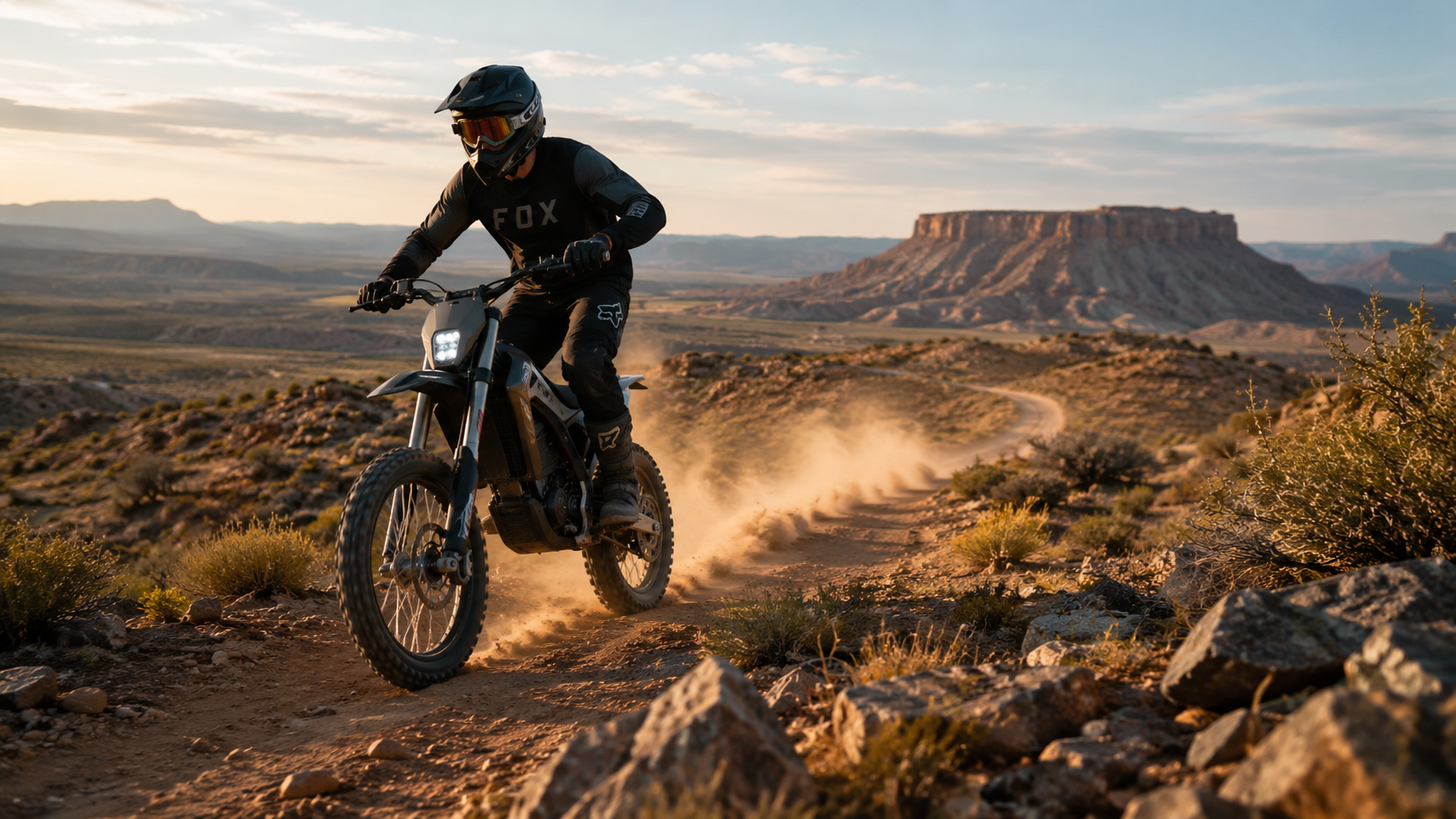
Electric Dirt Bike Range: How Far Can You Ride on One Charge?
Most adult electric dirt bikes range ride 25 to 70 miles on one charge. That is the honest range, and it is where the confusion starts. The number on the spec sheet and the number you get on a real trail are almost never the same.
Spec-sheet range comes from an easy test. Flat ground. A steady pace. A light rider, mild weather, the most efficient mode. Drop that same adult electric off-road motorcycle into sand and hill climbs and the battery empties faster. Two riders can buy the identical bike and walk away with very different mileage.
So look at how you actually ride before you compare batteries. Then weigh capacity, power modes, rider weight, and terrain together. Our electric dirt bike collection organized by battery and range lines the off-road models up by battery setup so you can match the spec to the riding you really do.
Quick Answer: Electric Dirt Bike Range per Charge
Range tracks with battery size. Riding style and terrain decide how much of it you keep. Here is the realistic planning band for each class, the kind we use when someone asks what to expect on a normal weekend ride. So how far can you ride an electric dirt bike on one charge?

|
Bike class
|
Battery (typical)
|
Advertised range
|
Real trail range
|
Best for
|
|
Lightweight / mini
|
48V to 52V
|
30 to 50 mi
|
15 to 35 mi
|
Beginners, short loops
|
|
Mid-size adult
|
60V
|
40 to 60 mi
|
25 to 50 mi
|
Mixed weekend trails
|
|
Full-size adult
|
60V to 72V
|
55 to 75 mi
|
40 to 70 mi
|
Long loops, heavier riders
|
|
High-performance
|
72V+
|
60 to 90 mi
|
30 to 60 mi*
|
Speed and climbs
|
Big batteries, but riders use the power, so real range often lands below the class above it.
Advertised Range vs Real Trail Range
Advertised range is a best case. Brands test on a smooth surface, at a calm speed, with a light rider in the efficient mode. A benchmark, not a promise.

The federal numbers say the same thing for cars, and the physics carries straight to dirt. The EPA multiplies its lab range by 0.7 to reach a real-world figure, a flat 30 percent cut for aggressive driving and climate load. A 200-mile lab result becomes about 140.
Off-road is harsher than any lab cycle. On dirt the motor fights rolling resistance the whole ride. Sand, mud, grass, rocks, and climbs all pull more current. Outdoor testers see it constantly, and GearJunkie notes most e-bikes miss their advertised range outside very specific conditions.
The working rule for real trail range riding: plan for 50 to 75 percent of the listed number. Ride hard and plan for less. Treat the brochure as the ceiling, never the floor.
What the Range Tests Actually Show
Controlled tests are useful because every bike rides the same trail, at the same pace, by the same rules. They strip out the marketing and leave the distance.
Electric Cycle Rider ran five mid-size electric dirt bikes until the packs died. They logged every mile by GPS, swapped riders every 10 to 15 minutes, and held a spirited singletrack pace in mid-power mode. The results were sobering:

|
Bike (controlled test)
|
Battery capacity
|
Range achieved
|
|
Arctic Leopard EX800
|
5.6 kWh (74V 75Ah)
|
34 miles
|
|
ECR Modded Surron Ultra Bee
|
4.1 kWh (74V 55Ah)
|
26 miles
|
|
Stock Surron Ultra Bee
|
4.1 kWh (74V 55Ah)
|
23 miles
|
|
Electric Motion Escape XR
|
3.5 kWh (50.4V 70Ah)
|
21 miles
|
|
Dust Moto Model One (proto)
|
2.8 kWh (72V 39Ah)
|
14 miles
|
Read that against the brochures. Even the 5.6 kWh Arctic Leopard, the biggest pack in the group, stopped at 34 miles on tight singletrack. Big battery. Hard trail. Modest distance.
Singletrack is brutal on a battery. The bike never settles. It starts, stops, climbs, and claws for grip, and every one of those is a current spike. Owner reports fill the rest of the picture. The same model can finish a full afternoon with charge to spare for a smooth rider in Eco, or die inside an hour for someone holding Boost on every straight. When you read a range number online, check the fine print: rider weight, terrain, speed, tire setup, power mode. A number without those is just a number.
Arctic Leopard EX800: Biggest Pack, Longest Run

The powerhouse of the test. A 5.6 kWh pack (74V 75Ah) and 17kW in Mode 2 with 30 percent regenerative braking, and it took the win at 34 miles. Regen is part of why: the motor claws a little charge back on every descent and slows the drain on long trails. Pros:
✓ Largest battery in the group, so the most stored energy to spend.
✓ Regenerative braking adds back charge on descents and steadies range.
Cons:
– Even the biggest pack only reached 34 miles on singletrack.
– More capacity usually means more weight to haul on slow climbs.
Surron Ultra Bee, Stock vs Modded: Same Battery, Different Miles
Both ran the identical 4.1 kWh pack (74V 55Ah). The stock bike, left near default with regen and traction control off, managed 23 miles. The modded version, heavier and more aggressive with an EBMX X9000 controller pushing 15kW in Map 2, somehow went farther at 26 miles, on the same battery and motor. Setup changes the result as much as hardware does.

Pros:
✓ Proven, widely supported platform with a deep aftermarket.
✓ Tuning and controller maps can shift real range several miles.
Cons:
– Stock range of 23 miles is modest for the price and power.
– Hard, aggressive riding empties the small-ish pack quickly.
Electric Motion Escape XR: Trials Heritage, Middle of the Pack
Built on trials DNA, so it is precise and efficient rather than brutal. Run at 50 percent throttle reactivity and 69 percent max power on a 3.5 kWh pack (50.4V 70Ah), it returned 21 miles. Lower voltage and a smaller pack capped the ceiling, but the smooth delivery kept it from bleeding out faster.

Pros:
✓ Precise, efficient power delivery from a trials background.
✓ Predictable throttle is easy on a battery in technical sections.
Cons:
– Smaller 3.5 kWh pack limits outright range.
– Tuned for finesse, not all-day distance.
Dust Moto Model One: The Prototype Wildcard
The outlier, a prototype that is not on sale yet and still developing its battery tech. With the smallest pack in the test at 2.8 kWh (72V 39Ah), it finished first to empty at 14 miles. A fair reminder that a high-voltage badge means little without the amp-hours behind it.

Pros:
✓ Lightweight prototype with promising suspension and handling.
– 72V badge does not help when the pack is only 2.8 kWh.
Cons:
– Smallest battery, so the shortest range by a wide margin.
– Not commercially available; specs may still change.
What This Means for Your Range
Three things fall out of the data. Watt-hours rule, so read volts times amp-hours, not the voltage badge. Singletrack is brutal, so even a 5.6 kWh pack landed at 34 miles. And setup matters as much as hardware, since the modded Surron beat the stock one on the same battery.
Owner reports fill the rest. The same model can finish a full afternoon with charge to spare for a smooth rider in Eco, or die inside an hour for someone holding Boost on every straight. When you read a range number online, check the fine print: rider weight, terrain, speed, tire setup, power mode. A number without those is just a number.
Valtinsu EM-5 Ultra vs Surron Ultra Bee: Range and Price
This is the comparison most adult buyers actually run, so here it is straight. The Valtinsu EM-5 Ultra and the Surron Ultra Bee HP land within a few miles of each other on range. They are nowhere near each other on price.
|
Spec
|
Valtinsu EM-5 Ultra
|
Surron Ultra Bee HP (2026)
|
|
Range (rated / tested)
|
75 mi rated
|
Up to 71 mi at 31 mph
|
|
Battery
|
72V 25Ah Samsung
|
74V 60Ah
|
|
Peak power
|
7,000W
|
~21kW (turbo)
|
|
Top speed
|
56 mph
|
~56 mph
|
|
Price (US)
|
$1,999 early-bird
|
~$6,000 to $8,300
|
|
Availability
|
Pre-order, ships ~Aug 2026
|
In stock / pre-order
|
Read the range rows first. The Ultra is rated for 75 miles; the Surron is tested to about 71 at a steady 31 mph. For a weekend trail rider, that is the same ballpark. The price rows are where it stops being close. The Surron carries a far bigger 74V 60Ah pack and a much higher peak output, which is why it dominates on raw track performance and acceleration.

Where Surron clearly wins: peak power, the deeper aftermarket, race pedigree, and resale value. That is a real list, and worth naming. Where the EM-5 Ultra wins: it puts a comparable real-world range on the trail for roughly a third to a quarter of the money, and it adds a reverse gear for backing out of ruts. If your goal is all-day range per dollar, the Ultra is hard to argue with. If your goal is the fastest, most modded race weapon on the trail, the Surron earns its premium.
The honest verdict: same range per Dollar neighborhood, very different bikes. Pick on budget and intent, not on the headline mile count.
Why Electric Dirt Bike Range Swings So Much
Off-road riding is never steady, so range never is either. The bike rolls easy across one flat, then doubles its draw on the next climb. Six factors move the needle: battery capacity, speed, terrain, rider weight, power mode, and temperature. You control some. The trail and the weather own the rest.

Battery Capacity and Watt-Hours
Capacity is the foundation. Bikes list it as volts times amp-hours, like 72V 25Ah. Multiply the two for watt-hours, the honest way to compare two packs. A 72V 25Ah pack stores about 1,800 watt-hours; a 60V 27Ah pack about 1,620. More stored energy, more range potential.
Potential is the key word. A high-power bike can burn through a big pack fast under repeated hard acceleration. Capacity sets the ceiling. The throttle decides how fast you reach it.
Rider Weight and Terrain
Weight is simple physics. The motor moves more mass, so a heavier rider pulls more current on climbs, starts, and soft ground. Gear and tools add to it. Terrain swings it harder still. Hard-packed dirt is kind to a battery; sand, mud, and rocky climbs all demand torque, and torque costs energy. The rider who clears 50 flat miles might lose a third of that on steep singletrack. Match the battery to your hardest day, not your easiest.
Speed, Throttle, and Power Modes
Speed is the quiet range killer. Push harder against drag and you spend energy faster, so a couple of long fast straights take a real bite out of the pack. Throttle style matters too. Smooth inputs keep current steady; snapping it wide open spikes the draw and spins the tire. Power modes are the lever. On a three-mode bike like the EM-5 Pro (26 / 40 / 52 mph), the mode you pick is the biggest range decision you make all day.
Temperature, Tire Pressure, and Battery Age
Cold weather drags performance down. A cold lithium pack gives up usable energy, which is why federal testing shows the steepest losses in the cold. Store the battery indoors before a winter ride. Tire pressure is a smaller lever: underinflated tires drag on firm ground. Age is the slow one. After many charge cycles a pack holds less than new, and good charging habits slow the fade. We cover the specific ones in our battery-care habits guide.
Electric Dirt Bike Range by Riding Style
The most useful range estimate starts with you, not the bike. A casual rider, a hill-climb rider, and a track rider pull wildly different mileage from the same machine. Find your style below and read the spec sheet through that lens.
Casual Trail Riding
Easiest on the battery by a wide margin. Moderate pace, calm throttle, and this is where most bikes hit their best real off-road range. A mid-size adult bike covers 35 to 60 miles ridden this way. Do not shop by top speed here. A lighter, beginner-friendly machine like the EM-5 with light fits this rider, with a 50-mile rating on its 48V pack.
Mixed Off-Road Riding
What most owners actually do. Hard-packed dirt, grass, loose soil, a few short climbs, a couple of fast straights. The realistic band is 25 to 50 miles for most adult bikes. It is also the most honest number to buy on, more realistic than a flat-road claim and less punishing than full motocross.
Aggressive Motocross and Hill Climbs
Hard launches, jumps, deep ruts, repeated full-throttle pulls. This drains a pack fastest, and the motor never stops asking for current. Here range is better measured in time than distance. Expect 30 to 60 minutes of genuinely hard use before a break, and do not be surprised when the odometer looks low. Ride this way and battery size, cooling, controller strength, and charge speed matter more than any headline range.
Riding to the Trail First
Some riders cover a stretch to reach private land before the dirt starts. That stretch spends battery first. Ten miles out and ten back is 20 gone before trail time counts. On a 75-mile EM-5 Ultra that is a rounding error. On a smaller pack it can be the whole day. Worth noting: every Valtinsu bike is off-road only and not street legal, so a public-road link needs legal equipment and a check of local rules.
Electric Dirt Bike Range by Model Type
Different bikes are built for different jobs. A light machine feels playful but carries a small pack. A full-size adult bike rides longer and weighs more. The right pick depends on rider, terrain, and how far you want to go between charges.
Lightweight and Beginner Bikes
Easy to load and control, friendly to new riders. Range runs 15 to 35 miles, capped by the smaller battery, which is plenty for backyard sessions and short loops. The real benefit is handling. Less weight means less throttle to place the bike, so a careful rider sometimes stretches more range than the spec implies.
Full-Size Adult Bikes
Bigger packs, stronger frames, real suspension. Better for heavier riders and rough trails, steadier at speed. Range spans 40 to 70 miles depending on the pack and how hard you ride. The catch is weight, which costs energy on slow technical climbs.

The Valtinsu EM-5 Pro sits squarely here and is the model most adult riders should look at first. A 60V 27Ah pack rated for 59 miles, 52 mph across three modes, 5,600W peak, and a 45-degree climb rating, for under $2,000. In our testing across the lineup, the Pro's geared motor lays its 177 lb-ft of torque down low, which is exactly where a fire-road climb drains a weaker bike. It runs IPX6, so wet trails are not a problem.
High-Performance and Long-Range Bikes
Stronger motors, higher peak power, faster everything. They spend energy fast when ridden hard, so a big battery keeps range respectable only until you use the power. Long-range builds answer that with larger packs. The EM-5 Ultra is the clearest example in the lineup: a 72V 25Ah Samsung pack rated for 75 miles, 7,000W peak, 56 mph, plus a reverse gear. As the comparison above showed, it lands in the same range neighborhood as a Surron Ultra Bee at a fraction of the price, with Surron keeping the edge on raw power and aftermarket depth.
How to Get More Miles From One Charge
You can stretch range without touching the battery. The whole game is wasting less energy, and the habits below also make the bike easier to ride.
Use Eco for the Easy Stuff
Eco is for flat trail, transit, and warm-up. It caps output and saves the pack. Save the stronger modes for climbs, sand, and the technical sections that need them, then drop back to Eco when the trail opens up. A smart mode strategy quietly adds miles and keeps the bike calmer for newer riders.
Roll the Throttle, Do Not Snap It
Smooth inputs save battery and improve traction at the same time. Hard bursts spin the rear tire and burn energy without moving you faster. Roll into the throttle, hold a steady speed on the easy parts, and let the motor pull clean. The same habit helps on hills, where a smooth climb beats a wheel-spinning launch every time.
Keep the Bike Maintained
A dragging brake steals range. A dry or over-tight chain adds resistance. Low pressure makes the motor work harder on firm ground. Run a quick pre-ride check: tire pressure, brake drag, chain tension, free-spinning wheels. Small problems compound over a long ride, and a few sensible accessories, a decent pump and a chain kit, pay for themselves in miles.
Plan a Return Buffer
Never build a ride that needs 100 percent of the pack to get home. Off-road range drops fast if the trail turns softer, steeper, or colder than expected. Turn back with more charge than you think you need, leave extra for hills and wrong turns, and scout a new route short first to learn the bike's real range before a long loop.
how far you can ride on a single charge
Range and charging are two halves of the same plan. Most electric dirt bikes need a few hours for a full charge. The Department of Energy puts EV charging anywhere from 3 to 12 hours depending on charger and pack, and a fast charger trims that. A removable battery changes the math entirely: charge it away from the bike, or carry a spare and turn one ride into two sessions.

Gas still refuels faster, and for long remote backcountry rides that matters. For tracks, short loops, private land, and local trail days, electric makes the most sense. Charge the night before, check the plug type, and know whether the riding area has power.
How We Judge Range Claims
Range is the spec brands inflate most, so we weight it carefully. Three things decide whether a number is worth trusting.
Watt-Hours Over Headlines
We convert every claim to watt-hours and read it next to bike weight. A big motor on a small pack is a short-range bike no matter what the banner says.
Tested, Not Just Stated
We trust controlled, GPS-logged tests and detailed owner reports over a single marketing figure. If the conditions are not stated, the number does not count.
Real-World Discount Applied
We plan on 50 to 75 percent of a stated range for trail use, the same direction the EPA's 0.7 factor points for cars. Anything closer to the claim is a bonus, not a baseline.
Choosing the Right Range Before You Buy
electric dirt bike range guide. A casual rider near home is fine on a smaller pack and a shorter range. An adult trail rider should target 35 to 60 real-world miles. Long-loop riders, heavier riders, and anyone riding to the trailhead first should reach for a larger pack, a removable battery, or a fast charger.
Do not buy the biggest range claim on the page. Check watt-hours, real test data, charge time, and how the bike behaves off-road. To see the off-road models lined up by battery and power, start with the EM-5 Pro and compare out from there. The right range plan gets you back to the truck with charge in the pack.
Conclusion
Range is not one fixed number. Most riders should expect 25 to 70 miles on a charge, but the real result rides on battery size, speed, weight, terrain, power mode, and throttle. A bike that reads like a 70-mile machine can feel closer to 40 on steep, soft ground.
Match the bike to your normal ride. Casual riders do fine with a smaller pack. Adult trail riders, long-loop riders, and anyone linking road to dirt should size up the battery or carry a spare. And if you are weighing a value pick against a premium one, the EM-5 Ultra versus Surron comparison shows the headline mile count is rarely the deciding factor. Price and intent are.
Get that right and range stops being anxiety. It becomes a plan: more ride time, less guessing, and a battery that still has something left when you roll back to the truck.
FAQs
How many miles can you get out of an electric dirt bike?
Most adult electric dirt bikes ride 25 to 70 miles on one charge. Smaller bikes land near 15 to 35 miles; larger adult bikes reach 40 to 70 in calm conditions.
The common mistake is trusting the advertised range without asking how it was measured. A flat-road test at a steady speed is nothing like a trail with hills, loose dirt, and ruts.
-
Plan on the low end of the range, not the headline.
-
Keep a return buffer for hills and wrong turns.
-
Compare by battery first in the electric dirt bike models by range.
What electric dirt bike can go 50 miles an hour?
Many adult off-road models reach 50 mph or more, using 60V to 72V systems and higher peak power. The Valtinsu EM-5 Pro tops out at 52 mph and the EM-5 Ultra at 56 mph.
A 50 mph top speed does not mean 50 miles at 50 mph. High-speed riding drains a pack far faster than calm trail riding.
-
Check that the speed claim is off-road, not street.
-
These bikes are not street legal; road use needs legal equipment and a license check.
-
For range, smooth torque matters more than top speed.
How does the Valtinsu EM-5 Ultra compare to a Surron Ultra Bee on range?
The EM-5 Ultra is rated for 75 miles at about $1,999. A 2026 Surron Ultra Bee HP is tested to roughly 71 miles at a steady 31 mph and sells for $6,000 to $8,300. Close on range, far apart on price.
Surron carries a bigger 74V 60Ah pack and much higher peak power, so it wins on raw track performance, aftermarket, and resale. The Ultra wins on range per dollar.
-
Want all-day range per dollar: the EM-5 Ultra.
-
Want the fastest modded race weapon: the Surron.
-
Both land in the same real-world range neighborhood.
What e-bike has a 100 mile range?
A few electric dirt bikes claim 100 miles, but the number comes from easy conditions: low speed, flat ground, a light rider, a calm mode. Real trail range lands well below it.
Off-road riding burns more because the bike climbs, restarts, and pushes through loose ground. Bigger batteries improve the odds, but speed and terrain still cut it hard.
-
For a true 100-mile day, plan a charge stop or a spare pack.
-
Do not route around the best-case product-page figure.
-
Some road e-bikes get close on pavement; trail use does not.
What electric bike has a 300 mile range?
Not a normal electric dirt bike. A 300-mile figure belongs to low-speed commuter e-bikes with extra battery packs or special long-range builds.
Off-road electric motorcycles are heavier, faster, and built for throttle use, so they use far more energy than a pedal-assist commuter. For a dirt bike, 300 miles is not a real target.
-
Check test speed, rider weight, and battery size on any 300-mile claim.
-
Ask whether pedal assist was used.
-
For trail riding, 40 to 70 real miles is already useful.
How fast does a 3,000W electric bike go?
A 3,000W electric bike usually reaches about 35 to 50 mph, depending on voltage, controller, rider weight, gearing, and terrain. Some are capped lower for safety or legal reasons.
Power alone does not set speed. A 3,000W motor on a heavy bike with knobby tires can be slower than expected, and dirt itself bleeds speed.
-
Check rated power and peak power, not one figure.
-
Confirm whether the claim is off-road or street.
-
Wheel size and aerodynamics change the result.
How long does an electric dirt bike take to charge?
Most electric dirt bikes take a few hours for a full charge. The Department of Energy puts EV charging at 3 to 12 hours depending on the charger and pack size, and a fast charger shortens it.
A removable battery changes the plan. You can charge it away from the bike, or carry a spare and run a second session without waiting.
-
Charge the night before a ride day.
-
A fast charger helps during breaks.
-
A spare pack beats charge time for back-to-back sessions.
Are electric dirt bikes worth buying?
Yes, if your rides match their strengths. They are quiet, quick off the line, easy to start, and simpler to maintain than gas. They shine on private land, local trails, tracks, and shorter sessions.
The trade-off is range planning. You charge the pack, watch the route, and accept that hard riding cuts distance. For long remote rides, gas still refuels faster.
-
Best for weekend trail riders who want low maintenance.
-
Instant torque gives strong low-speed control.
-
Gas still wins for multi-hour backcountry trips.
Sources
- Electric Cycle Rider, Mid-Size Battery Range Test: Which Bike Goes the Distance? (2024).
- U.S. Environmental Protection Agency, Fuel Economy and EV Range Testing (2025).
- FuelEconomy.gov (U.S. Department of Energy), Electric Vehicles.
- GearJunkie, The Best Electric Bikes of 2026 (2026).
- Cycling Electric, How to Get the Greatest Range From Your Electric Bike.


Looking for something else?

Electric Dirt Bike Replacement Parts Availability: What Buyers Should Verify Before Ordering
LEARN MORE
How to Check an Electric Dirt Bike for Safety Recalls by Model and Serial Number
LEARN MORE
How to Choose an Electric Dirt Bike Repair Shop: Questions to Ask Before Service
LEARN MORE
How to Lift a Fallen Electric Dirt Bike Without Hurting Yourself or the Bike
LEARN MORELooking for something else?

Electric Dirt Bike Fall Riding on Wet Leaves: Grip, Hidden Obstacles and Braking
LEARN MORE
Electric Dirt Bike Trailside Power Loss: Recovery Plan When the Battery Is Dead
LEARN MORE
Electric Dirt Bike Plastics Replacement Guide: Fitment, Color Kits and Install Order
LEARN MOREYou may also like
VALTINSU EM-5 Off-Road Electric Dirt Bike
$1,699.00
$2,099.00
VALTINSU EM-5 Pro Off-Road Black Electric Dirt Bike
$2,599.00
$2,899.00
VALTINSU EM-5 Pro Green Electric Dirt Bike
$2,599.00
$2,899.00