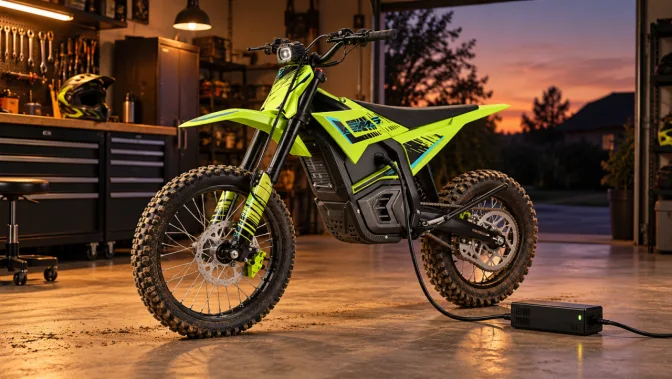
Electric Dirt Bike Battery Replacement Cost in 2026: Price by Voltage and When to Replace
Short answer? On a full size electric dirt bike you’re usually looking at somewhere between $1,200 and $2,500 for a new battery this year. Race class packs have crept past $3,000. Youth bikes, thankfully, cost a lot less.
If you own an adult electric off-road motorcycle and the pack won’t get you through your Saturday loop anymore, this is for you. The voltage on the case is a starting point, nothing more. What you’ll actually pay comes down to capacity, the cells inside, the connector, the charger and how much current the BMS can handle.
|
Where the numbers come from: on October 10, 2026 we went through every battery one large U.S. electric dirt bike dealer had listed (seventeen of them) and matched each price to its voltage and amp-hour rating. Prices in this market jump around, so treat the table as that day’s snapshot. |
What a Replacement Battery Costs Right Now

We expected a spread. We didn’t expect the 72V packs alone to differ by over a thousand dollars.
|
Pack |
Spec |
Stored energy |
Listed price |
|
E Ride Pro Mini pack |
60V or 72V |
Varies |
$1,299 |
|
E Ride Pro SS 2.0 pack |
72V 40Ah |
2,880Wh |
$1,849 |
|
EBMX pack for Sur-Ron Light Bee X |
High power upgrade |
Varies |
From $1,999.99 |
|
E Ride Pro SS 3.0 pack |
72V 50Ah |
3,600Wh |
$2,099 |
|
E Ride Pro SR pack |
72V 50Ah, dual connector |
3,600Wh |
$2,499 |
|
Ventus pack for Sur-Ron Ultra Bee |
96V 56Ah |
5,376Wh |
$3,499 |
The part that caught our eye wasn’t a price. Fifteen of the seventeen were sold out. A bike that sits in the garage all of April waiting on a back-ordered pack has lost the best weeks of the year, and a discount doesn’t buy those back.
Why Voltage Alone Does Not Set the Price

Compare watt-hours, not volts
Multiply nominal voltage by amp-hours and you get watt-hours, which is the energy the pack really holds. It’s grade school math, but it clears up a lot. That little 48V 23.4Ah entry pack? Call it 1,123Wh. Bump up to 60V 27Ah and you’re near 1,620Wh, and the 72V 50Ah units from the table hold 3,600Wh, which is more than triple the small one. How voltage changes the way the bike pulls is a separate question, and our 48V vs 60V comparison covers it.
Same voltage, different bill
Go back to the SS 3.0 and SR rows. Both are 72V 50Ah, same stored energy, and the SR still costs $400 more. That money goes into its case and the dual connector it needs to fit its bike. It isn’t extra capacity.
Price per watt-hour shows it plainly: about $0.58 for the SS 3.0, closer to $0.69 for the SR. Cell grade, discharge rating and the BMS fill in the rest, and you won’t see those in a listing title.
Hidden Costs Beyond the Pack

Chargers get forgotten. The full charge voltage has to match the pack, so a 60V battery uses a 67.2V charger and a 72V battery needs an 84V one. Move up in voltage and you’re usually buying both. (Valtinsu’s EM5 Charger UL 48V is $65, for reference.)
Then there’s the small stuff. Connectors and adapters have to be rated for peak current, not just shaped like the plug. Changing system voltage can mean a new controller too. Big lithium packs ship as hazardous freight, and if one ever goes back under warranty you pay that again. Some drop-off sites charge a recycling fee for the old one.
|
Before you order: add up the whole swap. An $1,800 pack plus a controller isn’t an $1,800 job. |
Signs It Is Time to Replace the Battery
Lost range on its own doesn’t prove much. A cold morning, tires a few psi low, a longer climb than usual: all of it eats watt-hours and none of it means the pack is worn. Ride your normal loop two or three times, same mode, similar weather, and note where you turn around.
If it keeps coming up short, that’s your first real clue. Watch for the others too. Maybe the power cuts out halfway up a hill the bike used to walk up. Maybe the display says full and you’re at 70% before the end of your street. Charging that used to finish by dinner now runs most of the night, or the same BMS code shows up every other ride.
Rule out the cheaper fixes first
Here’s the annoying part: a scorched connector can act a lot like a dying battery. So before spending two grand, borrow a buddy’s healthy pack to test your charger if you can, shine a flashlight into the main plug looking for dark or melted pins, and look up any controller codes in the manual. Paying a shop for an hour is still way cheaper than the wrong battery.
|
It’s a different story if the case has swollen, cracked or leaked, smells odd, or is warm after sitting all day. NFPA lists those as reasons to stop using a battery. Don’t ride it, don’t charge it, and call the seller. |
Replace, Rebuild or Upgrade

|
Option |
Makes sense when |
Main risk |
|
Same spec replacement |
The bike is healthy and still supported |
Highest upfront price |
|
Professional recell |
The original pack is discontinued and the case is sound |
Quality depends on the builder |
|
Capacity or voltage upgrade |
Range or power is the real limit |
May need a new controller, charger and wiring |
Recelling isn’t a weekend garage job. A 60V or 72V pack holds enough energy to burn you or start a fire if one weld is off, so hand it to a specialist who’ll put the warranty in writing. And if the motor and controller are tired too, price a newer bike against the full repair first.
Check Certification Before You Order
“Built to UL standards” tells you very little. Look for the standard number itself. UL 2271 covers battery packs for light electric vehicles, while UL 2849 tests the drive system, battery and charger together.
That may soon be the law rather than a nice extra. In June 2026 the CPSC published a proposed rule making those standards mandatory, replacement packs sold on their own included. For now it’s still a proposal.
Replacing the Battery on a Valtinsu
On a Valtinsu, spare batteries, controllers and throttles come through the After-Sales Center. Here’s what each current model runs:
|
Model |
Battery |
Stored energy |
Charger |
Age |
|
48V 23.4Ah |
About 1,123Wh |
48V 5A |
13+ |
|
|
60V 27Ah |
About 1,620Wh |
67.2V 5A |
16+ |
|
|
60V 27Ah |
About 1,620Wh |
67.2V 5A |
18+ |
The EM-5 Pro 60V platform and the EM23 share a battery spec on paper. Don’t read that as “the packs swap.” Get the exact part number from support first (our replacement parts checklist has the questions to send), or compare battery specs across the lineup.
How to Make Your Next Pack Last Longer

Funny enough, most of the wear happens while the bike’s parked. Going a few weeks without riding? Leave the pack somewhere around half, maybe 60%, rather than topped off or run flat. After a day of hard climbs, let it sit for half an hour before you plug in. NFPA’s e-bike safety guidance says to charge between 32°F and 105°F, and only with the charger made for that battery. A few more habits are in five habits that shorten pack life.
Conclusion
So, budget $1,200 to $2,500 for a full size pack this year and you won’t be caught off guard. Line packs up by watt-hours, count what the whole install costs, and make sure the thing is certified and actually in stock before you pay. Is the rest of your bike in good shape? Then a same spec replacement is the easy fix. Thinking about a new bike instead? Have a look at Valtinsu adult electric dirt bikes.
FAQs
How much does it cost to replace an electric dirt bike battery?
Usually somewhere in the $1,200 to $2,500 range for a full size bike. The ones we looked at in October 2026 went from $1,299 all the way to $3,499, while youth packs run cheaper. Don’t forget a charger, shipping and labor if you need them.
How long does an electric dirt bike battery last?
It depends a lot on how you treat it, but think several years. Heat, running it flat, lots of hard climbing and sloppy storage all shorten that, and the cells keep aging even if the bike never leaves the garage. Honestly, timing your usual loop every few months will tell you more than the receipt.
Why are electric dirt bike batteries so expensive?
Energy and current. A 72V 50Ah pack holds 3,600Wh and has to push serious current without sagging. The BMS, case, connectors and safety testing make up much of the rest.
Can I replace the battery myself?
Often, yes, if it’s removable and the new one matches voltage, connector, mount and charger. Snap a photo of the old label and plug before you order. Opening or rebuilding a pack is another matter; leave that to a specialist.
Can I put a 72V battery on a 60V bike?
Not until you’ve checked the controller, since a lot of them only accept one voltage range. You’d also need an 84V charger and wiring rated for it.
Can a dead battery be repaired?
Sometimes. A specialist can recell it or swap a failed BMS, which can be worth it when the original isn’t sold anymore. Get the quote and warranty in writing. Swollen, crushed or leaking packs go to recycling.
When should I replace the battery?
When the range won’t cover your normal ride, the cutoffs under load keep happening, or charging gets erratic. If the case swells or runs hot, don’t wait.
How do I dispose of an old battery?
Please don’t toss it in the trash or the recycling bin out front. The EPA wants these taken to a battery collection site or a household hazardous waste drop-off, ideally with a bit of tape over the terminals.


Looking for something else?

Electric Dirt Bike Replacement Parts Availability: What Buyers Should Verify Before Ordering
LEARN MORE
How to Check an Electric Dirt Bike for Safety Recalls by Model and Serial Number
LEARN MORE
How to Choose an Electric Dirt Bike Repair Shop: Questions to Ask Before Service
LEARN MORE
How to Lift a Fallen Electric Dirt Bike Without Hurting Yourself or the Bike
LEARN MORELooking for something else?

Electric Dirt Bike Fall Riding on Wet Leaves: Grip, Hidden Obstacles and Braking
LEARN MORE
Electric Dirt Bike Trailside Power Loss: Recovery Plan When the Battery Is Dead
LEARN MORE